1Does the right focus help the robot manipulate?Yes.
1.1Where do failures come from without focus?At a few decisive steps, from misreading geometry.
1.1.1

On whole tasks, does focus raise success?
Why this questionBefore building any focus: where do a plain agent's failures actually come from?
What we didWhole household tasks with and without a mesh focus, 30 trials each.

with focus 7/30 · without 5/30 · so every later test starts right before the failed step

ConclusionBarely: failures spread over unrelated steps. Focus barely moves the whole-task score: most failures come from steps that have nothing to do with focus. So every later test starts right before the step that failed.
1对的 focus 能帮机器人操作吗?能。
1.1不加 focus 时,失败出在哪?出在少数关键步,读错几何。
1.1.1

整局任务上,focus 能提高成功率吗?

为什么问这个做 focus 之前,先看不加 focus 的 agent 到底败在哪。
做了什么整局任务,加不加网格 focus 各 30 局。

加 focus 7/30 · 不加 5/30 · 所以之后都从出错那一步之前开局测

结论几乎不变:失败分散在无关步骤。 整局成功率几乎不变:多数失败出在和 focus 无关的步骤。所以之后都从出错那一步之前开局测。
1Does the right focus help the robot manipulate?Yes.
1.1Where do failures come from without focus?At a few decisive steps, from misreading geometry.
1.1.2

With a mesh focus, where does it break?
What we didAt the failing step we gave a mesh of the relevant regions, and traced each failure level by level against simulator truth: seen → used → reasoned → executed.

region in the mesh: 39/48, 44/47 failures · "looked but did not use" 10, 15 · "reasoned wrong" 23, 17

ConclusionIt sees the region but reads or asks wrongly. In almost every failure the deciding region was in the mesh; the agent looked but did not use it, or reasoned with the wrong criterion. The information is there, but not as the quantities a decision needs.
Whole task · with focus · hang mugs: asked the wrong question open in a new tab ↗
Where to look Rounds 23–25 (video 21–22.7 s): the handle is pressed from straight above onto the short front hook; the agent reads depth and releases; the mug falls.
What it shows It checked "the handle is directly above the hook face", not "does the hook bar pass through the loop".
1对的 focus 能帮机器人操作吗?能。
1.1不加 focus 时,失败出在哪?出在少数关键步,读错几何。
1.1.2

给了网格 focus,断在哪一级?

做了什么在出错那一步给相关区域的网格,按真值逐级定位每局失败:看到 → 用上 → 推理 → 执行。

决定成败的区域在网格里:39/48、44/47 · 看了没用上 10、15 · 推理错 23、17

结论区域看到了,但读错、问错。 几乎每局失败,决定成败的区域都在网格里;agent 看了没用上,或用错了判据。信息有,但不是判断要用的量。
整局 · 加 focus · 挂杯子:问错了问题 新标签页打开 ↗
看哪 第 23–25 轮(视频 21–22.7 秒):黄杯把手被从正上方压向前侧短钩,agent 读完深度就松手,杯子掉到架子底下。
分析什么 松手前做了 focus,但它核对的是“把手在钩面正上方”,没有问“钩杆有没有穿进把手环”。判据问错,focus 再准也拦不住。
1Does the right focus help the robot manipulate?Yes.
1.2Do the right points help, stripped toward real-robot conditions?Every step still helps.
1.2.1

Do all key part points from the simulator help?
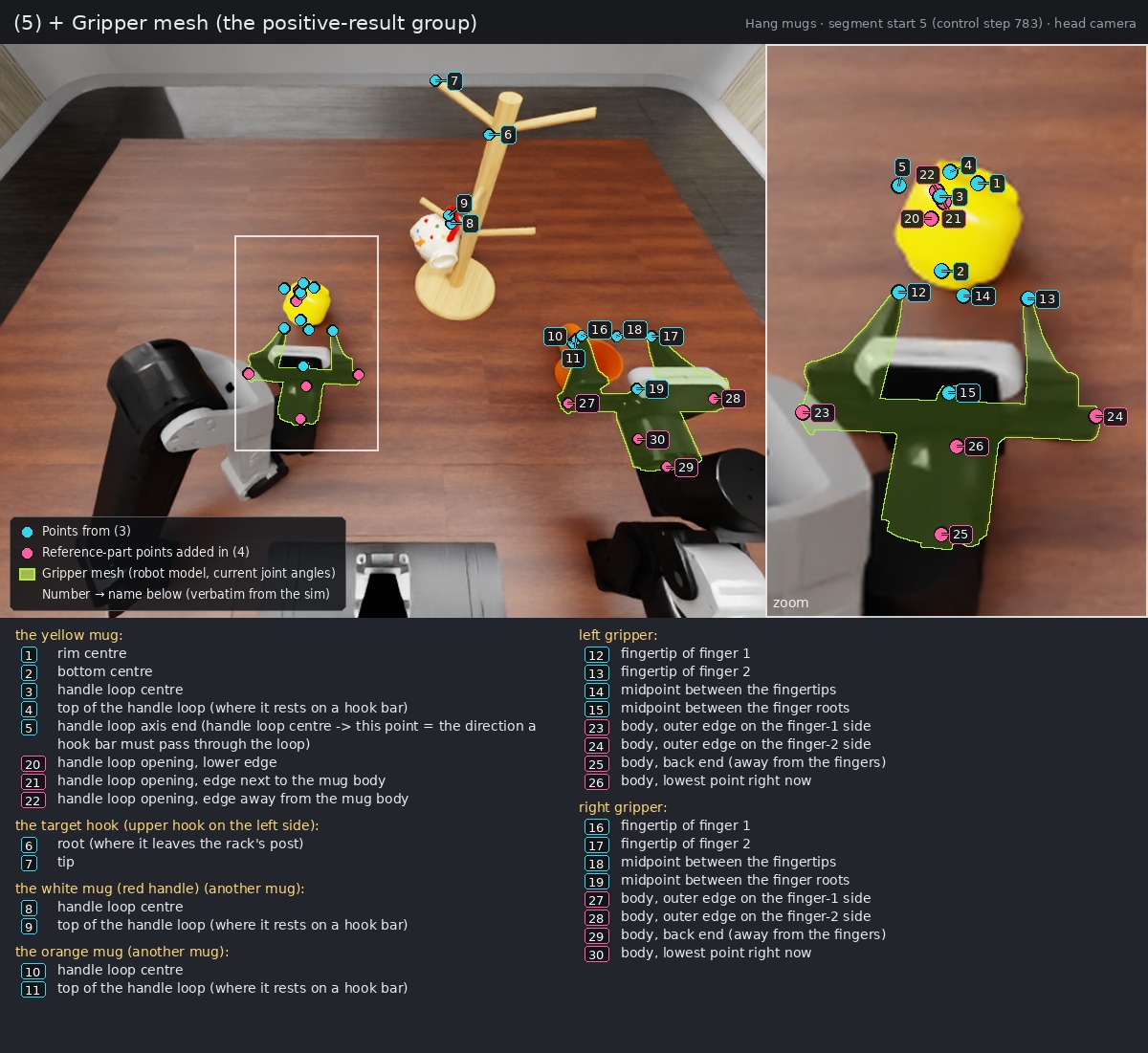
Why this questionWhat the agent lacks are the quantities a decision needs, so give it the right points directly; then remove, step by step, what a real robot could not get.
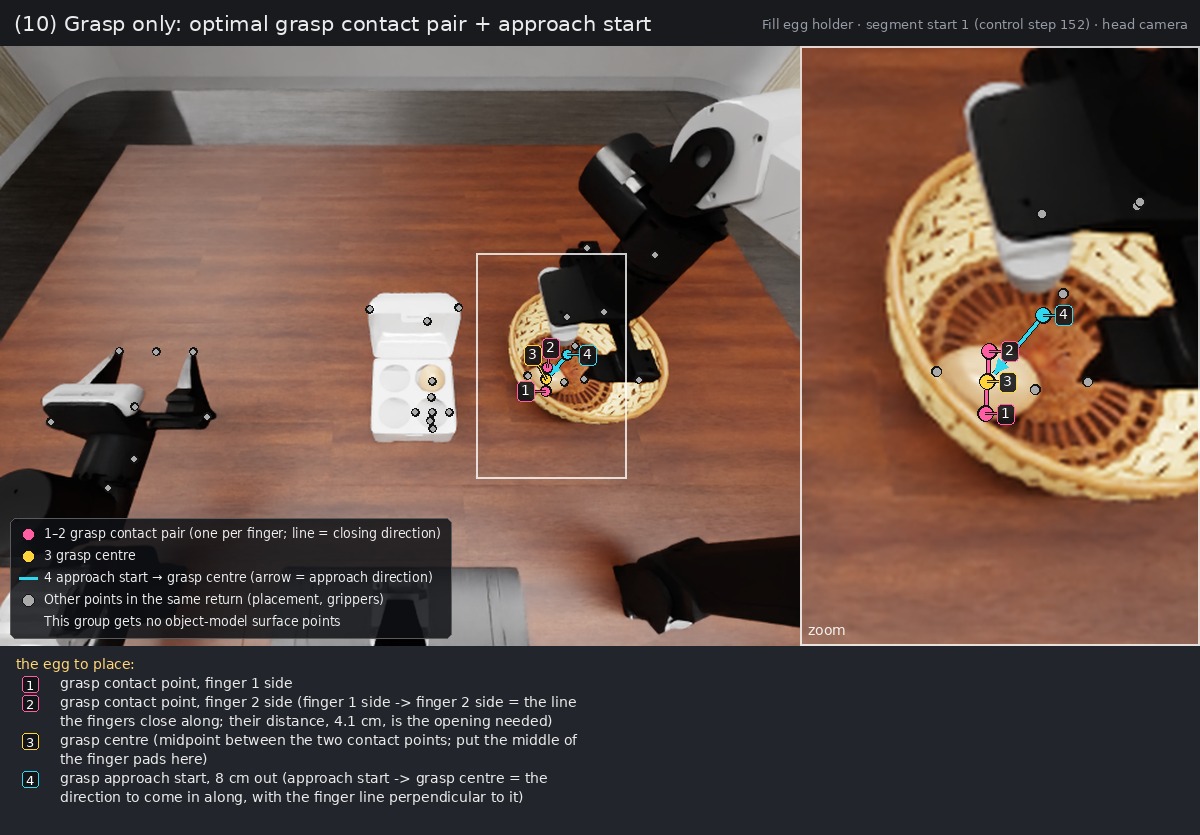
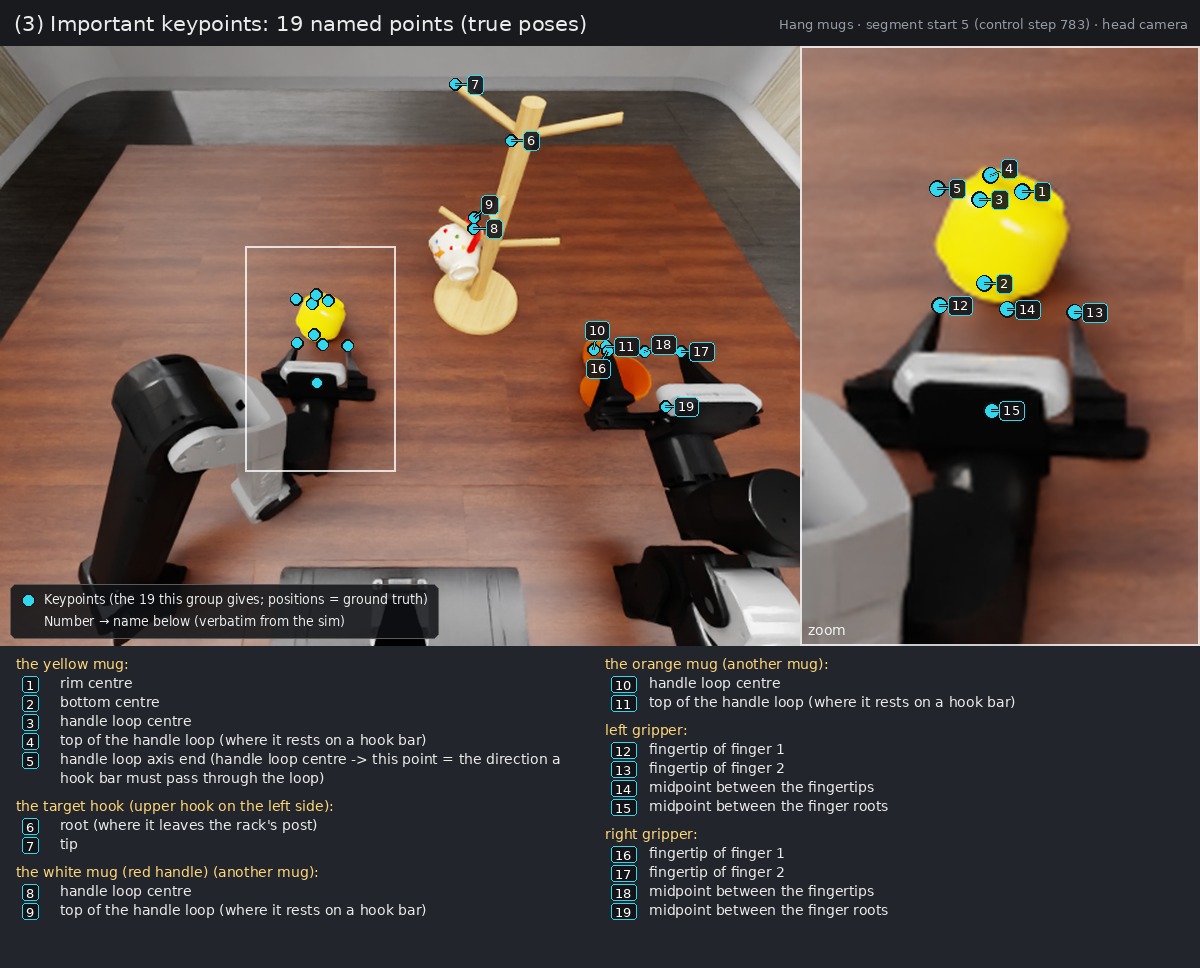
What we didThe simulator gives named 3D points of the key parts (from true poses) plus the gripper model. Three tests: the failing segment, grasp only, grasp to placement.

segment 34/59 vs 14/60 · grasp 55/60 vs 40/60 · full segment 29/60 vs 13/59

ConclusionYes, in all three tests. All three rise. With named points, "looked but did not use" falls from 32% to 10% of failures: the points are exactly what the decision uses.
Full segment · hang mugs · all points: threaded along the bar open in a new tab ↗
Where to look Round 6 turns the mug to the bar direction; rounds 9–12 (video 6.3–8.1 s) thread the loop about 3 cm along the bar, then release; the mug hangs.
What it shows With the loop centre and both bar endpoints, it turns the loop axis parallel to the bar, then slides along it; at release the loop centre is 0.6 cm from the bar line.
1对的 focus 能帮机器人操作吗?能。
1.2一步步剥离到真机条件,对的点还有用吗?每一步都有用。
1.2.1

仿真给全部关键部位点,有用吗?

为什么问这个缺的是判断要用的量,那就直接给对的点;再一步步拿掉真机拿不到的东西。
做了什么仿真按真值给关键部位的带名字三维点,加夹爪模型。三种测法:出错的那段、只测抓取、从抓起到放到位。

分段 34/59 对 14/60 · 抓取 55/60 对 40/60 · 整段 29/60 对 13/59

结论有用,三种测法都涨。 三种都涨。有了带名字的点,“看了没用上”从失败的 32% 降到 10%:给的正是判断要用的量。
整段 · 挂杯子开局 2(同一开局)· 给全部点:沿杆穿进 新标签页打开 ↗
看哪 第 6 轮转杯对齐杆方向;第 9–12 轮(视频 6.3–8.1 秒)把环从杆尖外沿杆穿进约 3 cm 再松手,杯子挂住。
分析什么 有了环心和杆的两个端点,agent 先把环轴转到和杆平行、再沿杆穿进;松手时环心离杆线 0.6 cm。
1Does the right focus help the robot manipulate?Yes.
1.2Do the right points help, stripped toward real-robot conditions?Every step still helps.
1.2.2

Is the gain just a better grasp?

What we didControl: no points, only an explicit grasp rule.

grasp rule only 18/60 · points + solvers 33/60 · mugs 2/18 vs 18/18

ConclusionNo: a grasp rule alone gets 18/60. The rule alone gets 18/60 (mugs 2/18), the points 33/60 (mugs 18/18): the gain is in placing, not only in grasping.
1对的 focus 能帮机器人操作吗?能。
1.2一步步剥离到真机条件,对的点还有用吗?每一步都有用。
1.2.2

好处只是抓得更好吗?

做了什么对照:不给点,只加一条明确的抓取规则。

只加抓取规则 18/60 · 给点 + 求解器 33/60 · 杯子 2/18 对 18/18

结论不是:只加抓取规则 18/60。 只加规则 18/60(杯子 2/18),给点 33/60(杯子 18/18):好处在放置,不只是抓取。
1Does the right focus help the robot manipulate?Yes.
1.2Do the right points help, stripped toward real-robot conditions?Every step still helps.
1.2.3

Do only the currently visible parts still help?
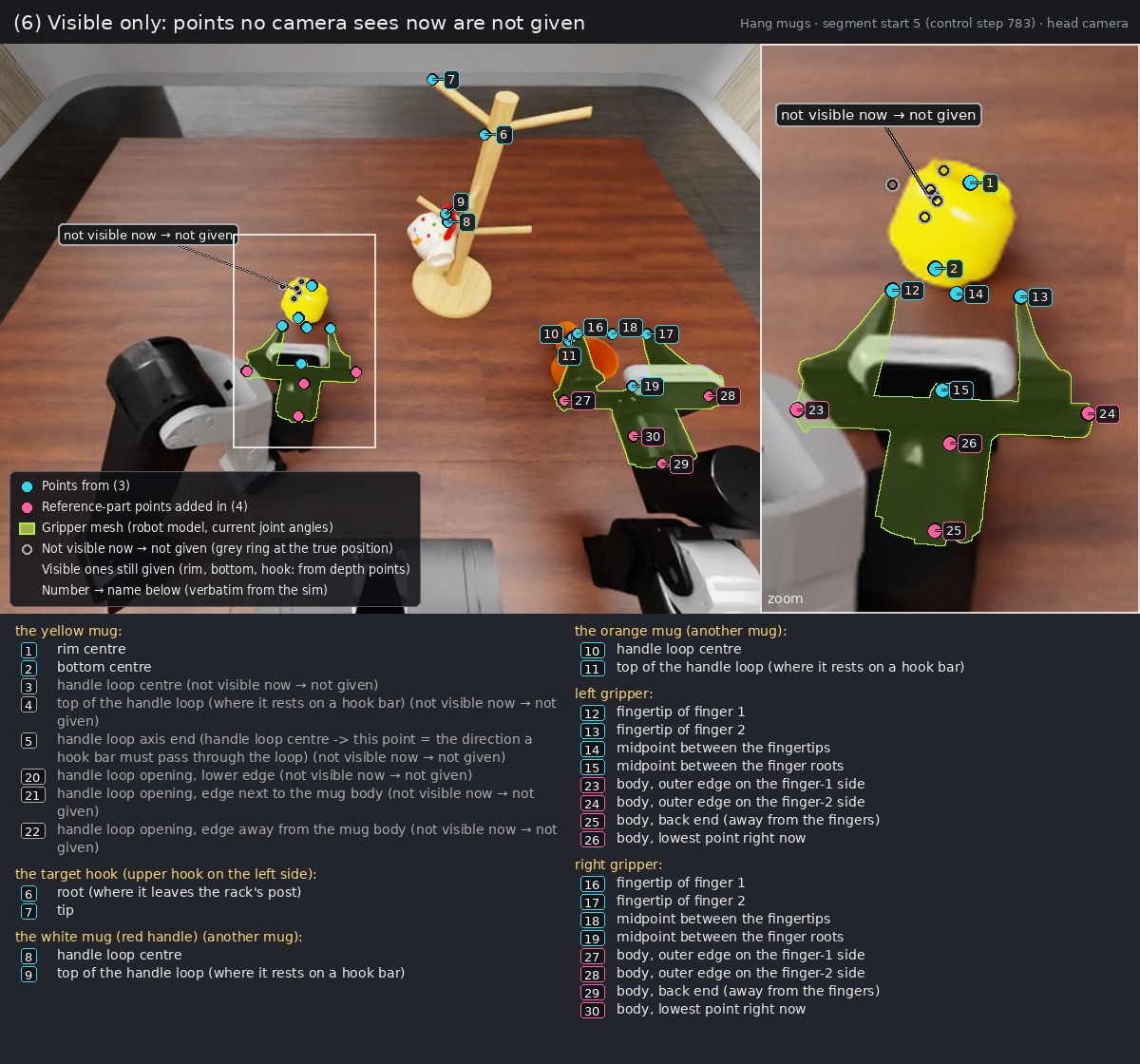
What we didDrop every part no camera sees right now; visible parts keep their true positions.

segment 27/60 · grasp 52/60 · full segment + solvers 24/59

ConclusionStill helps. Still helps: the benefit does not depend on hidden information. This is why later focus is built only from what is visible now.
1对的 focus 能帮机器人操作吗?能。
1.2一步步剥离到真机条件,对的点还有用吗?每一步都有用。
1.2.3

只给当前看得见的部位,还有用吗?

做了什么拿掉当前没有相机看得到的部位,看得见的保持真值位置。

分段 27/60 · 抓取 52/60 · 整段 + 求解器 24/59

结论仍有用。 仍有用:好处不依赖看不见的信息。所以之后的 focus 只从当前看得见的部分建。
1Does the right focus help the robot manipulate?Yes.
1.2Do the right points help, stripped toward real-robot conditions?Every step still helps.
1.2.4

Do points help with neutral names that do not say which to use?
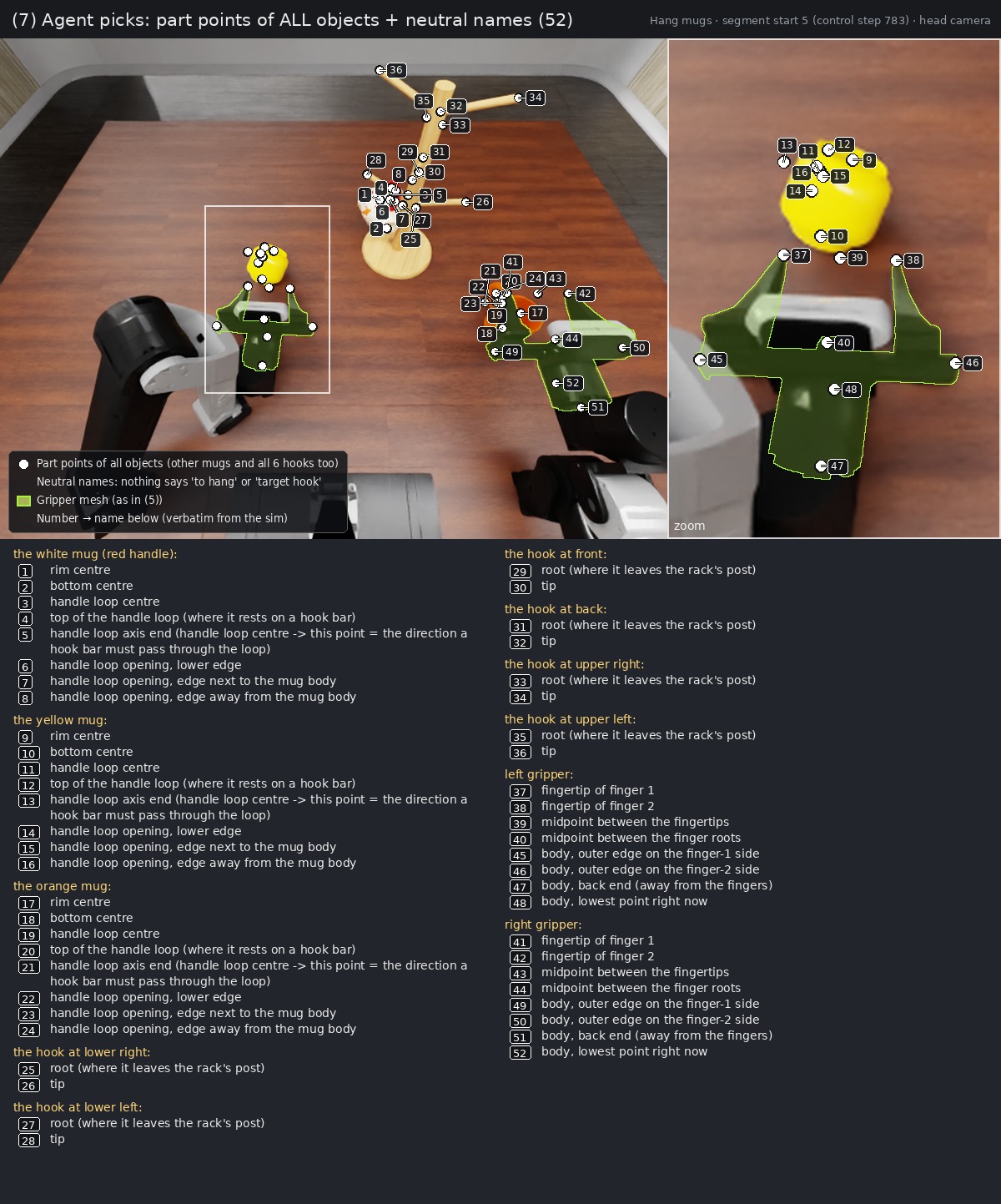
What we didAll part points of all objects, distractors included, with names that only say which part of which object.

segment 30/56 · grasp 47/60 · full segment 30/60

ConclusionStill helps. Still helps: the agent finds the parts it needs on its own.
1对的 focus 能帮机器人操作吗?能。
1.2一步步剥离到真机条件,对的点还有用吗?每一步都有用。
1.2.4

名字改中性、不说用哪个,还有用吗?

做了什么给所有物体(含干扰物)的全部部位点,名字只说是哪个物体的哪个部位。

分段 30/56 · 抓取 47/60 · 整段 30/60

结论仍有用。 仍有用:agent 自己找到要用的部位。
1Does the right focus help the robot manipulate?Yes.
1.2Do the right points help, stripped toward real-robot conditions?Every step still helps.
1.2.5

Does grasping improve without contact points?
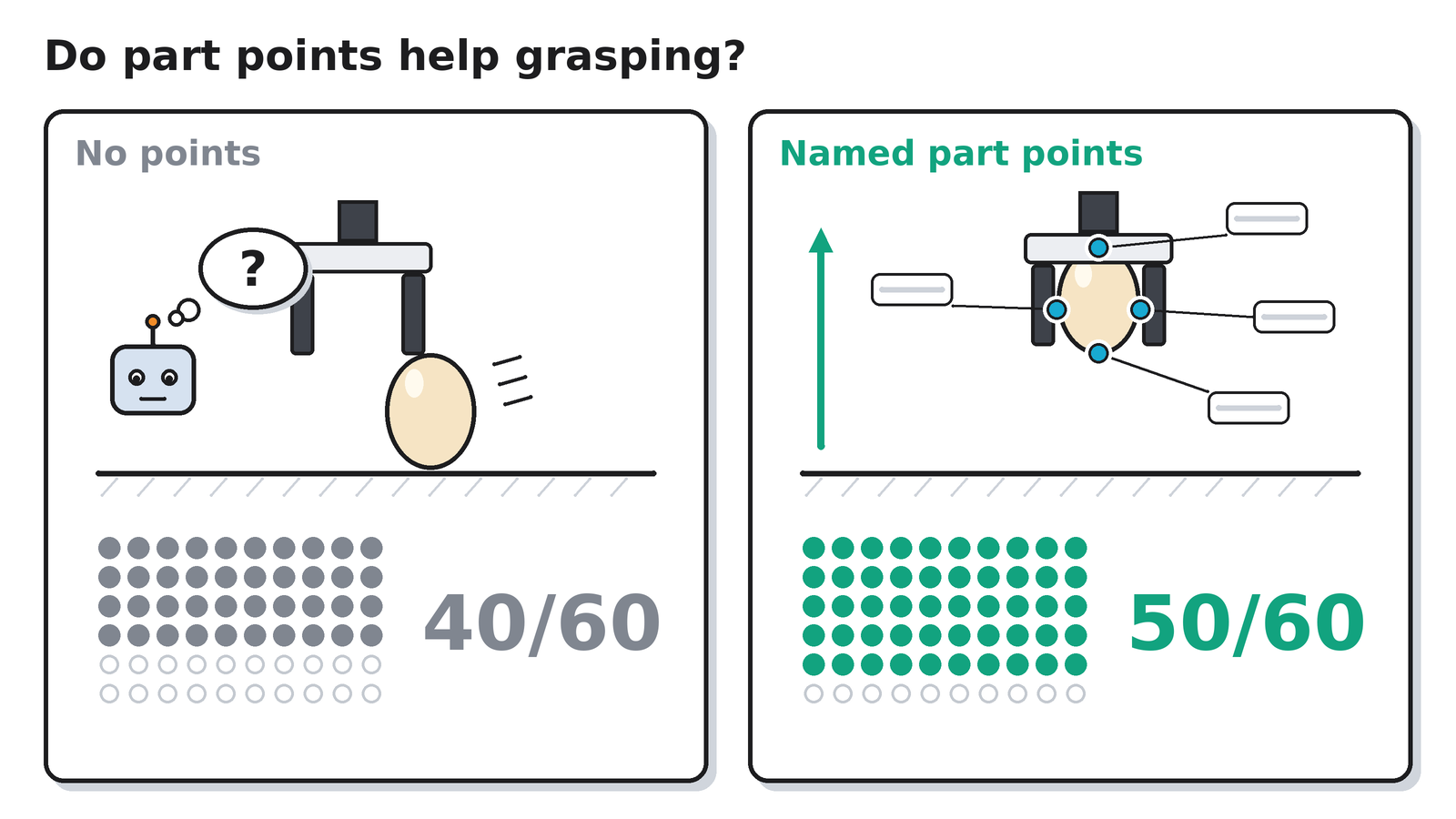
What we didGrasp only, without the optimal contact pair: just ordinary named part points.

ordinary part points 50/60 · no points 40/60

ConclusionStill helps: 50/60. Grasping still improves: it chooses good contacts from the part points itself.
1对的 focus 能帮机器人操作吗?能。
1.2一步步剥离到真机条件,对的点还有用吗?每一步都有用。
1.2.5

不给接触点,抓取还能提高吗?

做了什么只测抓取,不给最优接触点对,只给普通部位点。

普通部位点 50/60 · 不给点 40/60

结论仍有用:50/60。 抓取仍提高:它能从部位点自己选接触位置。
1Does the right focus help the robot manipulate?Yes.
1.2Do the right points help, stripped toward real-robot conditions?Every step still helps.
1.2.6

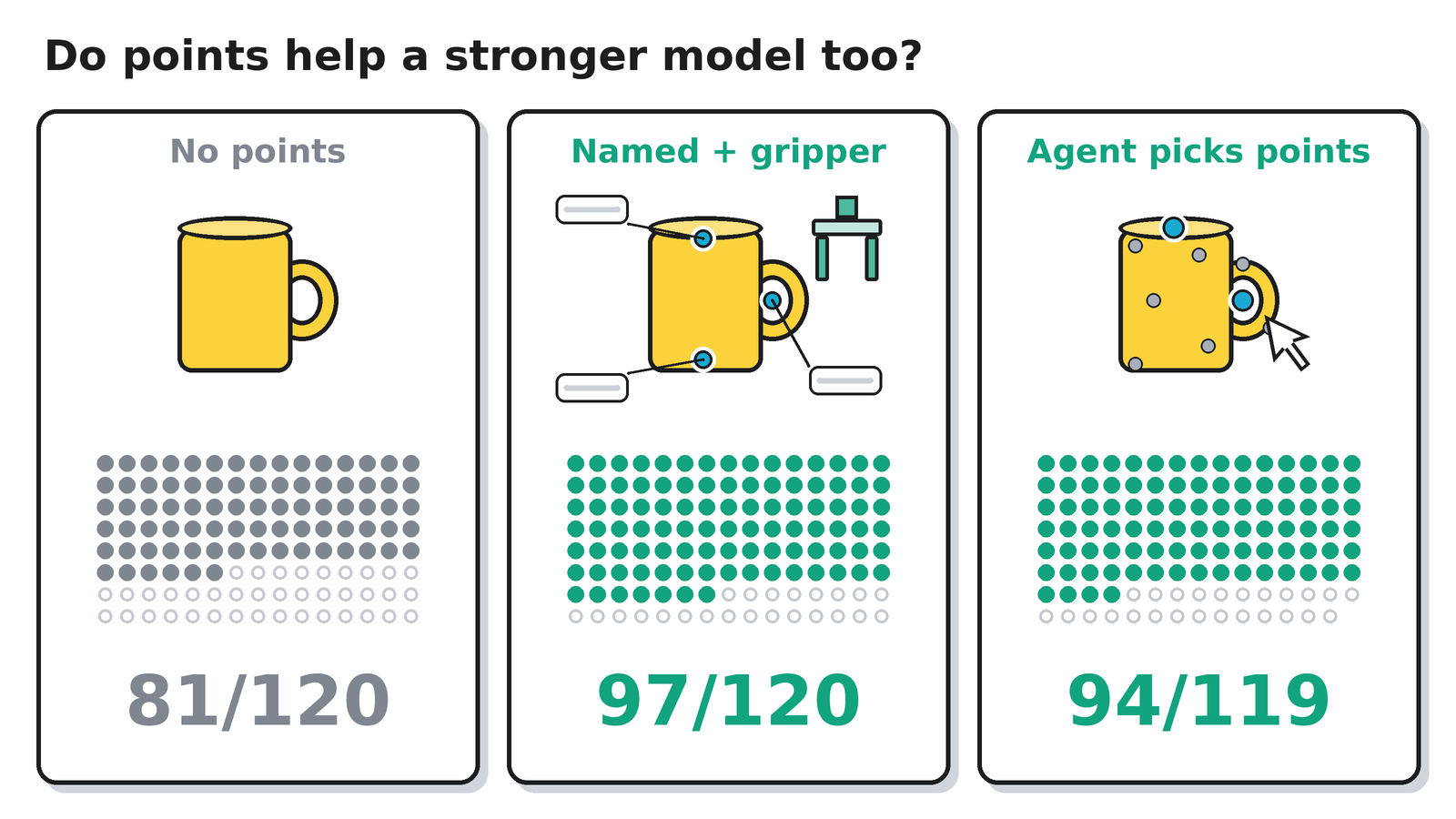
Does it hold on a stronger model?

What we didSame 20 start states on GPT-6 Astra.

Astra: 97/120 vs 81/120 · agent picks 94/119

ConclusionYes, on Astra. The gain holds on the stronger model, also when it picks from neutral names.
1对的 focus 能帮机器人操作吗?能。
1.2一步步剥离到真机条件,对的点还有用吗?每一步都有用。
1.2.6

换更强的模型还成立吗?

做了什么同样 20 个开局,换 GPT-6 Astra。

Astra:97/120 对 81/120 · 自己挑 94/119

结论成立,Astra 上复现。 强模型上同样成立,中性名字自己挑也成立。
1Does the right focus help the robot manipulate?Yes.
1.3What form of focus helps?Computed, named part points.
1.3.1

Does a surface mesh of the regions help?
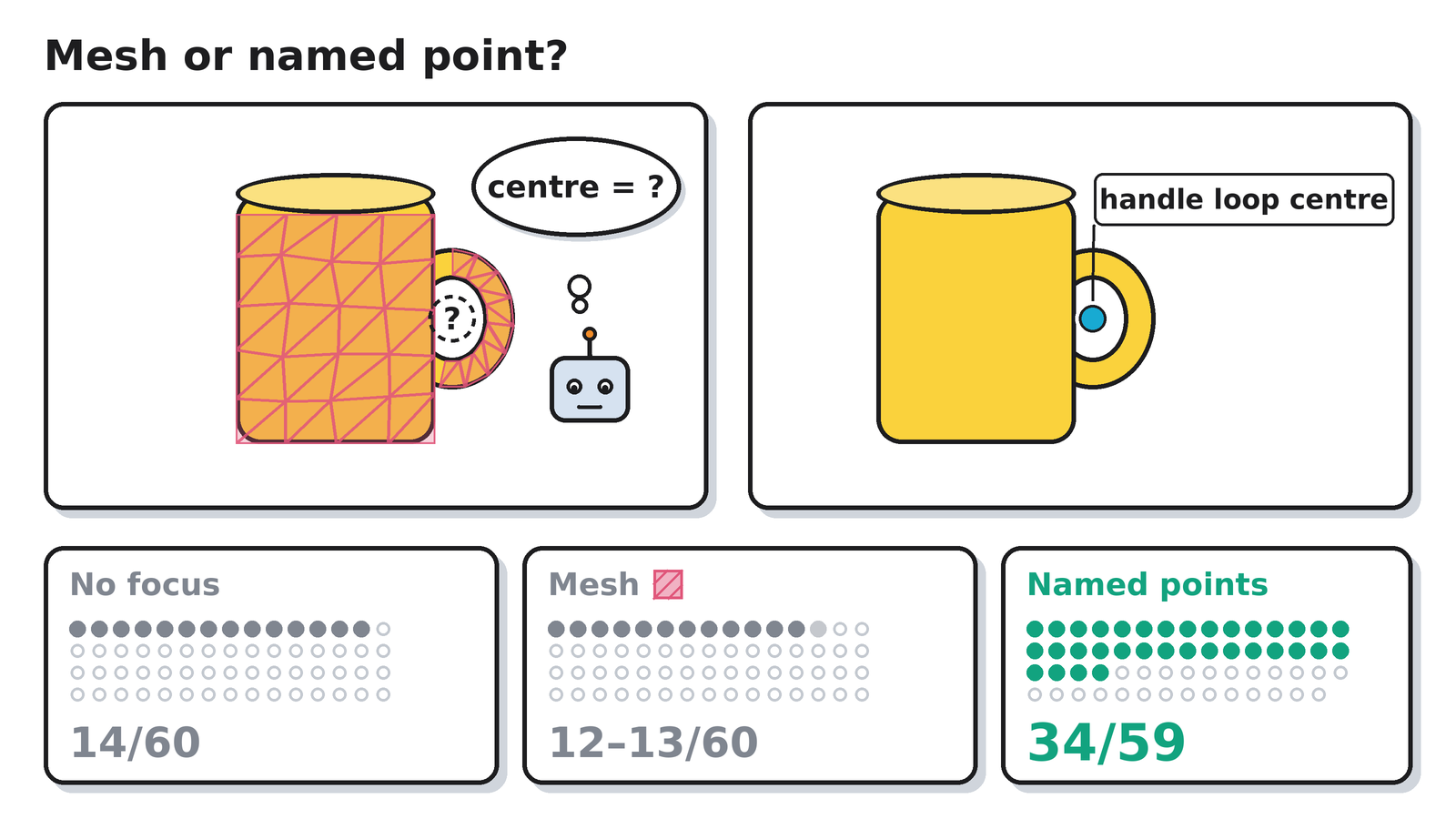
Why this questionPoints help. Which form of focus is it that helps?
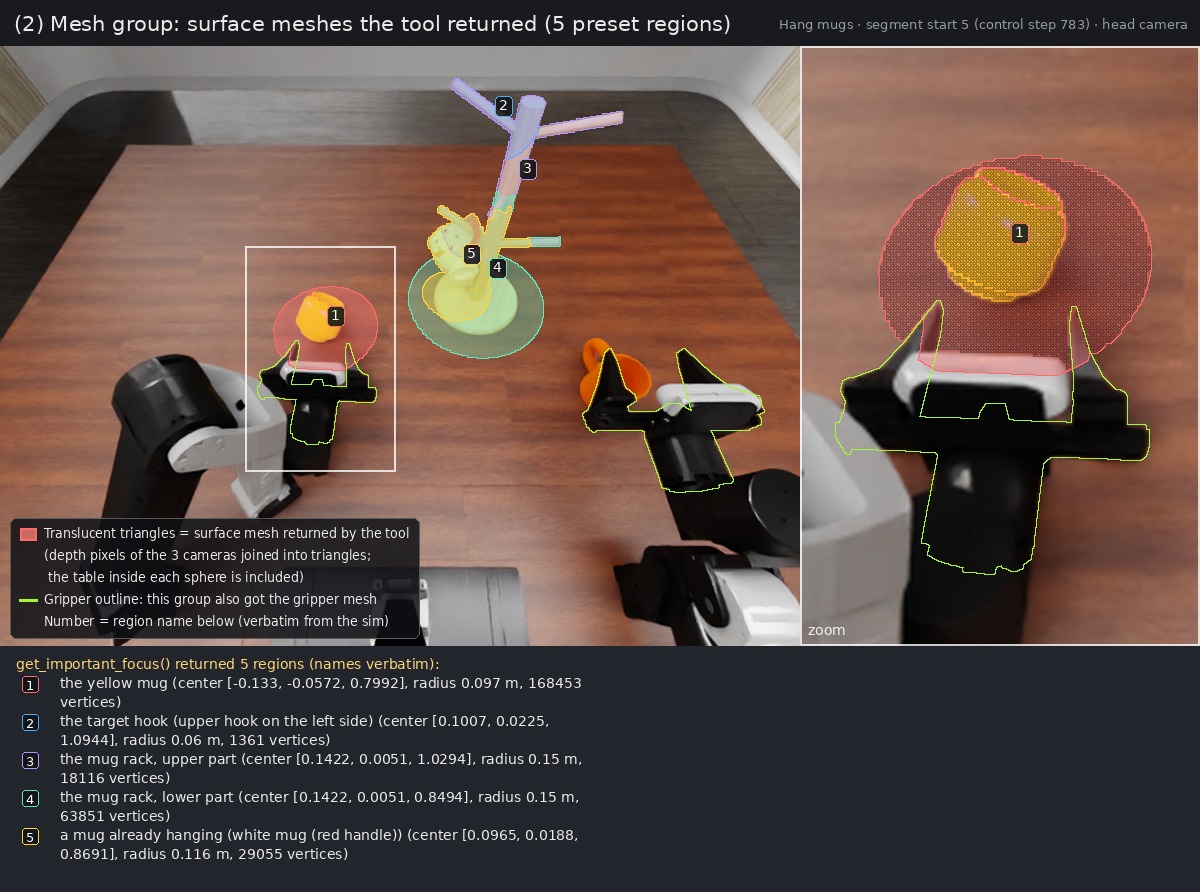
What we didSurface meshes of the regions, chosen by the agent or predefined by us.

agent-chosen 12/60 · predefined 13/60 · no focus 14/60

ConclusionNo gain. No gain: the loop centre or the clearance still has to be computed from the mesh, and the agent does not do it.
Mesh condition · hang mugs: lower, release, the mug falls open in a new tab ↗
Where to look the depth read at step 236 (2 cm gap) vs the judgement written at release (step 240)
What it shows the reading says not hooked; the judgement says hooked
1对的 focus 能帮机器人操作吗?能。
1.3什么形式的 focus 有用?算好、带名字的部位点。
1.3.1

区域的表面网格有用吗?

为什么问这个点有用。那到底是哪种形式的 focus 有用?
做了什么区域的表面网格,agent 自选或我们预选。

自选区域 12/60 · 预选区域 13/60 · 不加 14/60

结论没有提升。 没有提升:环心、间隙还得从网格里算,agent 算不出来。
网格组 · 挂杯子:下放、松手、杯子掉落 新标签页打开 ↗
看哪 第 236 步读数(杯柄与钩杆间空 2 cm)和第 240 步松手时写的判断
分析什么 读数说没挂上,判断说挂上了
1Does the right focus help the robot manipulate?Yes.
1.3What form of focus helps?Computed, named part points.
1.3.2

Does forcing a check or a preview make the mesh work?
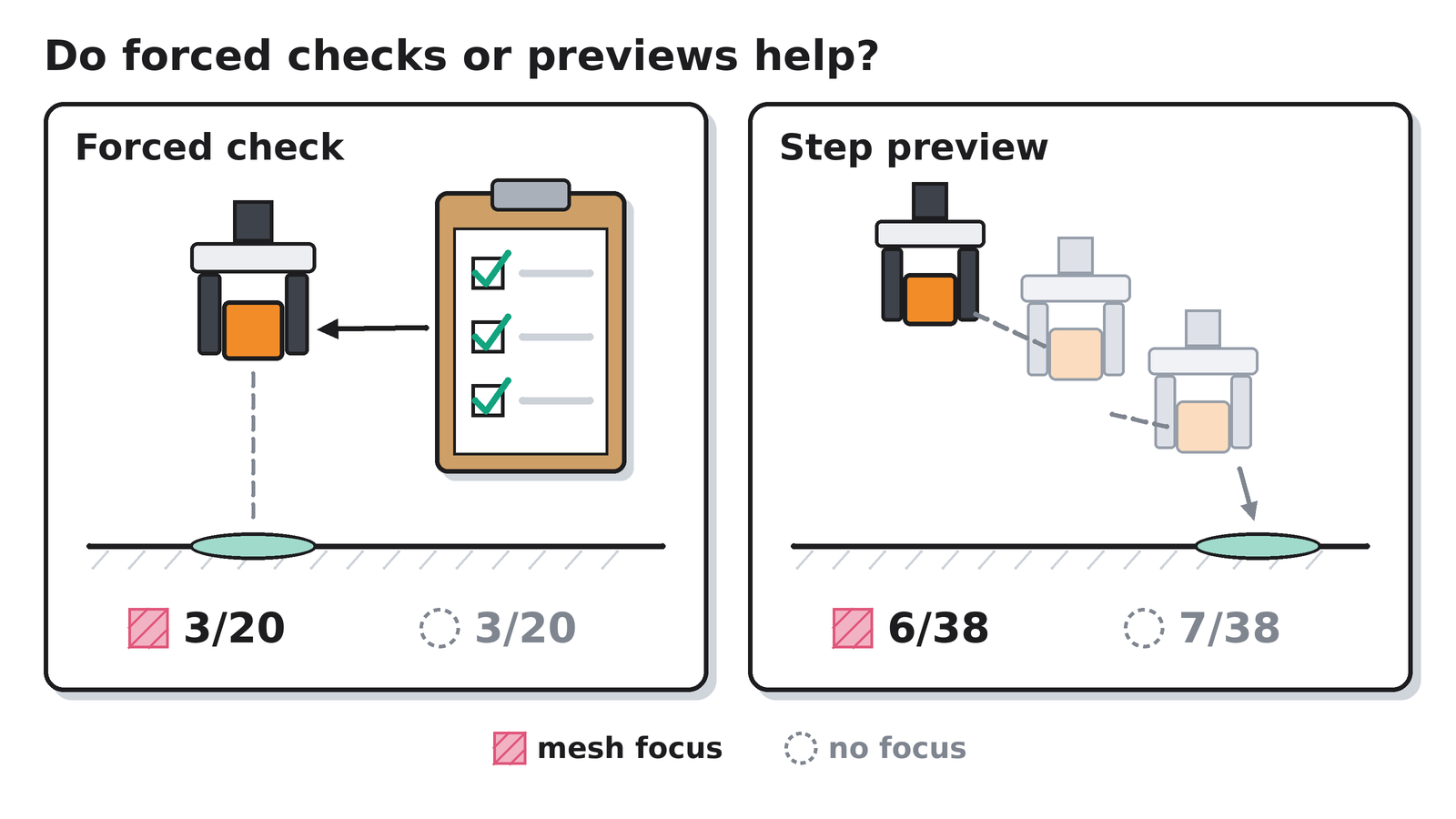
What we didTo rule out "it just did not look carefully": force a check before each decisive action, or preview what the gripper would hit.

check 3/20 vs 3/20 · preview 6/38 vs 7/38

ConclusionStill no gain. Still no gain: the problem is the representation, not care.
1对的 focus 能帮机器人操作吗?能。
1.3什么形式的 focus 有用?算好、带名字的部位点。
1.3.2

逼它核对、给它预演,网格就有用了吗?

做了什么排除“只是没仔细看”:每个关键动作前强制核对,或预演夹爪会碰到什么。

核对 3/20 对 3/20 · 预演 6/38 对 7/38

结论仍没提升。 仍没提升:问题在表示形式,不在细心。
1Does the right focus help the robot manipulate?Yes.
1.3What form of focus helps?Computed, named part points.
1.3.3

Do named task keypoints help?

What we didNamed task keypoints, e.g. "handle loop centre", "hook tip".

21/60 vs 14/60

ConclusionHelps. Helps: the decision is written in exactly these quantities.
1对的 focus 能帮机器人操作吗?能。
1.3什么形式的 focus 有用?算好、带名字的部位点。
1.3.3

带名字的任务关键点有用吗?

做了什么带名字的任务关键点,比如“把手环中心”“钩尖”。

21/60 对 14/60

结论有用。 有用:判断就是用这些量写的。
1Does the right focus help the robot manipulate?Yes.
1.3What form of focus helps?Computed, named part points.
1.3.4

Do reference parts add to the keypoints?
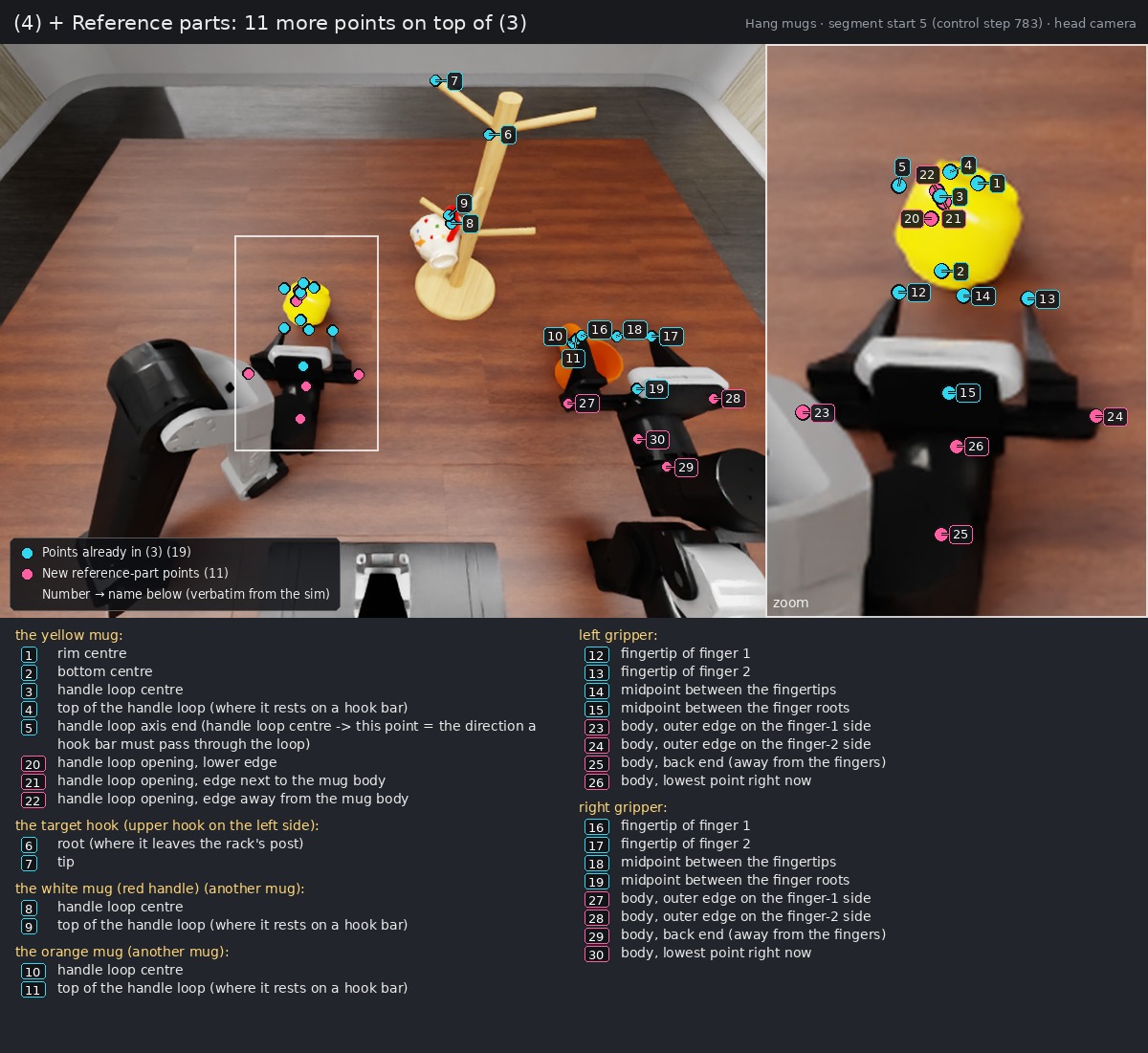
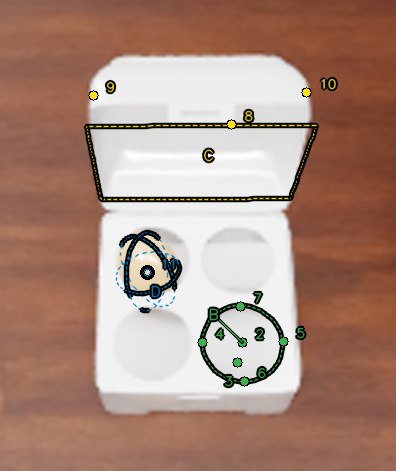
What we didAdd the edges and faces a decision is checked against: rim edges, socket holes, key slot, gripper body.

29/58

ConclusionHelps more. Helps more: many remaining failures lacked exactly such a reference.
1对的 focus 能帮机器人操作吗?能。
1.3什么形式的 focus 有用?算好、带名字的部位点。
1.3.4

再加参照部件,还能更好吗?

做了什么再加判断要对照的边和面:杯口边、插孔、钥匙槽、夹爪本体。

29/58

结论更有用。 更有用:剩下的失败很多正缺这类参照。
1Does the right focus help the robot manipulate?Yes.
1.3What form of focus helps?Computed, named part points.
1.3.5

Does the gripper model add more?

What we didAdd the gripper's own surface from the robot model at the current joints.

34/59 (p=0.0002 vs no focus)

ConclusionHelps most. Best result: the agent can now check its own collisions.
Named points · hang mugs: rotate, thread, release open in a new tab ↗
Where to look the loop axis and bar direction it computed from two named points before rotating
What it shows same start as the failed mesh trial; the difference is getting the computed quantity
1对的 focus 能帮机器人操作吗?能。
1.3什么形式的 focus 有用?算好、带名字的部位点。
1.3.5

再加夹爪模型,还能更好吗?

做了什么再加按当前关节角算出的夹爪表面。

34/59(对不加 p=0.0002)

结论最有用。 最好:agent 能判断自己会不会碰到。
带名字的点 · 挂杯子:转杯、穿环、松手 新标签页打开 ↗
看哪 转杯前它用两个命名点算出的环轴和杆方向
分析什么 同一开局网格组失败、这里成功:差在给的是算好的量
1Does the right focus help the robot manipulate?Yes.
1.3What form of focus helps?Computed, named part points.
1.3.6

Does drawing the points on images or as shapes add more?
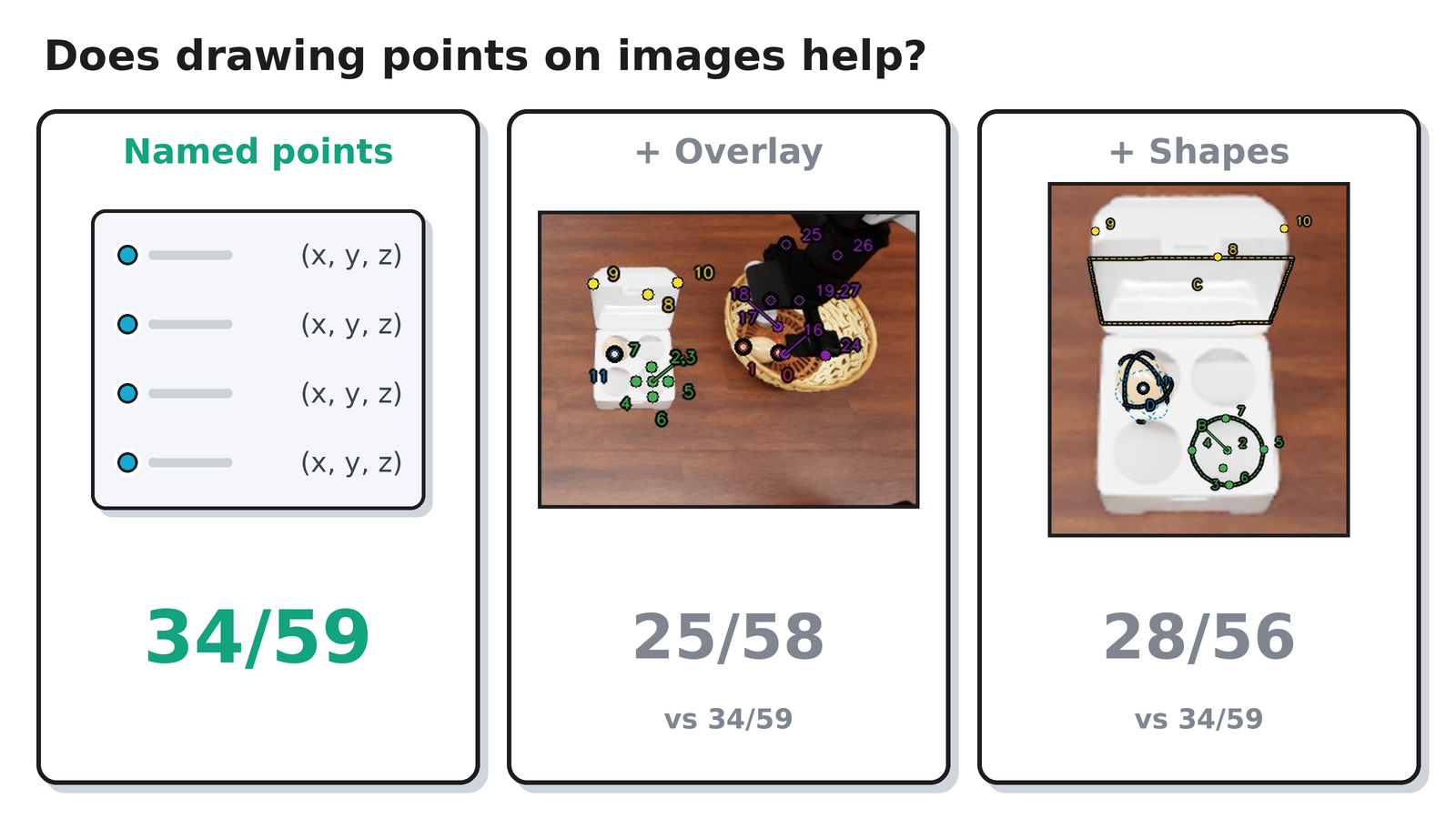
What we didThe same points drawn on the camera images, or given as circles, rectangles and lines.

overlay 25/58 · shapes 28/56 · points 34/59

ConclusionSame as points. No extra gain: the named points already carry the information.
1对的 focus 能帮机器人操作吗?能。
1.3什么形式的 focus 有用?算好、带名字的部位点。
1.3.6

把点画到画面上或画成形状,还能更好吗?

做了什么同样的点画到相机画面上,或给成圆、矩形、折线。

叠加 25/58 · 形状 28/56 · 点 34/59

结论和点一样。 没有额外增益:带名字的点本身就够了。
1Does the right focus help the robot manipulate?Yes.
1.3What form of focus helps?Computed, named part points.
1.3.7

Do more precise insertion points add more?

What we didEven more precise insertion points on 9 hard start states.

9 hard starts: 17/54 vs 5/27

ConclusionSame level. Same level: more precision is not the bottleneck.
1对的 focus 能帮机器人操作吗?能。
1.3什么形式的 focus 有用?算好、带名字的部位点。
1.3.7

给更精确的插入点,还能更好吗?

做了什么在 9 个难开局上给更精确的插入点。

9 个难开局:17/54 对 5/27

结论同一水平。 同一水平:再精确不是瓶颈。
1Does the right focus help the robot manipulate?Yes.
1.4Why does it help?The parts are computed and named.
1.4.1

Does it depend on us picking the points?
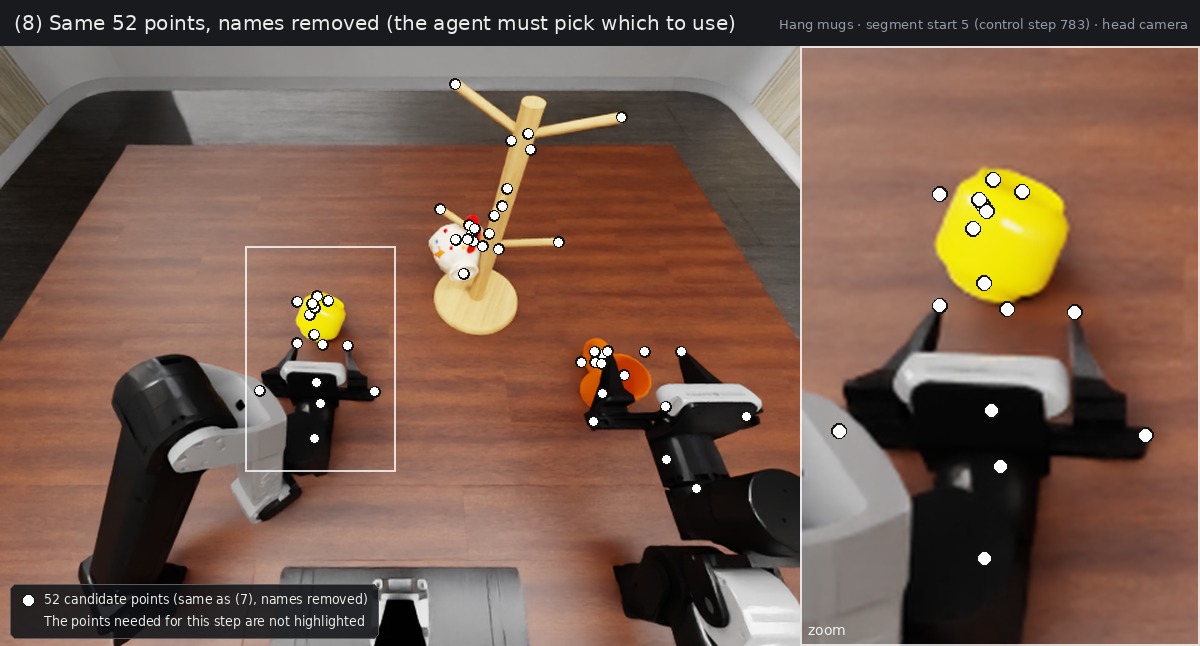
Why this questionNamed part points help. Is it the information itself, or because we picked it for the agent?
What we didAll part points of all objects with neutral names; the agent picks.

agent picks 30/56 · we pick 34/59

ConclusionNo: it picks just as well. Same level as our picking: the benefit is the information, not our choice.
1对的 focus 能帮机器人操作吗?能。
1.4为什么有用?部位算好了、带名字。
1.4.1

靠我们替它挑点吗?

为什么问这个带名字的部位点有用。是信息本身,还是因为我们替它挑好了?
做了什么全部物体的全部部位点、中性名字,agent 自己挑。

自己挑 30/56 · 我们挑 34/59

结论不靠:它自己挑一样好。 和我们挑的一样:好处来自信息,不是我们的挑选。
1Does the right focus help the robot manipulate?Yes.
1.4Why does it help?The parts are computed and named.
1.4.2

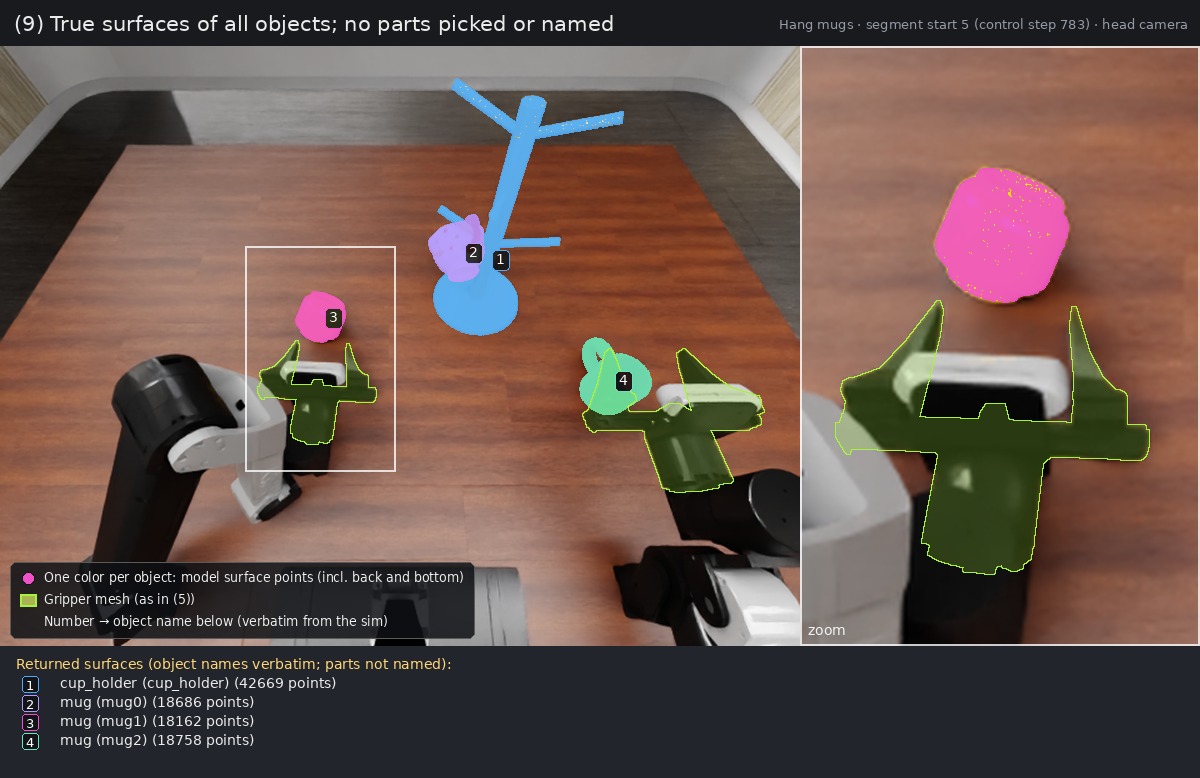
Is raw geometry enough?

What we didThe true surfaces of all objects, no part selection, no part names.

full surfaces, unnamed 21/60 · named parts 34/59

ConclusionNo: it must be parts. Falls back: what the agent lacks is the step from geometry to parts.
1对的 focus 能帮机器人操作吗?能。
1.4为什么有用?部位算好了、带名字。
1.4.2

光有几何就够吗?

做了什么所有物体的真值表面,不挑部位、不起名字。

全部表面不命名 21/60 · 命名部位 34/59

结论不够:要算成部位。 掉回去了:agent 缺的是从几何算出部位这一步。
1Does the right focus help the robot manipulate?Yes.
1.4Why does it help?The parts are computed and named.
1.4.3

Do numerical solvers add to the points?

What we didAdd grasp and placement solvers that turn the points into gripper poses.

tube reorientation: points 3/12 · + solvers 10/12 (p=0.012)

ConclusionYes, for big in-hand turns. Helps where the object must turn a lot in the hand (tubes 3/12 → 10/12).
1对的 focus 能帮机器人操作吗?能。
1.4为什么有用?部位算好了、带名字。
1.4.3

数值求解器能再加分吗?

做了什么加抓取、放置求解器,把点直接算成夹爪位姿。

试管转向:只给点 3/12 · 加求解器 10/12(p=0.012)

结论能,手里大角度转动时。 在手里要大角度转动时有用(试管 3/12 → 10/12)。
2Can the agent build that focus itself from RGB-D?Precision catches up; success not yet.
2.1Can tools extract the parts automatically?Partly: best 20/60.
2.1.1

Can generic parts come from the point cloud?
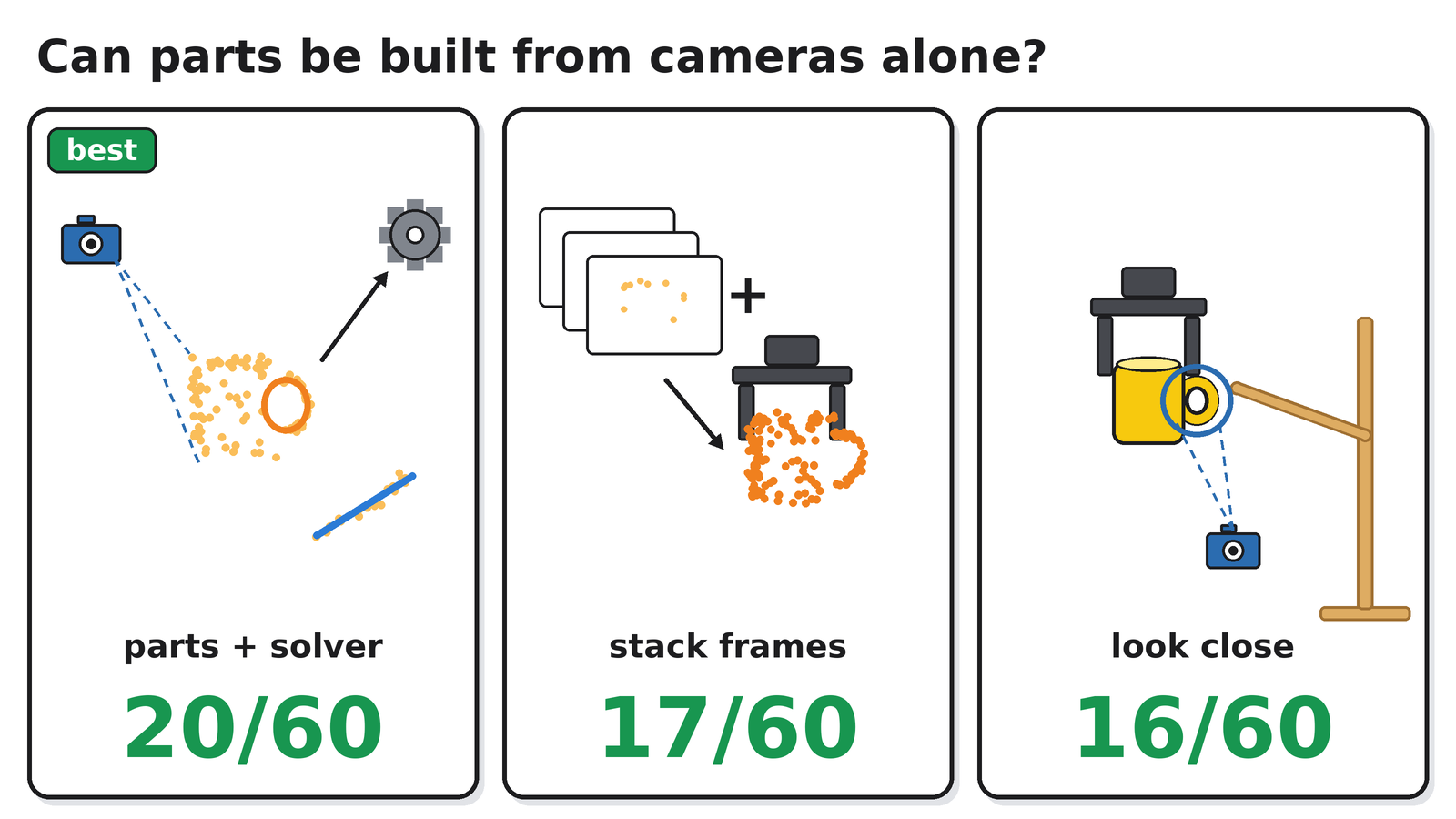
Why this questionPart 1 used simulator points. A real robot only has RGB-D: can tools extract the parts automatically?
What we didExtract generic parts from the point cloud, then solve the placement; variants stack frames or measure up close.

parts + solver 20/60 · stack frames 17/60 · look close 16/60 · no focus 14/60

ConclusionYes, the best tool: 20/60. Above no focus (20/60), far below simulator points (34/59).
2agent 能只用 RGB-D 自己建出这样的 focus 吗?精度追上了,成功率还没有。
2.1工具能自动提取部位吗?部分可以:最好 20/60。
2.1.1

能从点云直接取通用部位吗?

为什么问这个第一部分用的是仿真给的点。真机只有 RGB-D:工具能自动提取部位吗?
做了什么从点云提取通用部位再求放置;变体有跨帧累积、凑近量。

部位+求解器 20/60,多帧累积 17/60,松手前近看 16/60,不给点 14/60

结论能,最好的工具:20/60。 高于不加 focus(20/60),远低于仿真给点(34/59)。
2Can the agent build that focus itself from RGB-D?Precision catches up; success not yet.
2.1Can tools extract the parts automatically?Partly: best 20/60.
2.1.2

Does confirming the grip before release help?
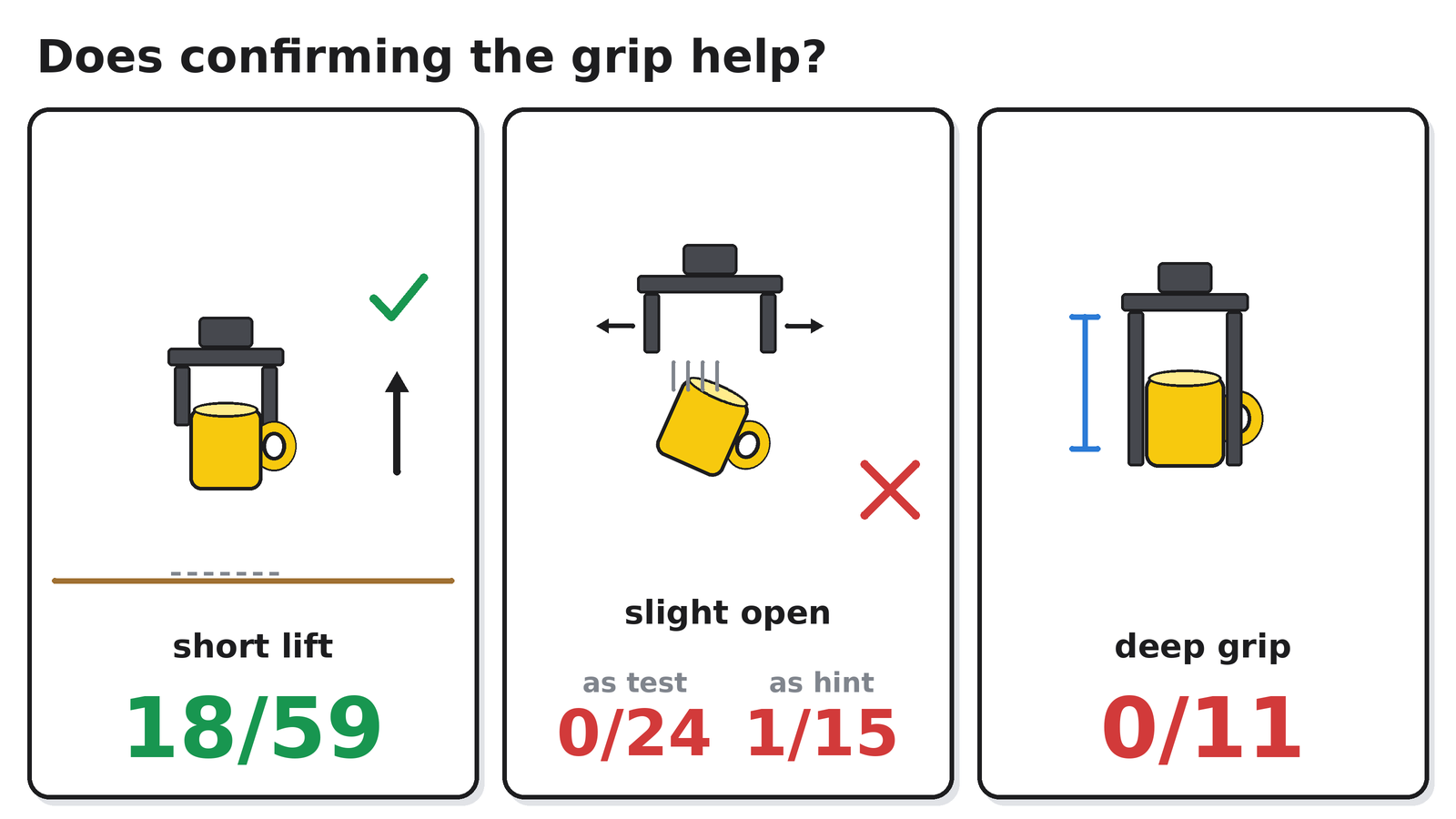
What we didMany runs dropped the object after reaching the target: confirm the grip before release.

short lift 18/59 · slight open 0/24, 1/15 · deep grip 0/11

ConclusionA short lift does: 18/59. A short lift keeps 18/59; a slight-open test itself drops the mug.
2agent 能只用 RGB-D 自己建出这样的 focus 吗?精度追上了,成功率还没有。
2.1工具能自动提取部位吗?部分可以:最好 20/60。
2.1.2

松手前确认抓牢有用吗?

做了什么很多局到位后掉了:松手前先确认抓牢。

短抬 18/59,微松 0/24、1/15,深抓 0/11

结论短抬一下有用:18/59。 短抬保持 18/59;微张测试本身就让杯子掉。
2Can the agent build that focus itself from RGB-D?Precision catches up; success not yet.
2.1Can tools extract the parts automatically?Partly: best 20/60.
2.1.3

Can merged neighbouring objects be split?
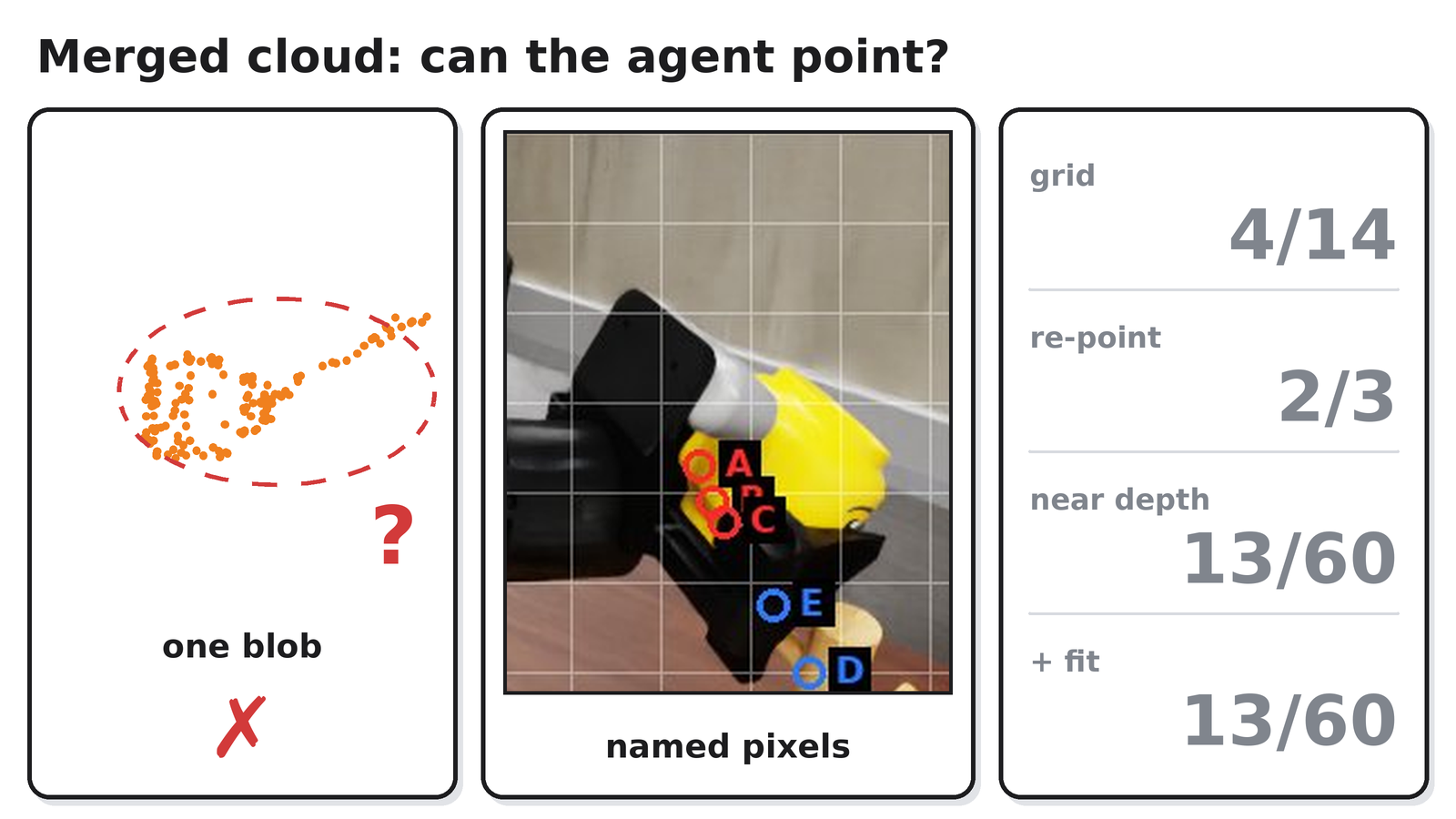
What we didNeighbouring objects merged into one part in the point cloud: the agent names pixels on a grid image instead.

grid 4/14 · re-point 2/3 · near depth 13/60 · point + fit 13/60

ConclusionYes: the agent names pixels on a grid. Objects are separated, but scores stay near 13/60.
2agent 能只用 RGB-D 自己建出这样的 focus 吗?精度追上了,成功率还没有。
2.1工具能自动提取部位吗?部分可以:最好 20/60。
2.1.3

粘在一起的相邻物体能分开吗?

做了什么点云里相邻物体粘成一块:改让 agent 在网格图上点名像素。

网格指点 4/14,松手前再指 2/3,取近处深度 13/60,指点+拟合 13/60

结论能:agent 在网格上点名像素。 物体分开了,分数仍在 13/60 附近。
2Can the agent build that focus itself from RGB-D?Precision catches up; success not yet.
2.1Can tools extract the parts automatically?Partly: best 20/60.
2.1.4

Can we make it use its measured points?
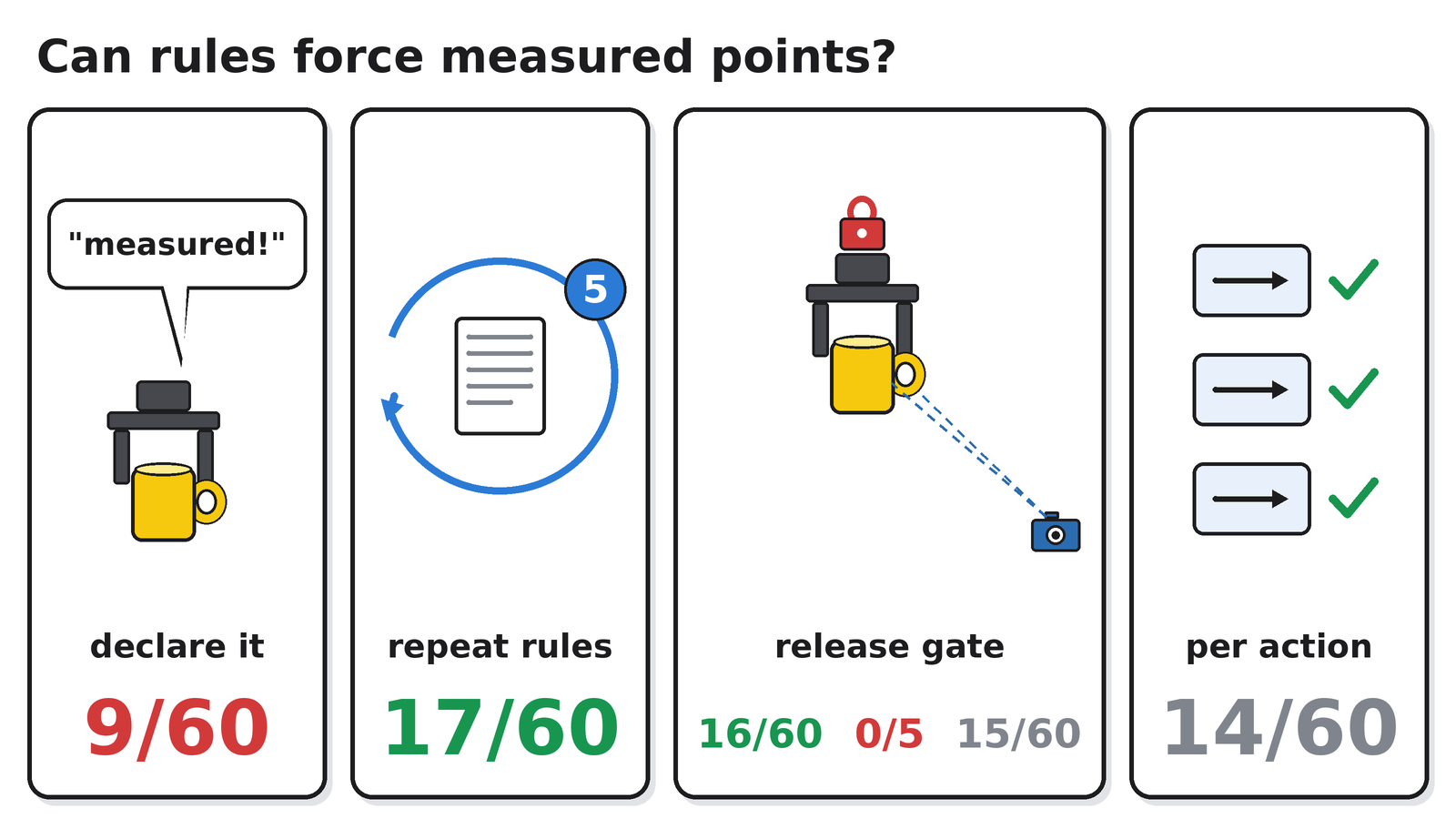
What we didMeasured points were often not used: declare them, repeat the rules, or block release until a check passes.

declare 9/60 · repeat rules 17/60 · release gate 16/60, 0/5, 15/60 · per action 14/60

ConclusionRepeating the rules works best. Releases that truly used a measurement all succeeded; totals stay flat because the measurement itself is off.
2agent 能只用 RGB-D 自己建出这样的 focus 吗?精度追上了,成功率还没有。
2.1工具能自动提取部位吗?部分可以:最好 20/60。
2.1.4

能让它用上量到的点吗?

做了什么量到的点常没用上:要求声明、定期重复规则、或检查不过不让松手。

声明 9/60,重复规则 17/60,松手门 16/60、0/5、15/60,按动作核对 14/60

结论定期重复规则最好。 真正用了测量的松手都成功了;总数不变,因为测量本身就偏。
2Can the agent build that focus itself from RGB-D?Precision catches up; success not yet.
2.1Can tools extract the parts automatically?Partly: best 20/60.
2.1.5

Can a part in the gripper be measured by pointing at one depth pixel?
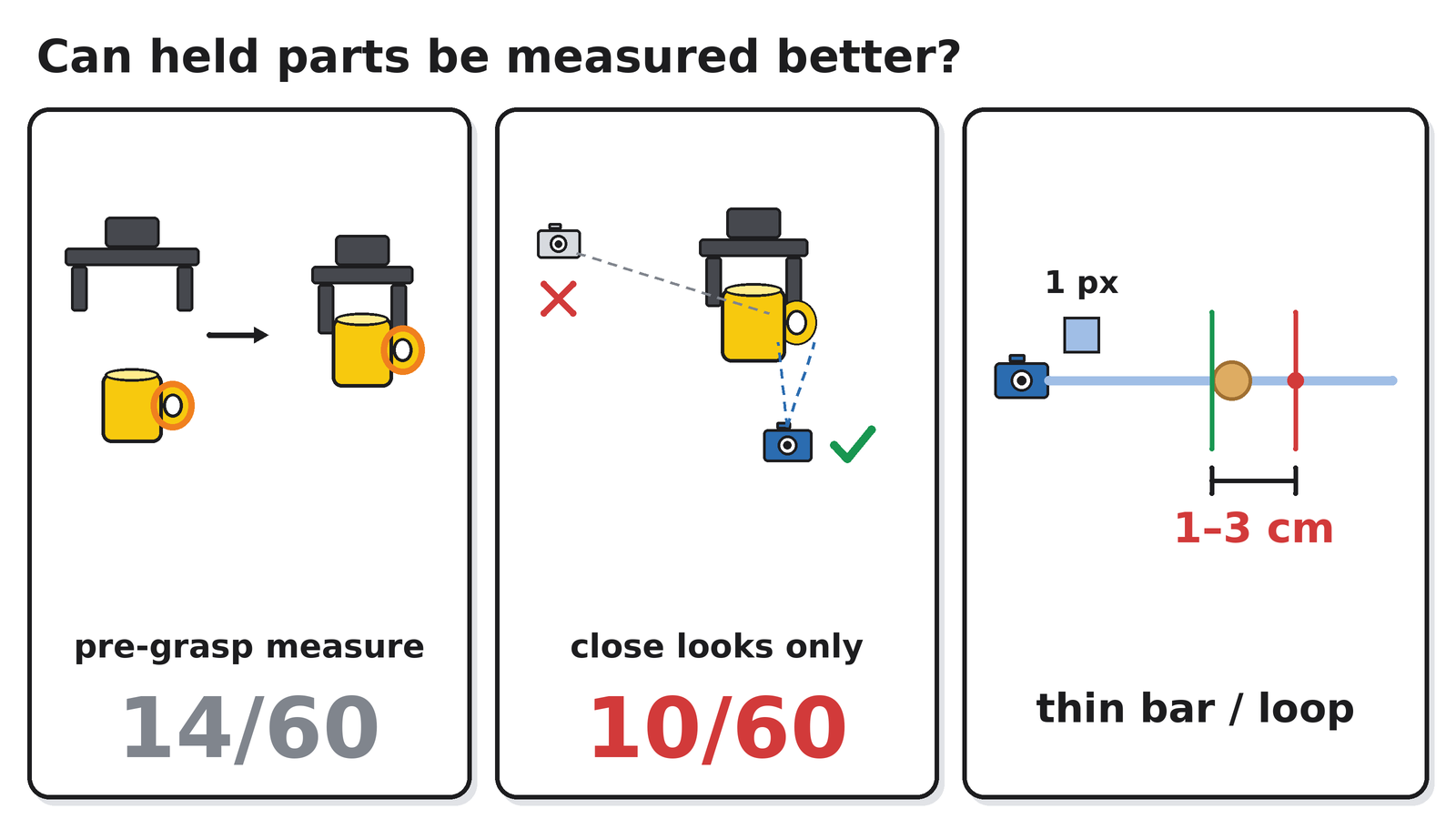
What we didMeasure the held part before grasping and carry it with the gripper; accept only close, clear measurements.

pre-grasp measure 14/60 · close looks only 10/60 · 1 px on thin bar/loop: depth 1–3 cm off

ConclusionNo: thin or hollow parts read the background. The bottleneck shows: one pixel on a thin bar or hollow loop reads depth 1–3 cm off.
2agent 能只用 RGB-D 自己建出这样的 focus 吗?精度追上了,成功率还没有。
2.1工具能自动提取部位吗?部分可以:最好 20/60。
2.1.5

夹在手里的物体部位,在深度图上指一个像素能量准吗?

做了什么抓之前量好、随夹爪带走;只收近处清楚的测量。

抓前量好 14/60,只收近看 10/60,细杆/空心环上 1 像素深度偏 1–3 cm

结论不能:细杆、空心处读到背景。 瓶颈露出来了:细杆、空心环上一个像素,深度偏 1–3 cm。
2Can the agent build that focus itself from RGB-D?Precision catches up; success not yet.
2.1Can tools extract the parts automatically?Partly: best 20/60.
2.1.6

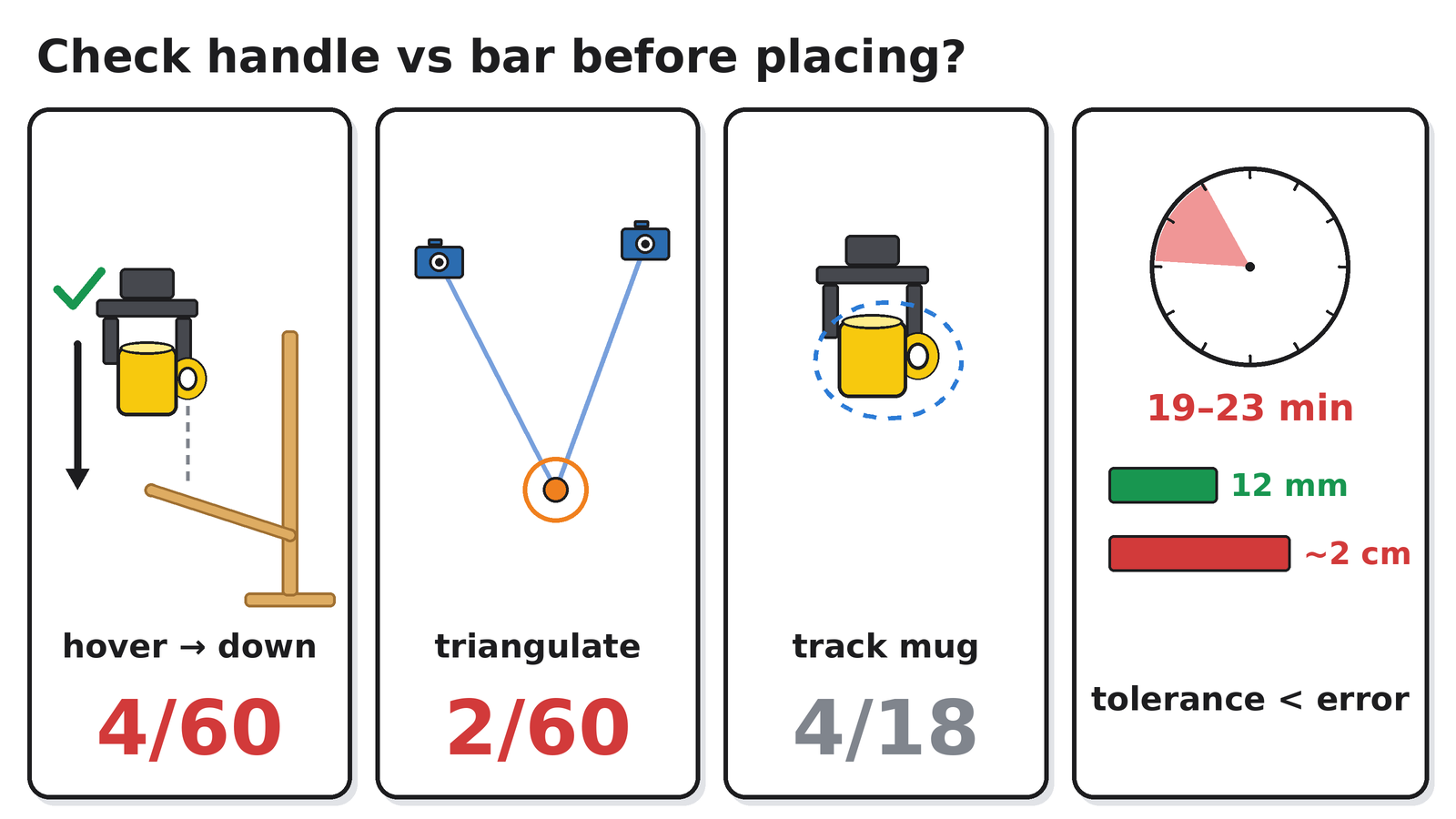
Do check gates before placing help?

What we didCheck handle against bar before placing: hover then lower, triangulate, track the mug.

hover then down 4/60 · triangulate 2/60 · track mug 4/18 · first check at min 19–23 · tolerance 12 mm vs ~2 cm error

ConclusionThey cost more time than they save. Checks come too late (minute 19–23) and the 12 mm tolerance is below the ~2 cm error: right placements are blocked, wrong ones pass.
Hover check · hang mugs: tracked loop centre 2.1 cm off open in a new tab ↗
Where to look rounds 16–17
What it shows it said "the bar tip is inside the loop"; the true loop was still outside the tip
2agent 能只用 RGB-D 自己建出这样的 focus 吗?精度追上了,成功率还没有。
2.1工具能自动提取部位吗?部分可以:最好 20/60。
2.1.6

放之前加检查关卡有用吗?

做了什么放之前核对把手和杆:悬停后下放、三角化、跟踪杯子。

悬停后直降 4/60,多视角交会 2/60,跟踪杯身 4/18,首次核对在第 19–23 分钟,容差 12 mm、误差约 2 cm

结论花的时间比省的多。 检查太晚(第 19–23 分钟),12 mm 容差小于约 2 cm 误差:放对的被拦、放错的通过。
悬停核对 · 挂杯子:跟踪的环心偏 2.1 cm 新标签页打开 ↗
看哪 第 16–17 轮(视频 18.7–19.9 秒):检查通过后竖直下放 6.75 cm,agent 说“杆尖已在环里”就松手,撤手时杯子掉到架底。
分析什么 agent 跟踪的环心比真值偏 2.1 cm;松手时真环心还在杆尖外 0.5 cm、比杆高 2.4 cm。
2Can the agent build that focus itself from RGB-D?Precision catches up; success not yet.
2.1Can tools extract the parts automatically?Partly: best 20/60.
2.1.7

Without gates, the agent's own points?
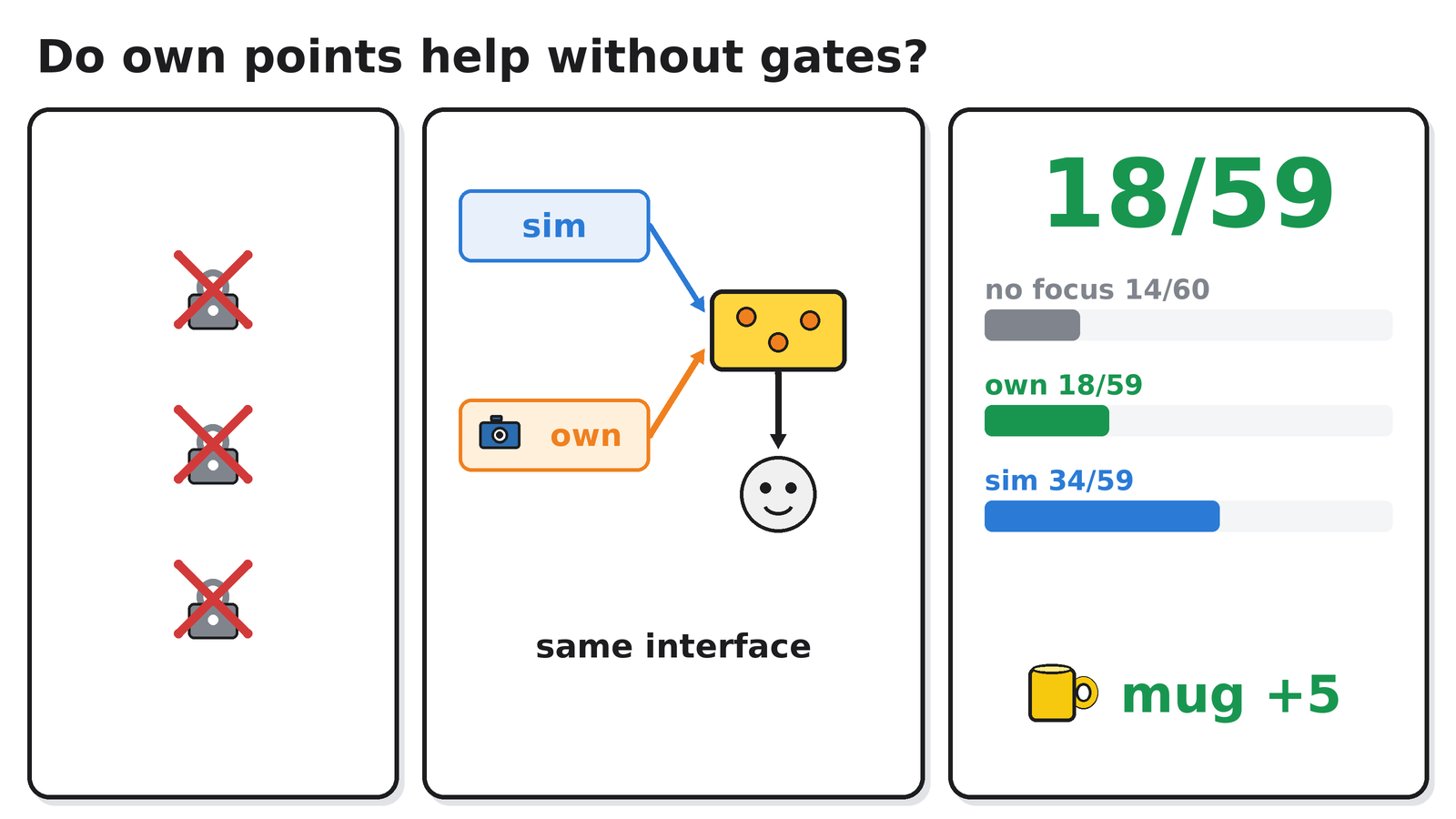
What we didRemove all gates; the agent's own points go through the same interface as simulator points.

own points 18/59 · no focus 14/60 · sim points 34/59 · mug +5

ConclusionBack to 18/59. Back to 18/59. The gap to simulator points is the measurement of held parts.
2agent 能只用 RGB-D 自己建出这样的 focus 吗?精度追上了,成功率还没有。
2.1工具能自动提取部位吗?部分可以:最好 20/60。
2.1.7

去掉关卡,只用 agent 自己的点?

做了什么去掉所有关卡,agent 自己的点和仿真给点走同一接口。

自量的点 18/59,不给点 14/60,仿真给点 34/59,挂杯子多 5 局

结论回到 18/59。 回到 18/59。和仿真给点的差距在手里部位的测量。
2Can the agent build that focus itself from RGB-D?Precision catches up; success not yet.
2.2The gripper hides the held part: which tracking methods did we try instead of re-measuring?Registration removes drift; objects turn when tilted.
2.2.1

Does remembering the last-seen position help?
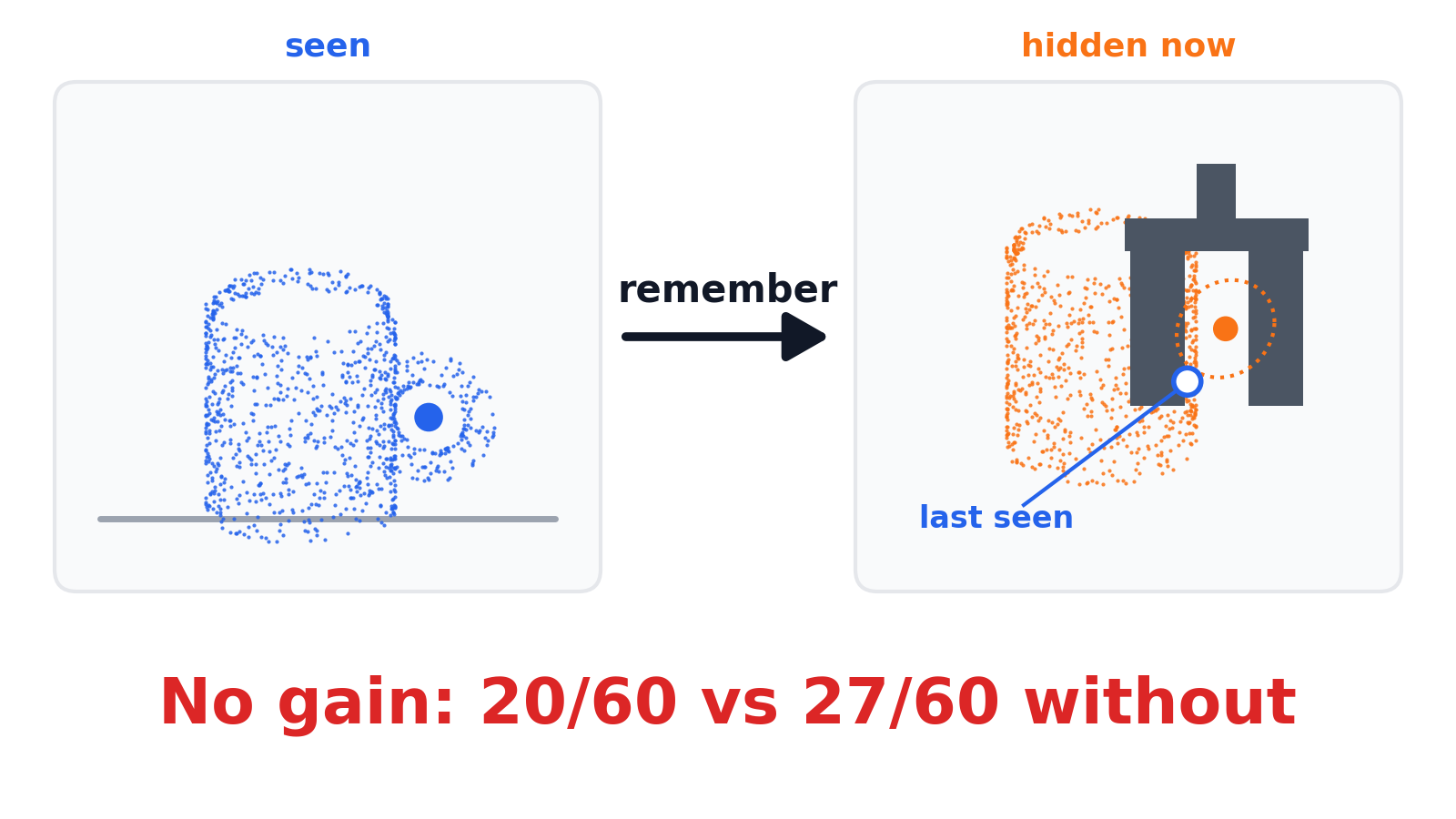
Why this questionThe tools fall short mainly on held parts, which the gripper hides. Instead of re-measuring them, can we track them?
What we didKeep a hidden part at the position where it was last seen.

hidden parts given at last-seen position 20/60; visible points only 27/60; no points 14/60

Conclusionno gain: 20/60 vs 27/60 without Worse than visible points only: the part moves after it was last seen.
2agent 能只用 RGB-D 自己建出这样的 focus 吗?精度追上了,成功率还没有。
2.2夹爪挡住了手里的部位:我们试了哪 7 种追踪方法来代替重新测量?配准能去漂移;物体一斜就转。
2.2.1

记住最后看到的位置有用吗?

为什么问这个工具主要差在手里的部位,它们被夹爪挡住。不重量,能不能跟踪它们?
做了什么部位看不见时,沿用最后看到的位置。

看不见时给上次位置 20/60;只给看得见的点 27/60;不给点 14/60

结论没用:20/60对27/60 比只给看得见的还差:最后看到之后部位还会动。
2Can the agent build that focus itself from RGB-D?Precision catches up; success not yet.
2.2The gripper hides the held part: which tracking methods did we try instead of re-measuring?Registration removes drift; objects turn when tilted.
2.2.2

Can accumulating frames complete the held object?
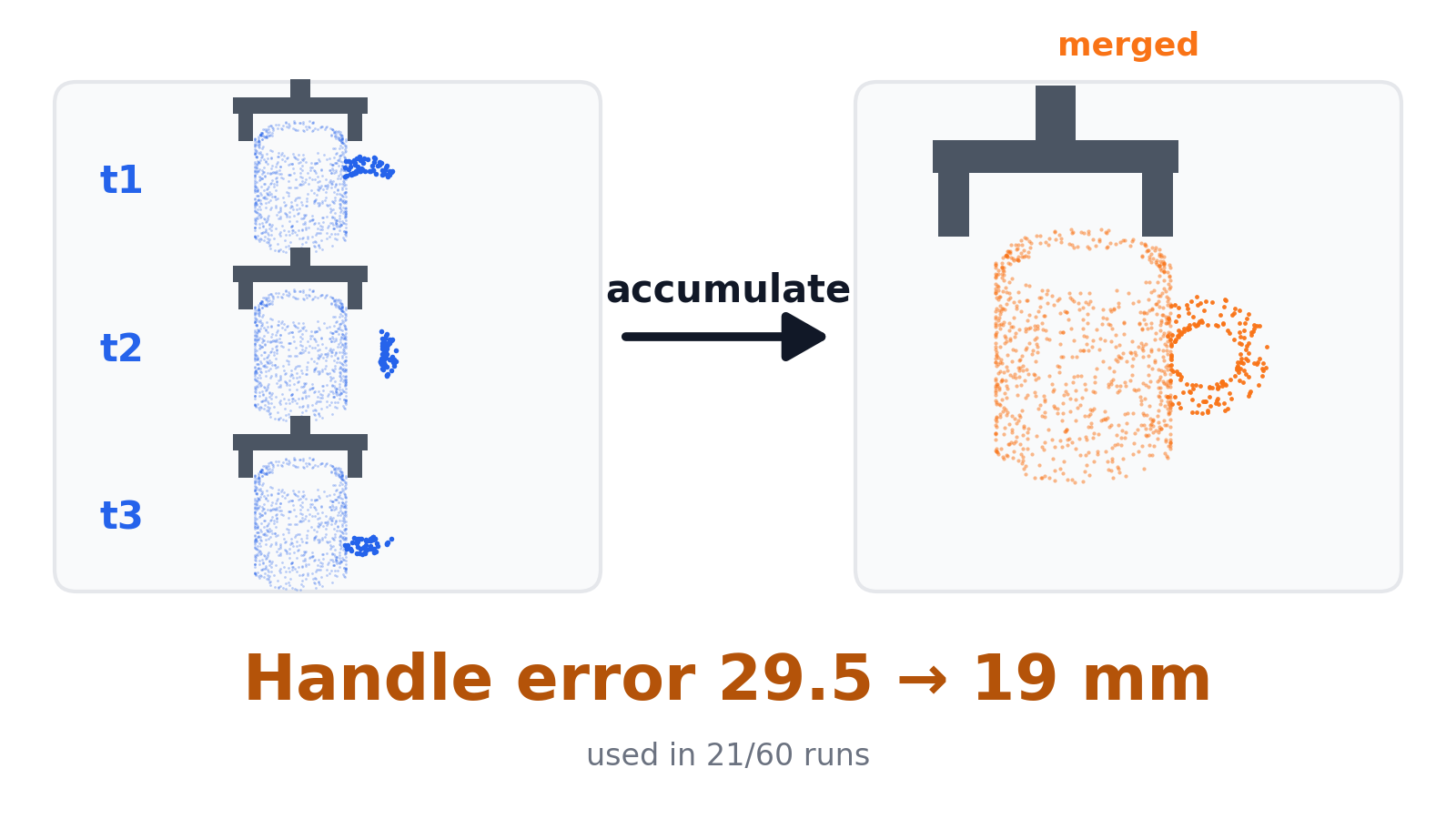
What we didMerge the held object's points across frames to fill in the hidden side.

handle-to-bar at release 29.5 → 19 mm (sim-given points 6.8 mm); used in 21/60 runs; 17/60 vs no focus 14/60

Conclusionhandle error 29.5 → 19 mm, rarely used Helps a little (29.5 → 19 mm), still far from simulator points (6.8 mm).
2agent 能只用 RGB-D 自己建出这样的 focus 吗?精度追上了,成功率还没有。
2.2夹爪挡住了手里的部位:我们试了哪 7 种追踪方法来代替重新测量?配准能去漂移;物体一斜就转。
2.2.2

跨帧累积能补全被夹物体吗?

做了什么跨帧合并手里物体的点,补全被挡的一面。

松手时把手离杆 29.5→19 mm(仿真给点 6.8 mm);60 局里 21 局用上;17/60,不加 14/60

结论把手偏差29.5→19 mm 小有帮助(29.5 → 19 mm),离仿真给点(6.8 mm)还远。
2Can the agent build that focus itself from RGB-D?Precision catches up; success not yet.
2.2The gripper hides the held part: which tracking methods did we try instead of re-measuring?Registration removes drift; objects turn when tilted.
2.2.3

Can the gripper pose carry a pre-grasp measurement?
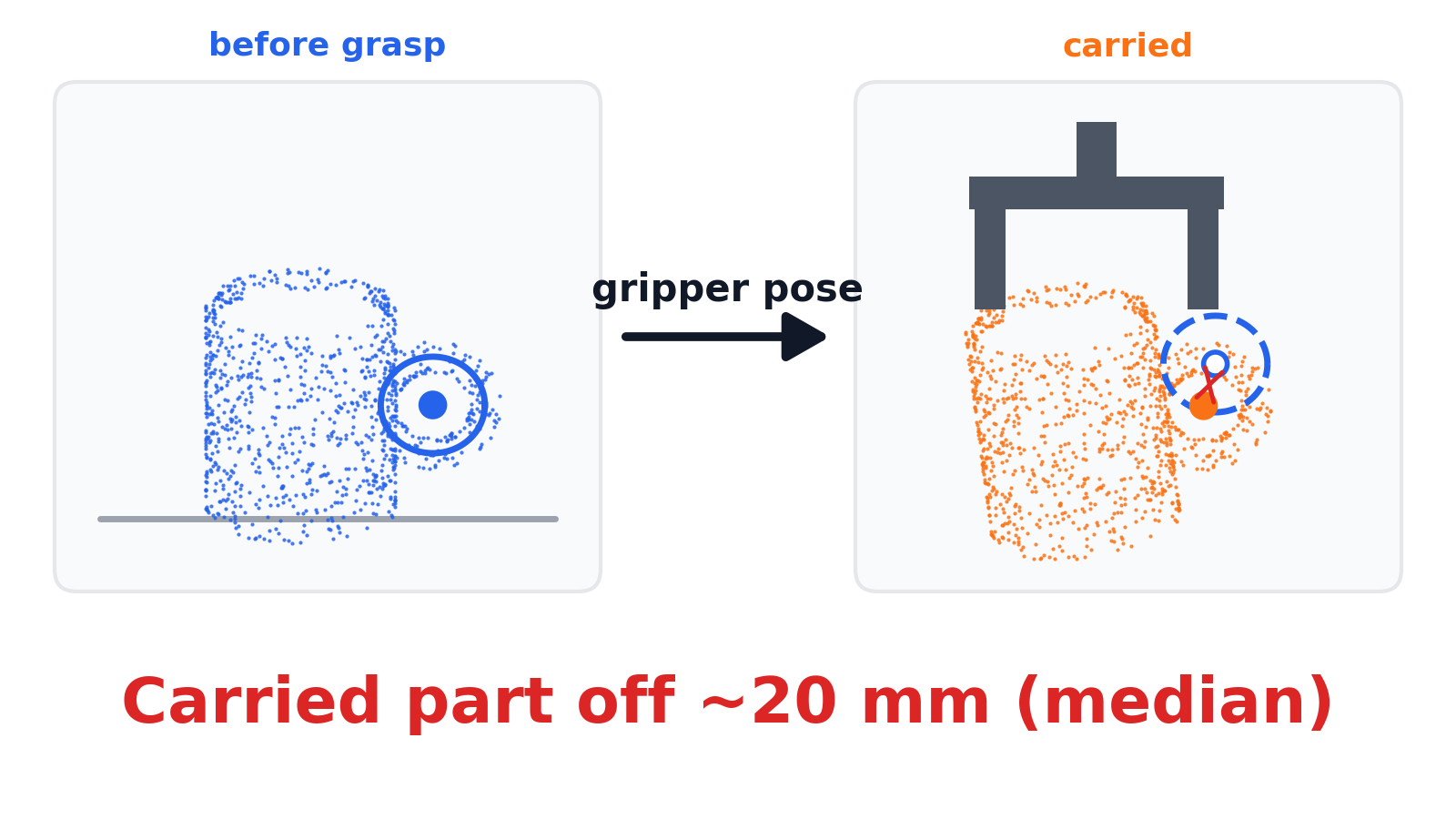
What we didMeasure the part before closing the gripper, then move it with the gripper pose.

stored handle-loop error at hover 5–48 mm, median ~20 mm (14 cases); 14/60 = no focus 14/60

Conclusioncarried part drifts ~20 mm The object shifts when grasped and while carried: about 20 mm off.
2agent 能只用 RGB-D 自己建出这样的 focus 吗?精度追上了,成功率还没有。
2.2夹爪挡住了手里的部位:我们试了哪 7 种追踪方法来代替重新测量?配准能去漂移;物体一斜就转。
2.2.3

合爪前量好能随夹爪带走吗?

做了什么合爪前量好,之后随夹爪位姿一起算。

悬停时存下的环误差 5–48 mm,中位约 20 mm(14 例);14/60,与不加相同

结论带着走会漂约20 mm 抓取和搬运时物体会动:偏约 20 mm。
2Can the agent build that focus itself from RGB-D?Precision catches up; success not yet.
2.2The gripper hides the held part: which tracking methods did we try instead of re-measuring?Registration removes drift; objects turn when tilted.
2.2.4

Can the free wrist camera re-look up close?
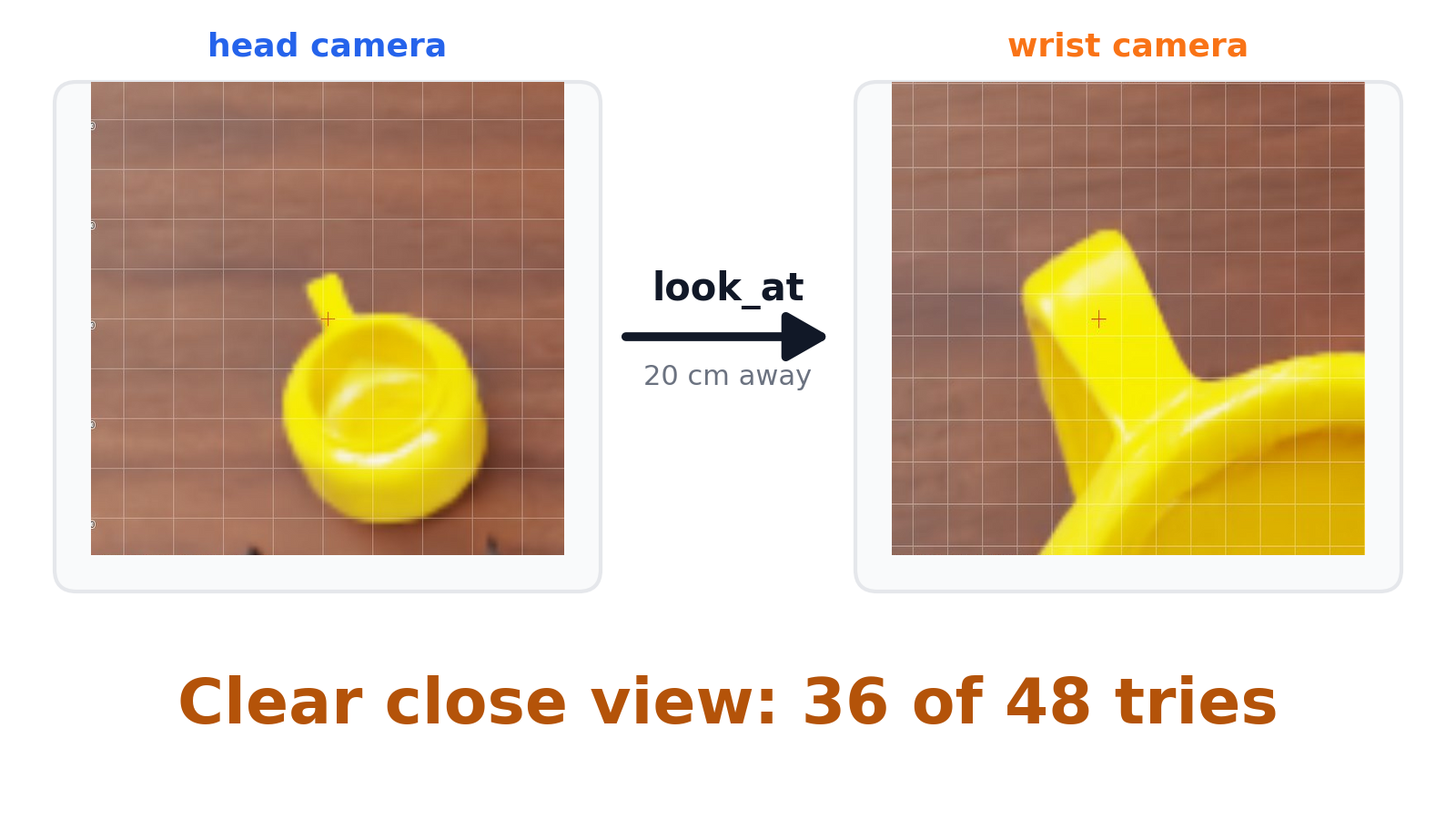
What we didMove the free hand's wrist camera close to the part and look again.

look_at: 48 calls, 36 reached the view, 20 cm from the part; costs agent time

Conclusionclear close view in 36 of 48 A clear close view most of the time (36/48), at a cost in time.
2agent 能只用 RGB-D 自己建出这样的 focus 吗?精度追上了,成功率还没有。
2.2夹爪挡住了手里的部位:我们试了哪 7 种追踪方法来代替重新测量?配准能去漂移;物体一斜就转。
2.2.4

空闲腕相机能凑近再看吗?

做了什么把空闲手的腕相机移到部位跟前再看。

look_at 调用 48 次、到位 36 次,离部位 20 cm;耗 agent 时间

结论48次里36次看清 多数能拿到清楚的近景(36/48),但花时间。
2Can the agent build that focus itself from RGB-D?Precision catches up; success not yet.
2.2The gripper hides the held part: which tracking methods did we try instead of re-measuring?Registration removes drift; objects turn when tilted.
2.2.5

Can several close views triangulate hidden points?
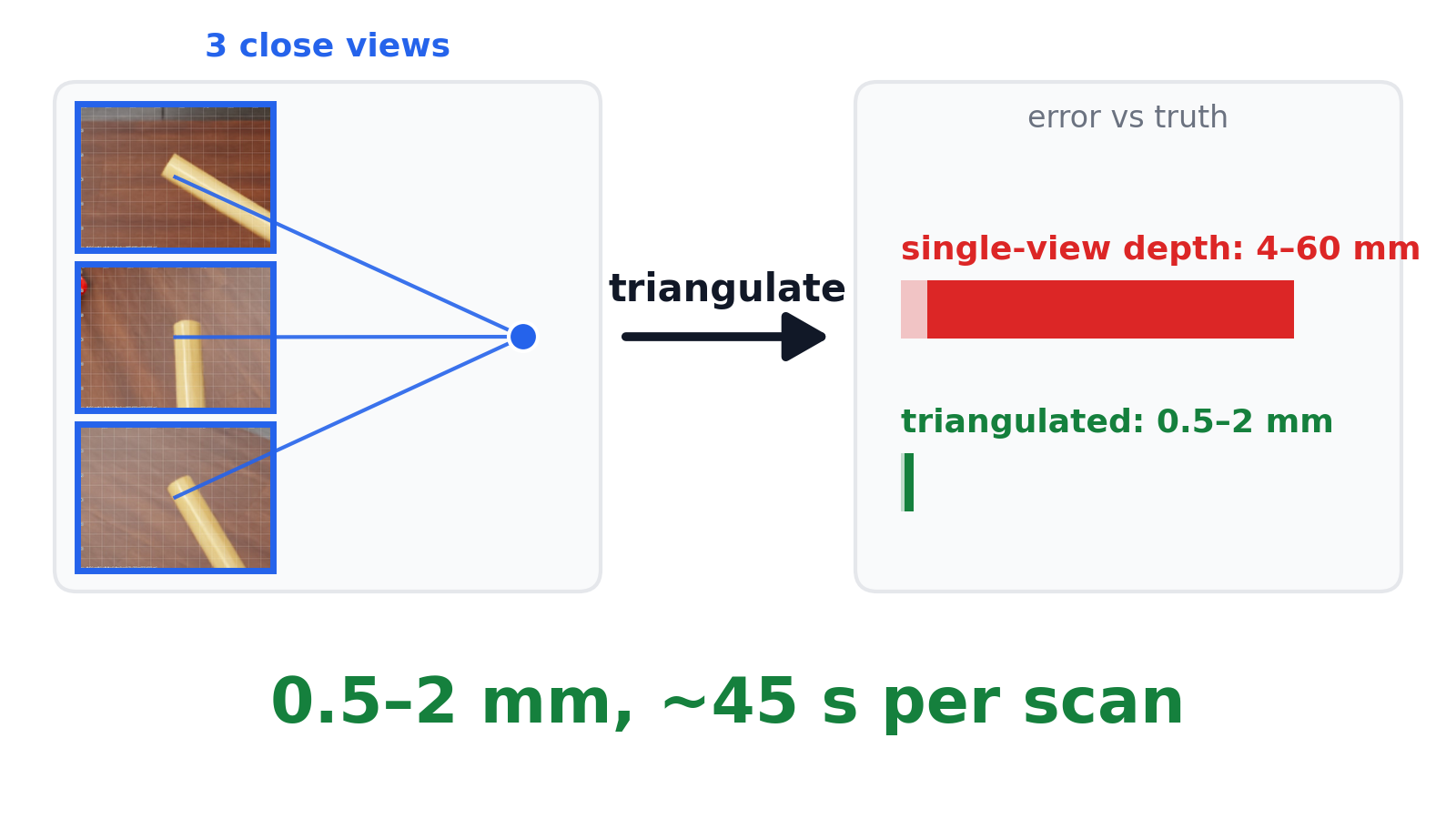
What we didPoint at the same part from several close views and intersect the rays.

triangulated 0.5–2 mm vs single-view depth 4–60 mm; ~45 s per 3-view scan; returns to start within 0.7–1.4 mm

Conclusionprecise: 0.5–2 mm vs 4–60 mm Precise: 0.5–2 mm vs 4–60 mm from a single view; about 45 s per scan.
2agent 能只用 RGB-D 自己建出这样的 focus 吗?精度追上了,成功率还没有。
2.2夹爪挡住了手里的部位:我们试了哪 7 种追踪方法来代替重新测量?配准能去漂移;物体一斜就转。
2.2.5

多视角交会能量准吗?

做了什么从几个近处视角指同一部位,射线求交。

交会 0.5–2 mm,单视角深度 4–60 mm;三视角扫描每次约 45 s;回位误差 0.7–1.4 mm

结论交会准到0.5–2 mm 很准:0.5–2 mm,单视角 4–60 mm;每次约 45 秒。
2Can the agent build that focus itself from RGB-D?Precision catches up; success not yet.
2.2The gripper hides the held part: which tracking methods did we try instead of re-measuring?Registration removes drift; objects turn when tilted.
2.2.6

Can ICP move a measurement through the grasp?
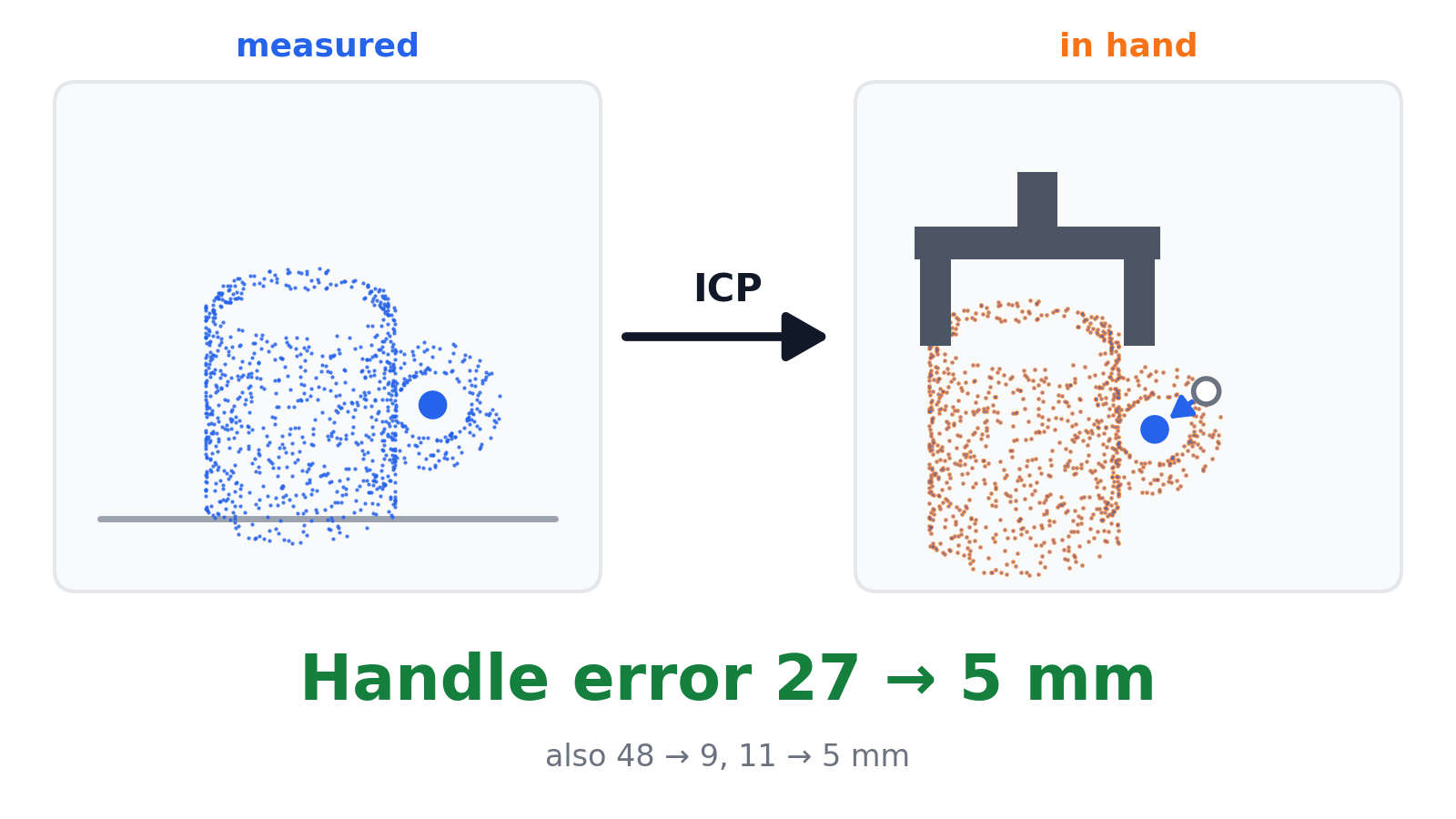
What we didRegister the object surface from the measuring frame to the grasped surface (ICP).

handle loop vs truth 27 → 5, 48 → 9, 11 → 5 mm (replay probes)

Conclusionfixes grasp push: 27 → 5 mm Undoes the shift caused by grasping: 27 → 5 mm.
2agent 能只用 RGB-D 自己建出这样的 focus 吗?精度追上了,成功率还没有。
2.2夹爪挡住了手里的部位:我们试了哪 7 种追踪方法来代替重新测量?配准能去漂移;物体一斜就转。
2.2.6

ICP能补回抓起时的位移吗?

做了什么把测量那一帧的物体表面配准到抓住后的表面(ICP)。

环对真值 27→5、48→9、11→5 mm(回放探针)

结论抓起位移补回:27→5 mm 补回抓取时的位移:27 → 5 mm。
2Can the agent build that focus itself from RGB-D?Precision catches up; success not yet.
2.2The gripper hides the held part: which tracking methods did we try instead of re-measuring?Registration removes drift; objects turn when tilted.
2.2.7

Can ICP track the held surface while carrying?
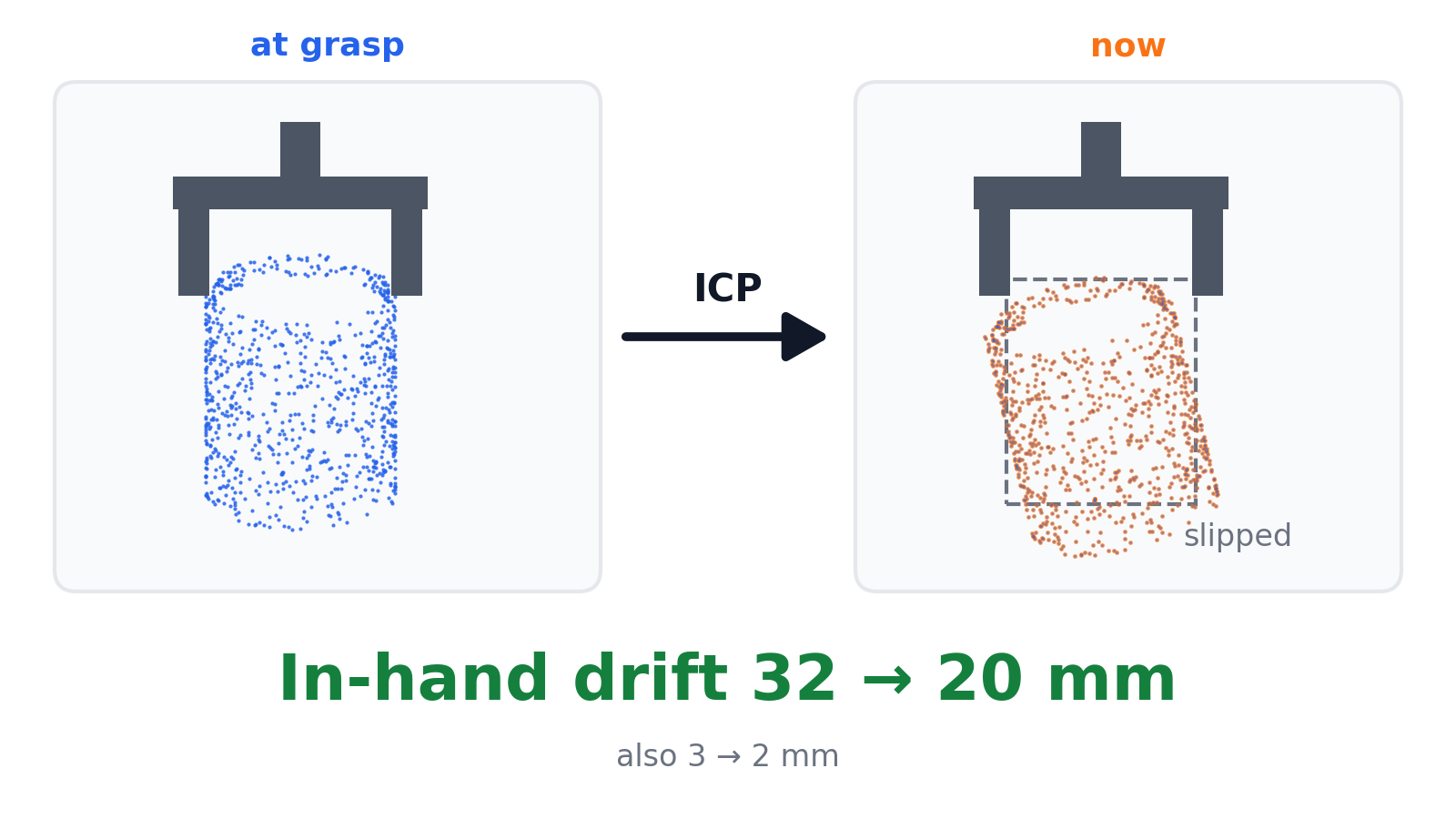
What we didWhile carrying, register the stored surface to the current view (ICP) to follow in-hand drift.

in-hand drift 0–13 mm / 0–15° removed: 32 → 20, 3 → 2 mm; rest = error at measuring; turn of a round body not seen

Conclusionremoves carrying drift: 32 → 20 mm Removes the drift (32 → 20 mm); what remains is the error made when measuring.
2agent 能只用 RGB-D 自己建出这样的 focus 吗?精度追上了,成功率还没有。
2.2夹爪挡住了手里的部位:我们试了哪 7 种追踪方法来代替重新测量?配准能去漂移;物体一斜就转。
2.2.7

ICP能跟踪手里的物体吗?

做了什么搬运中把存下的表面配准到当前画面(ICP),跟住在手漂移。

在手漂移 0–13 mm/0–15° 补回:32→20、3→2 mm;剩余为量时误差;圆杯身转角看不出

结论补回漂移:32→20 mm 去掉漂移(32 → 20 mm);剩下的是测量时就有的误差。
2Can the agent build that focus itself from RGB-D?Precision catches up; success not yet.
2.2The gripper hides the held part: which tracking methods did we try instead of re-measuring?Registration removes drift; objects turn when tilted.
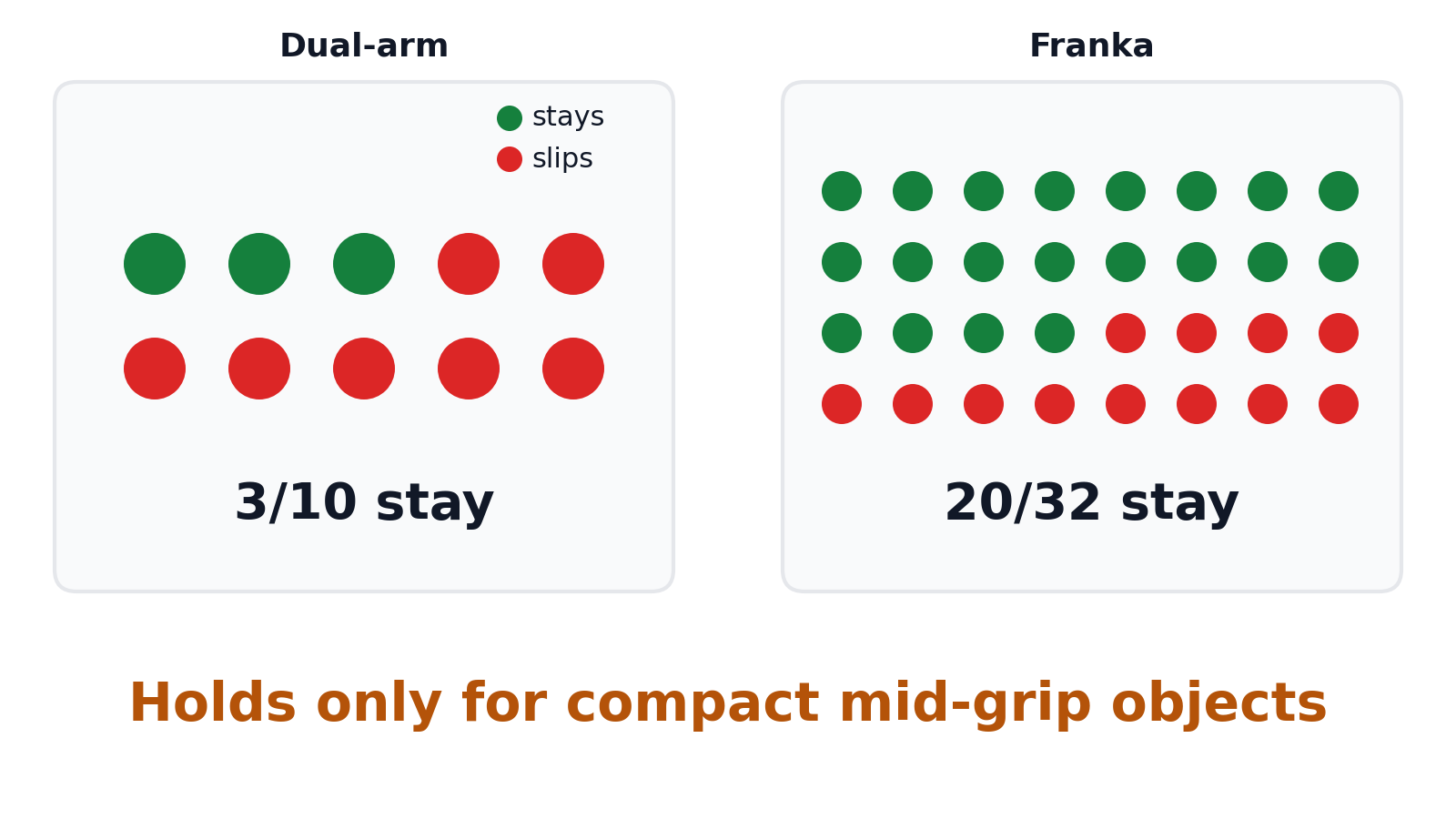
2.2.8

Does the object stay put in the hand?

What we didGrasp, rotate and tilt objects from 13 tasks (plus 42 Franka grasps); measure how much they move in the hand.

dual-arm: tube, toothbrush, cube ≤3.6 mm, mug 40 mm/22°, 6 of 10 turn or drop; Franka: 20/32 within 5 mm & 5°, banana end 22–25 mm

Conclusiononly compact mid-grip objects stay put Only compact objects gripped in the middle stay put; mugs and tools turn. Tracking cannot be the general method.
2agent 能只用 RGB-D 自己建出这样的 focus 吗?精度追上了,成功率还没有。
2.2夹爪挡住了手里的部位:我们试了哪 7 种追踪方法来代替重新测量?配准能去漂移;物体一斜就转。
2.2.8

物体在手里会不会动?

做了什么抓起 13 个任务的物体(另有 Franka 42 次)旋转、倾斜,量它们在手里动了多少。

双臂:试管、牙刷、小方块 ≤3.6 mm,杯子 40 mm/22°,10 个里 6 个转或掉;Franka:32 次里 20 次在 5 mm 且 5° 内,香蕉抓一端 22–25 mm

结论只有夹中段的小物体不动 只有握在中间的紧凑物体不动;杯子、工具会转。跟踪做不了通用方法。
2Can the agent build that focus itself from RGB-D?Precision catches up; success not yet.
2.3Can the agent point at the parts itself?Fixed targets yes; held, hidden parts no.
2.3.1

Which prompt makes it point accurately?
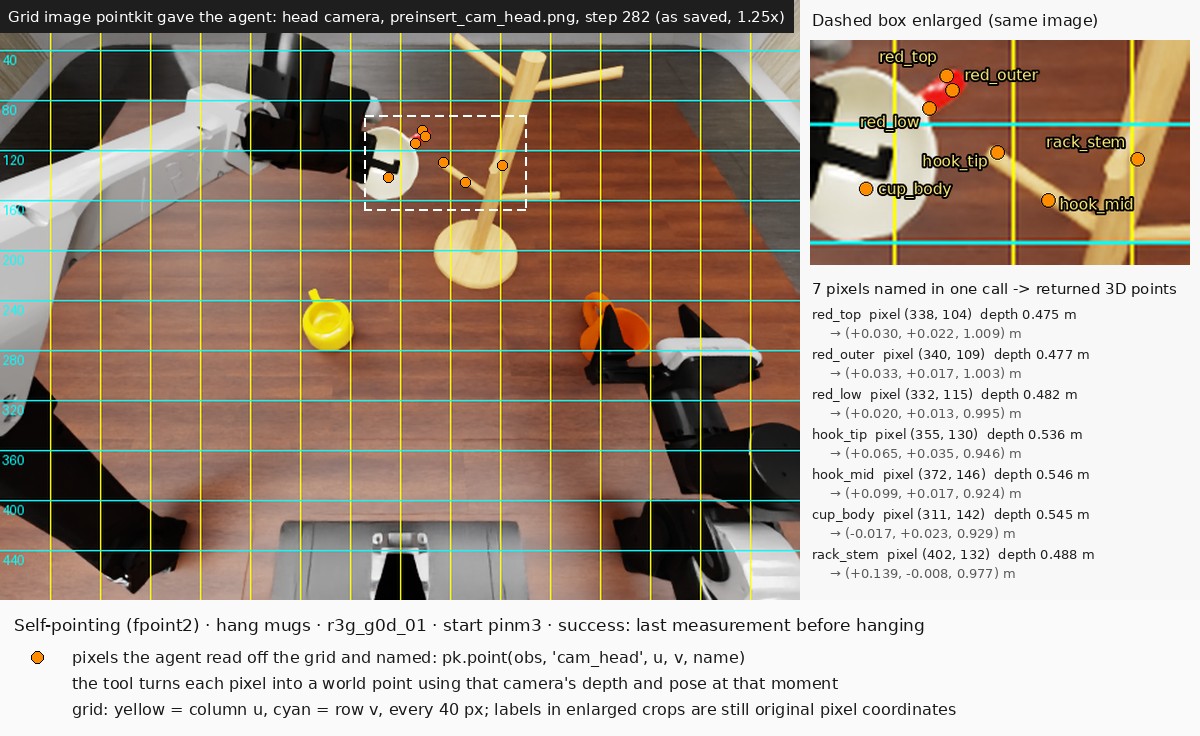
Why this questionTools and tracking stay below simulator points. As decided on 10-28: let the agent itself name the points each subgoal needs.
What we didThe agent only points, no actions; is the mug loop centre within 1 cm?

loop centre within 1 cm: original 1/6 · subgoal wording 2/6 · + done-conditions 4/6

ConclusionState the done-conditions first: 4/6. Writing the done-conditions first makes it point best (4/6).
2agent 能只用 RGB-D 自己建出这样的 focus 吗?精度追上了,成功率还没有。
2.3agent 能自己指出部位吗?固定目标能;手里看不见的不能。
2.3.1

什么提示词让它指得准?

为什么问这个工具和跟踪都低于仿真给点。按 10-28 组会:让 agent 按子目标自己指出要用的点。
做了什么agent 只指点不动手;看杯环中心是否在 1 cm 内。

环心 1 cm 内:原写法 1/6 · 子目标写法 2/6 · 加完成条件 4/6

结论先写完成条件:4/6。 先写完成条件,指得最准(4/6)。
2Can the agent build that focus itself from RGB-D?Precision catches up; success not yet.
2.3Can the agent point at the parts itself?Fixed targets yes; held, hidden parts no.
2.3.2

How accurate is it on full tasks?

What we didFull runs on hang mugs, plug in charger, insert tubes: the pixels it names become 3D points via depth, and the solvers use them.

agent pointing 22/72 · simulator points 41/72 · hook tip 5.8 mm · hole centres 3.4–4.4 mm

ConclusionTargets 3–6 mm; held parts 2–3 cm off. Fixed targets are accurate (3–6 mm); held, hidden parts are 2–3 cm off: it substitutes a nearby visible surface point.
Agent pointing · hang mugs start 1: loop centre replaced by the midpoint of two surface points open in a new tab ↗
Where to look rounds 13–14
What it shows its "handle centre" was 2.5 cm off; at release the loop axis was 61° from the bar
2agent 能只用 RGB-D 自己建出这样的 focus 吗?精度追上了,成功率还没有。
2.3agent 能自己指出部位吗?固定目标能;手里看不见的不能。
2.3.2

完整任务上指得多准?

做了什么挂杯子、插充电器、插试管完整跑:它点名的像素按深度变三维点,交给求解器。

自己指点 22/72 · 仿真给点 41/72 · 钩尖 5.8 mm · 孔心 3.4–4.4 mm

结论目标 3–6 mm;手里部位偏 2–3 cm。 固定目标准(3–6 mm);手里看不见的部位偏 2–3 cm:它用附近看得见的表面点顶替。
自己指点 · 挂杯子开局 1:环心用两个表面点的中点代替 新标签页打开 ↗
看哪 第 13–14 轮(视频 6.3–8.4 秒):agent 认为“把手中心离钩尖约 2 cm、在容差内”就松手,杯子从钩边掉下。
分析什么 它的“把手中心”是把手外侧两个看得见的表面点取中点再加 6 mm,比真环心偏 2.5 cm;松手时环心离杆线 1.8 cm、环轴偏杆 61°。
2Can the agent build that focus itself from RGB-D?Precision catches up; success not yet.
2.3Can the agent point at the parts itself?Fixed targets yes; held, hidden parts no.
2.3.3

Do more time or a stronger model close the gap?

What we didTime limit doubled to 50 minutes; Opus with the same prompt and tools.

50 min: 12/38 · Opus 9/12 vs simulator points 11/12

ConclusionOpus comes close. More time does not help; Opus comes close because it checks before releasing.
2agent 能只用 RGB-D 自己建出这样的 focus 吗?精度追上了,成功率还没有。
2.3agent 能自己指出部位吗?固定目标能;手里看不见的不能。
2.3.3

多给时间、换更强的模型,能补上吗?

做了什么时限加到 50 分钟;Opus 用同样的提示和工具。

50 分钟:12/38 · Opus 9/12 对仿真给点 11/12

结论Opus 接近。 加时间没用;Opus 接近,因为它松手前会核对。
2Can the agent build that focus itself from RGB-D?Precision catches up; success not yet.
2.4Why does self-built focus fall short?Key points are hidden, and it does not know.
2.4.1

Which points make up the gap?

Why this questionThe agent still trails simulator points (22 vs 41/72). Is it because it cannot track hidden points, or because it does not realize its points are not the parts?
What we didSwitch points back to simulator ones step by step: held parts, targets, grasp points, all.

agent 22/72 → + grasp points 30/74 → all points 31/72 · simulator 41/72

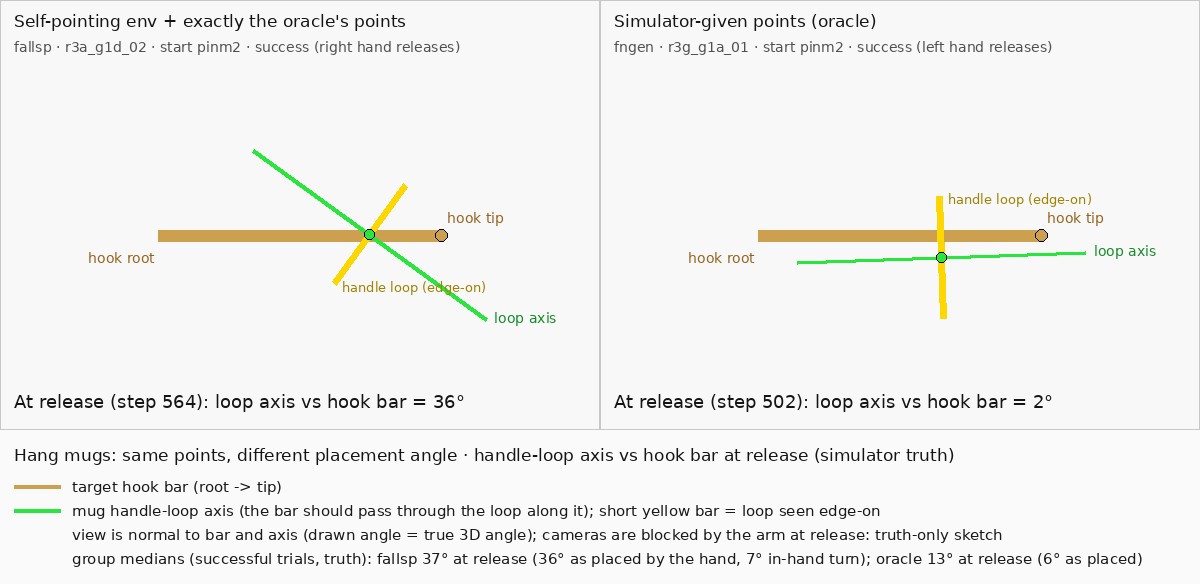
ConclusionHeld parts and grasp points. The gap sits in held parts and grasp points; the mug is also posed wrong from the start (36° vs 6°).
2agent 能只用 RGB-D 自己建出这样的 focus 吗?精度追上了,成功率还没有。
2.4自己建的 focus 为什么不够?关键点被挡住,而且它意识不到。
2.4.1

差距出在哪类点上?

为什么问这个agent 仍落后仿真给点(22 对 41/72)。是追踪不了看不见的点,还是意识不到自己的点并不是那个部位?
做了什么逐级换回仿真给点:手里部位、目标点、抓取点、全部。

自己指点 22/72 → 加抓取点 30/74 → 全换 31/72 · 仿真给点 41/72

结论手里部位和抓取点。 差距在手里部位和抓取点;杯子从一开始就摆偏了(36° 对 6°)。
2Can the agent build that focus itself from RGB-D?Precision catches up; success not yet.
2.4Why does self-built focus fall short?Key points are hidden, and it does not know.
2.4.2

Does it know a key point is hidden?

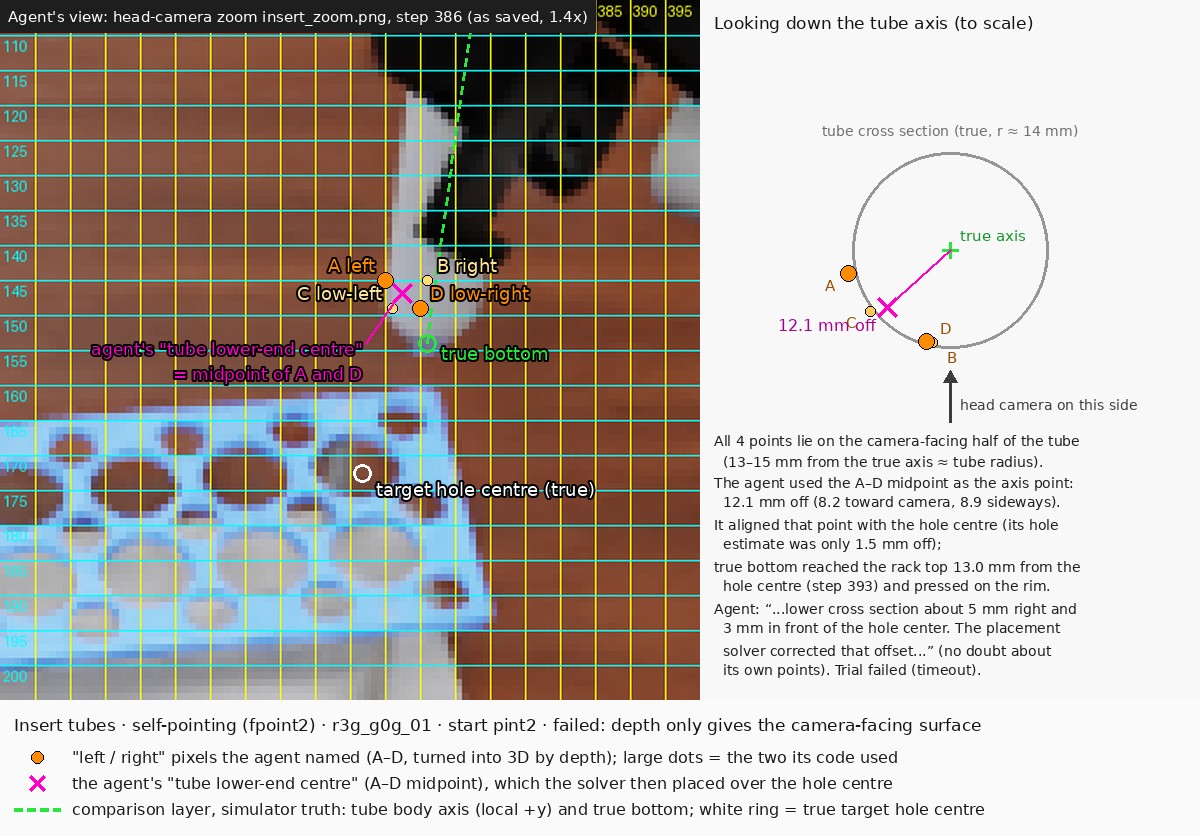
What we didInsert-tube trials checked against truth along the tube axis: where are the points it calls the tube's left, right and bottom?

"left/right" points both on the near face: 6–7 mm off the axis sideways, 16–18 mm toward the camera (tube radius 14 mm)

ConclusionNo: two near-side points become the "diameter". All on the camera-facing surface. It takes two near-side points as the diameter and never realizes the bottom is hidden.
2agent 能只用 RGB-D 自己建出这样的 focus 吗?精度追上了,成功率还没有。
2.4自己建的 focus 为什么不够?关键点被挡住,而且它意识不到。
2.4.2

它知道关键点被挡住了吗?

做了什么插试管逐局对真值:它说的管子“左”“右”“底”到底在哪?

“左右”两点都在正面中间:离轴左右 6–7 mm、朝相机偏 16–18 mm(管半径 14 mm)

结论不知道:把朝向面两点当成直径。 全在朝相机那一面。它把正面两点当直径,完全没意识到管底被挡住了。
2Can the agent build that focus itself from RGB-D?Precision catches up; success not yet.
2.4Why does self-built focus fall short?Key points are hidden, and it does not know.
2.4.3

What does one hidden point cost?

What we didFollow what happens after a hidden point is mis-measured.

blocked trials: bottom 8–19 mm from the hole · simulator points 0–3 mm

ConclusionThe tube lands on the rack and slides up. Bottom 8–19 mm off → presses on the rack → pushed up in the hand → cannot insert.
Agent pointing · insert tubes start 2: bottom off-centre, pushed up in the hand open in a new tab ↗
Where to look Head camera, round 7 (video 0:03.7–0:04.2): the tube held in the right hand comes down beside the target hole; its bottom lands on the rack around the hole and the tube slides up between the fingers. FOCUS panel of rounds 1–6: the single pixels the agent pointed on the tube and the rack.
What it shows Truth (tube body axis): when the tube started to be pushed up in the hand, its bottom was 14 mm sideways from the target hole centre (closest 13 mm). In successful simulator-point runs the bottom was 0–3 mm from the centre. The tube points it used are the single pixels in the FOCUS panel (rounds 1–6).
2agent 能只用 RGB-D 自己建出这样的 focus 吗?精度追上了,成功率还没有。
2.4自己建的 focus 为什么不够?关键点被挡住,而且它意识不到。
2.4.3

一个点被挡,代价多大?

做了什么跟踪一个被挡的点量偏之后发生了什么。

卡住的局:管底离孔 8–19 mm · 仿真给点 0–3 mm

结论管底压到架面、在手里被顶上去。 管底偏 8–19 mm → 压到架面 → 在手里被顶上去 → 插不进。
自己指点 · 插试管开局 2:管底偏离孔心,被顶回手里 新标签页打开 ↗
看哪 头部相机第 7 轮(视频 0:03.7–0:04.2):右手拿的试管落到目标孔旁边,管底压在孔周围的架面上,试管在指间往上滑。第 1–6 轮的 FOCUS 面板是 agent 在试管和架子上指的单个像素。
分析什么 仿真真值(沿管身轴线):试管开始被顶回手里时,管底离目标孔心 14 mm(最近 13 mm);仿真给点的成功局管底离孔心 0–3 mm。
2Can the agent build that focus itself from RGB-D?Precision catches up; success not yet.
2.4Why does self-built focus fall short?Key points are hidden, and it does not know.
2.4.4

Does it doubt its own points?

What we didWhat it wrote before inserting, and whether it read the tool note "points lie on the surface".

the tool text "points lie on the surface" was read in every trial

ConclusionNever: "aligned within 1 mm" every time. Every trial wrote "aligned within 1 mm" and read the note: the knowledge is there, but it is not applied to its own points.
2agent 能只用 RGB-D 自己建出这样的 focus 吗?精度追上了,成功率还没有。
2.4自己建的 focus 为什么不够?关键点被挡住,而且它意识不到。
2.4.4

它会怀疑自己的点吗?

做了什么插入前它写了什么,是否读到工具说明“点在表面上”。

“点在表面上”的工具说明每局都读到了

结论从不:每局都写“对准 1 mm 内”。 每局都写“对准 1 mm 内”,也都读到了说明:知识有,没用到自己的点上。
2Can the agent build that focus itself from RGB-D?Precision catches up; success not yet.
2.5Does looking more close the gap?Looking helps judgement, not measuring.
2.5.1

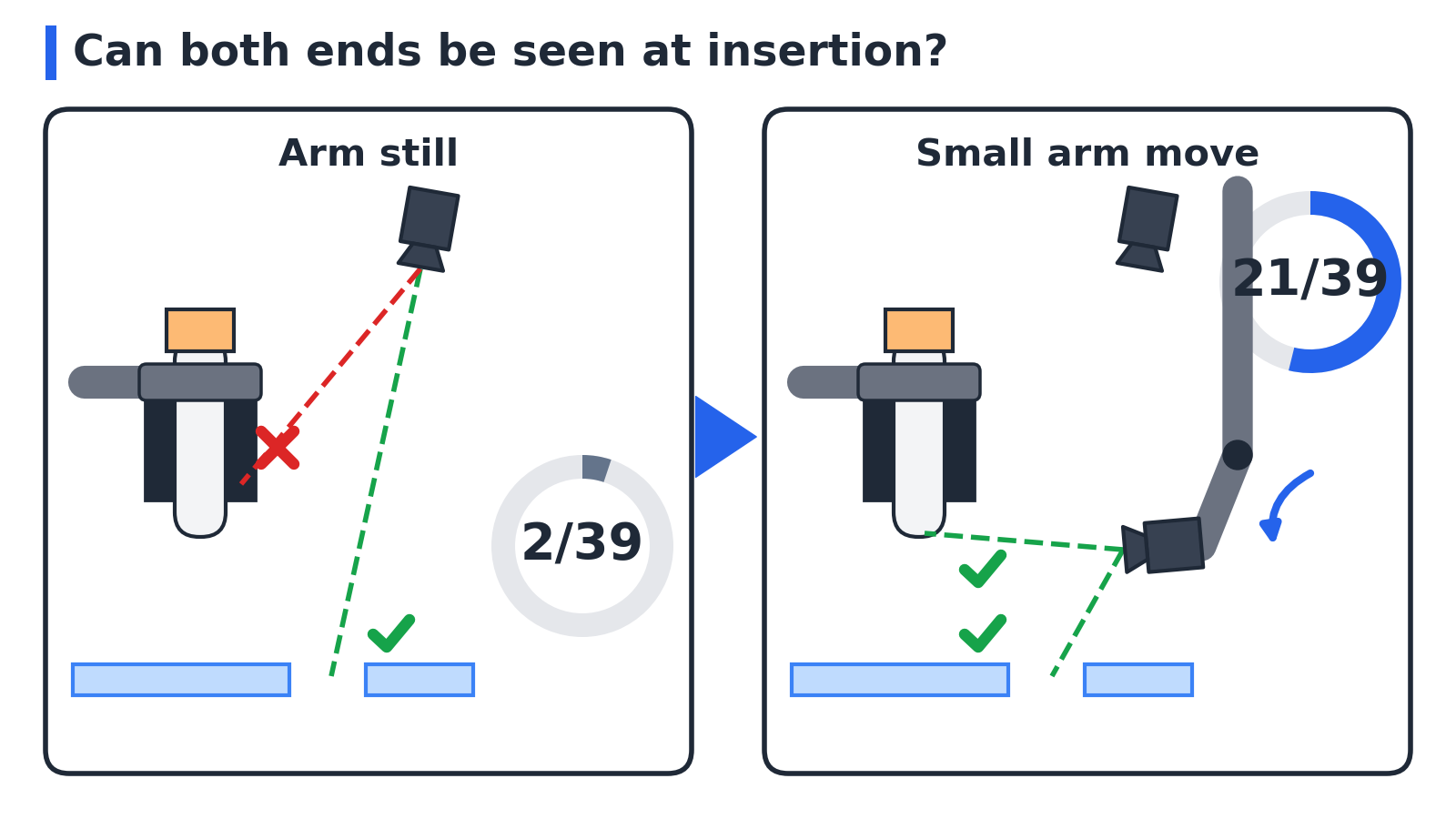
Can both ends be seen at insertion?

Why this questionIf the part is hidden, maybe another view is enough.
What we didRestore 39 "start inserting" moments: which cameras see both the tube bottom and the hole?

Arm still: 2/39 see tube bottom and hole; after a small arm move: 21/39

ConclusionMove the arm a little: 21/39. A small arm move makes both visible in 21/39.
2agent 能只用 RGB-D 自己建出这样的 focus 吗?精度追上了,成功率还没有。
2.5多看能补上吗?看能帮判断,量不准。
2.5.1

插入时两头都看得见吗?

为什么问这个部位被挡住,也许换个视角看就行。
做了什么恢复 39 个“开始插”的时刻:哪些相机能同时看到管底和孔?

不动手臂:头部相机同时看见管底和孔口 2/39;动一下手臂:21/39

结论手臂动一下:21/39。 手臂动一下,21/39 两头都看得见。
2Can the agent build that focus itself from RGB-D?Precision catches up; success not yet.
2.5Does looking more close the gap?Looking helps judgement, not measuring.
2.5.2

Does looking help the release judgement?
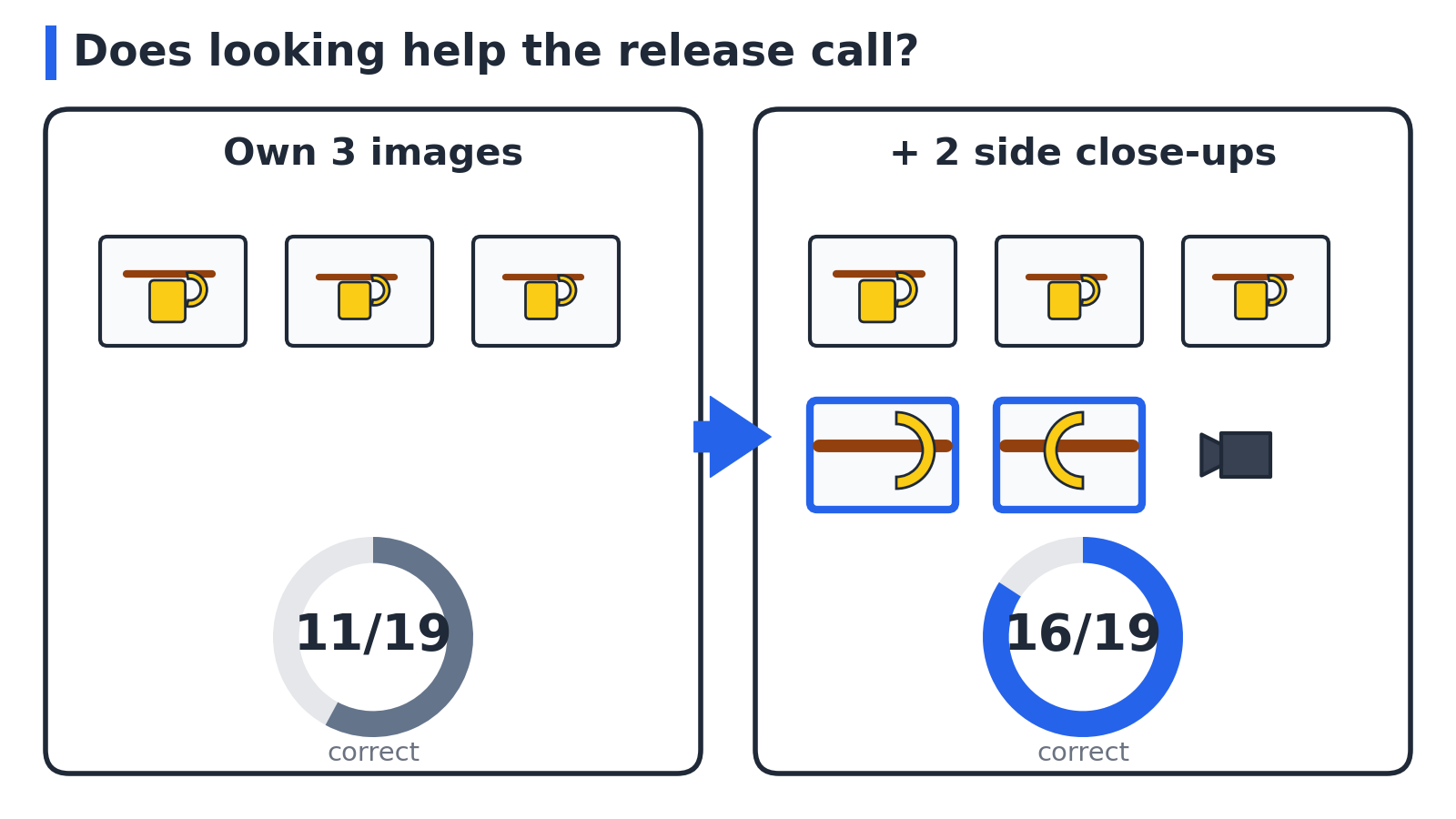
What we didRestore 19 moments before releasing a mug: judge whether it would hang, with its own images vs plus two side close-ups.

Own three images: 11/19 correct; plus two side close-ups: 16/19

ConclusionYes: 11 → 16/19 correct. Close-ups improve the judgement (11 → 16/19): the information is in the images.
2agent 能只用 RGB-D 自己建出这样的 focus 吗?精度追上了,成功率还没有。
2.5多看能补上吗?看能帮判断,量不准。
2.5.2

看能帮它判断该不该松手吗?

做了什么恢复 19 个松手前的时刻:判断现在松手能否挂上,只用自己三张图 vs 加两张侧面近景。

只用自己的三张图:11/19 判断对;加两张侧面近景:16/19

结论能:判对 11 → 16/19。 近景让判断变准(11 → 16/19):信息在图里。
2Can the agent build that focus itself from RGB-D?Precision catches up; success not yet.
2.5Does looking more close the gap?Looking helps judgement, not measuring.
2.5.3

Does a look-closer tool fix measuring?
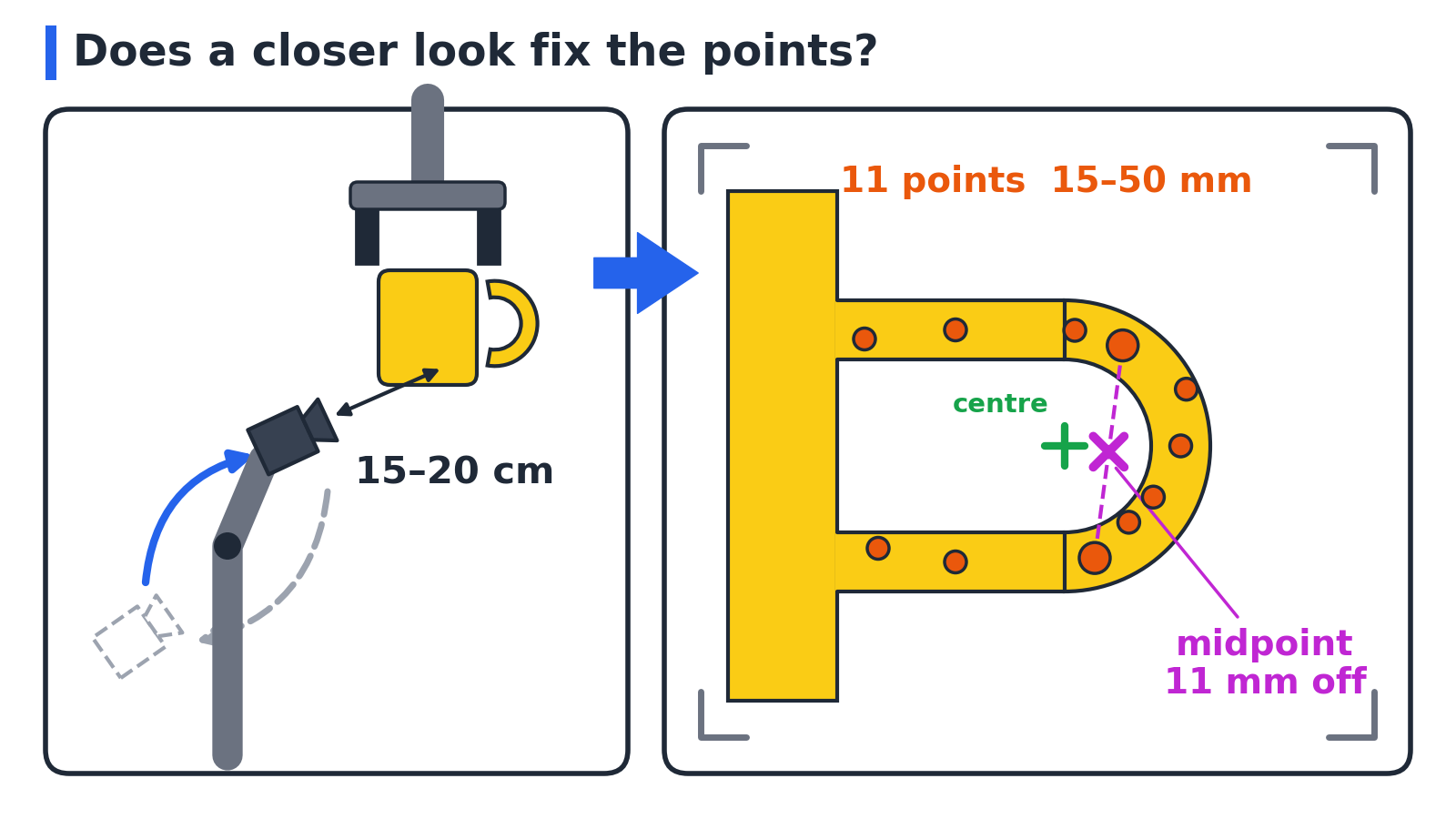
What we didA tool moves the free wrist camera 15–20 cm from the part and returns a close-up.

Camera 15–20 cm from target; 11 handle points 15–50 mm from loop centre; midpoint 11 mm off

ConclusionAdds a view; still one pixel per point. The view is better, but it still reads one pixel per point (11 mm off). Seeing is not measuring.
Look-closer tool · hang mugs start 1: looked closer, still measured the handle from surface pixels open in a new tab ↗
Where to look Rounds 4–5 (video 0:01.6–0:09.0): the left hand brings the held mug in front of the head camera for the close look (pose presented at ≈0:05.4). FOCUS panel of round 6: “close look: yellow mug handle” followed by 11 handle points, each one pixel with its depth.
What it shows Truth at the presented pose: the 11 single-pixel handle points are 15–50 mm from the true loop centre (median 24 mm); the handle centre it then used (midpoint of two of these surface pixels) is 11 mm off. The close view added a viewpoint; the measurement was still one surface pixel per point.
2agent 能只用 RGB-D 自己建出这样的 focus 吗?精度追上了,成功率还没有。
2.5多看能补上吗?看能帮判断,量不准。
2.5.3

凑近看工具能量准吗?

做了什么工具把空闲腕相机移到离部位 15–20 cm,拍近景返回。

相机离目标 15–20 cm;11 个把手点离环心 15–50 mm;所用中点偏 11 mm

结论多了视角;仍是一点一像素。 看清了,但量法仍是一点一像素(偏 11 mm)。看见不等于量准。
凑近看工具 · 挂杯子开局 1:凑近看了,仍用表面像素量把手 新标签页打开 ↗
看哪 第 4–5 轮(视频 0:01.6–0:09.0):左手把拿着的杯子送到头部相机前凑近看(约 0:05.4 摆好)。第 6 轮 FOCUS 面板:“close look: yellow mug handle” 后面 11 个把手点,每个点是一个像素加它的深度。
分析什么 摆好时的真值:11 个单像素把手点离真环心 15–50 mm(中位 24 mm);它随后用的把手中心(其中两个表面像素的中点)偏 11 mm。凑近看多了一个视角,量法仍是每个点一个表面像素。
2Can the agent build that focus itself from RGB-D?Precision catches up; success not yet.
2.5Does looking more close the gap?Looking helps judgement, not measuring.
2.5.4

Do view candidates or a look before contact help?
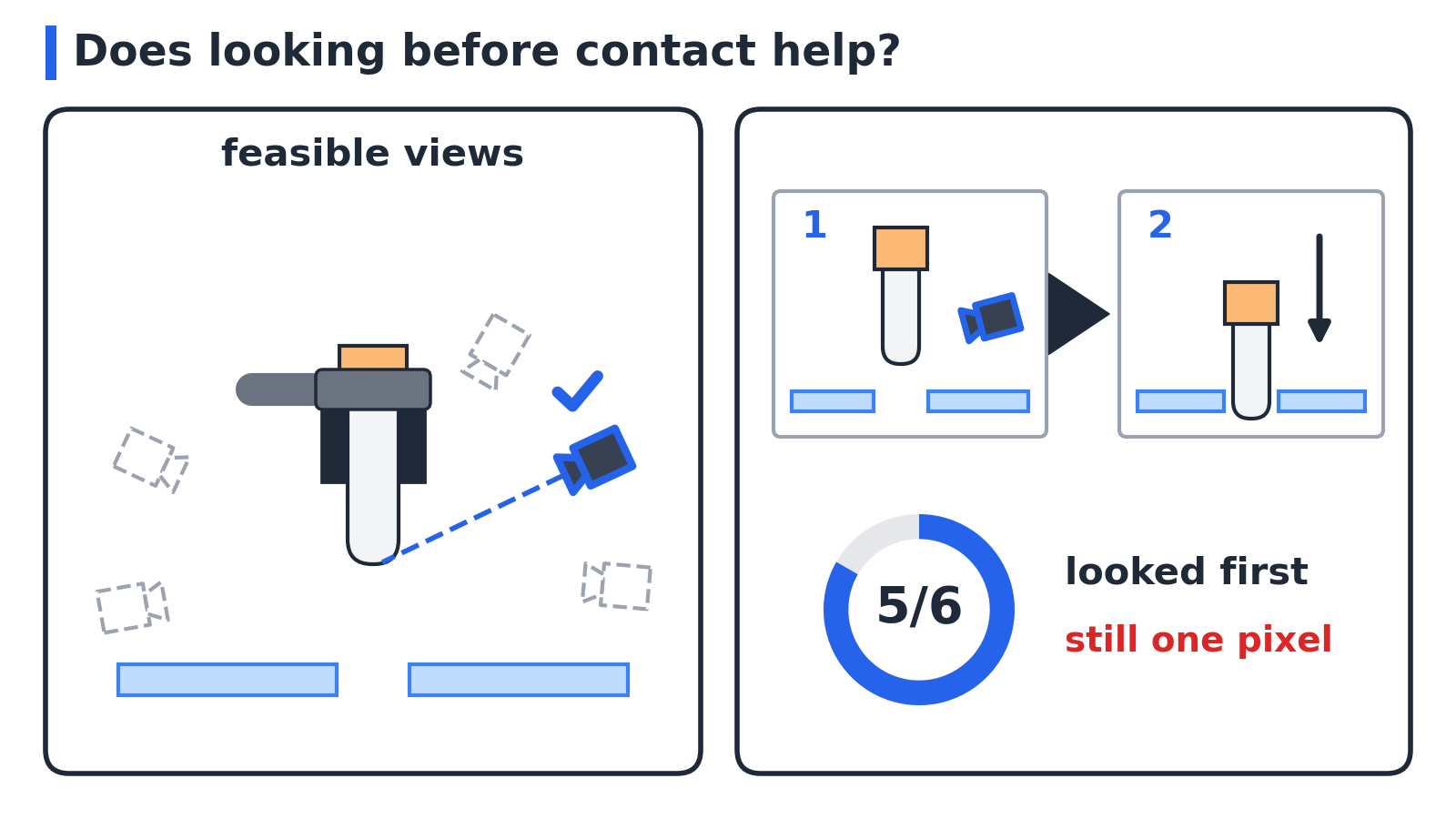
What we didThe tool proposes feasible viewpoints; or a rule: look once before contact.

Looked before inserting in 5/6 trials; still read one pixel; 2/6 succeeded

ConclusionSame measuring, same level. It looks (5/6) but still measures with single pixels.
2agent 能只用 RGB-D 自己建出这样的 focus 吗?精度追上了,成功率还没有。
2.5多看能补上吗?看能帮判断,量不准。
2.5.4

候选视角、接触前看一眼有用吗?

做了什么工具给出可行视角让它挑;或规定接触前看一眼。

插前照规则先看 5/6 局;仍读单个像素;成功 2/6

结论量法不变,水平不变。 它看了(5/6),量法还是单像素。
2Can the agent build that focus itself from RGB-D?Precision catches up; success not yet.
2.5Does looking more close the gap?Looking helps judgement, not measuring.
2.5.5

How many benchmark tasks need an extra view?

What we didScan all 192 benchmark tasks: which have hidden key parts, and which camera on each robot could see them.

free wrist camera 44 · side fixed camera 7 · turn a fixed camera 21 · own wrist along the tool 19 · no clear way 13

Conclusion104 of 192; most have a camera that can get it. 104 tasks need an extra view; for 91 of them a camera can get it.
2agent 能只用 RGB-D 自己建出这样的 focus 吗?精度追上了,成功率还没有。
2.5多看能补上吗?看能帮判断,量不准。
2.5.5

基准里多少题需要额外视角?

做了什么扫 192 道基准题:哪些有看不见的关键部位,每种机器人哪个相机能看到。

空闲腕相机 44 · 侧面固定相机 7 · 转固定相机 21 · 自己腕相机沿工具 19 · 无确定办法 13

结论192 题里 104 题;多数有相机能看到。 104 道需要额外视角,其中 91 道有相机能看到。
2Can the agent build that focus itself from RGB-D?Precision catches up; success not yet.
2.6Does geometric construction close the gap?Yes: precision matches simulator points.
2.6.1

Does it infer hidden parts on its own?
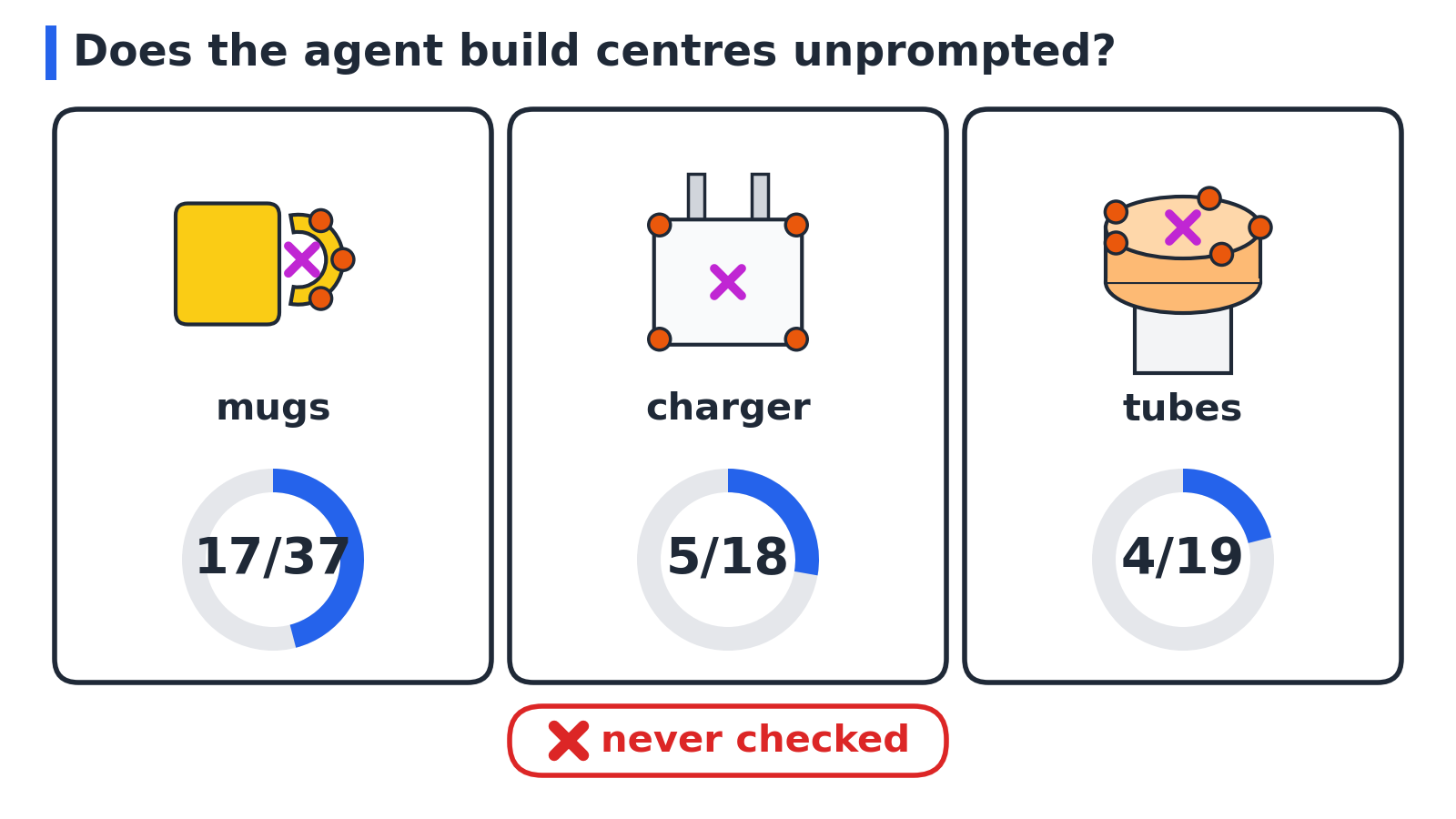
Why this questionLooking adds views but not measurement. The missing step is computing the part from several visible points: geometric construction.
What we didRead the code of all 74 agent-pointing trials: does it ever construct parts on its own?

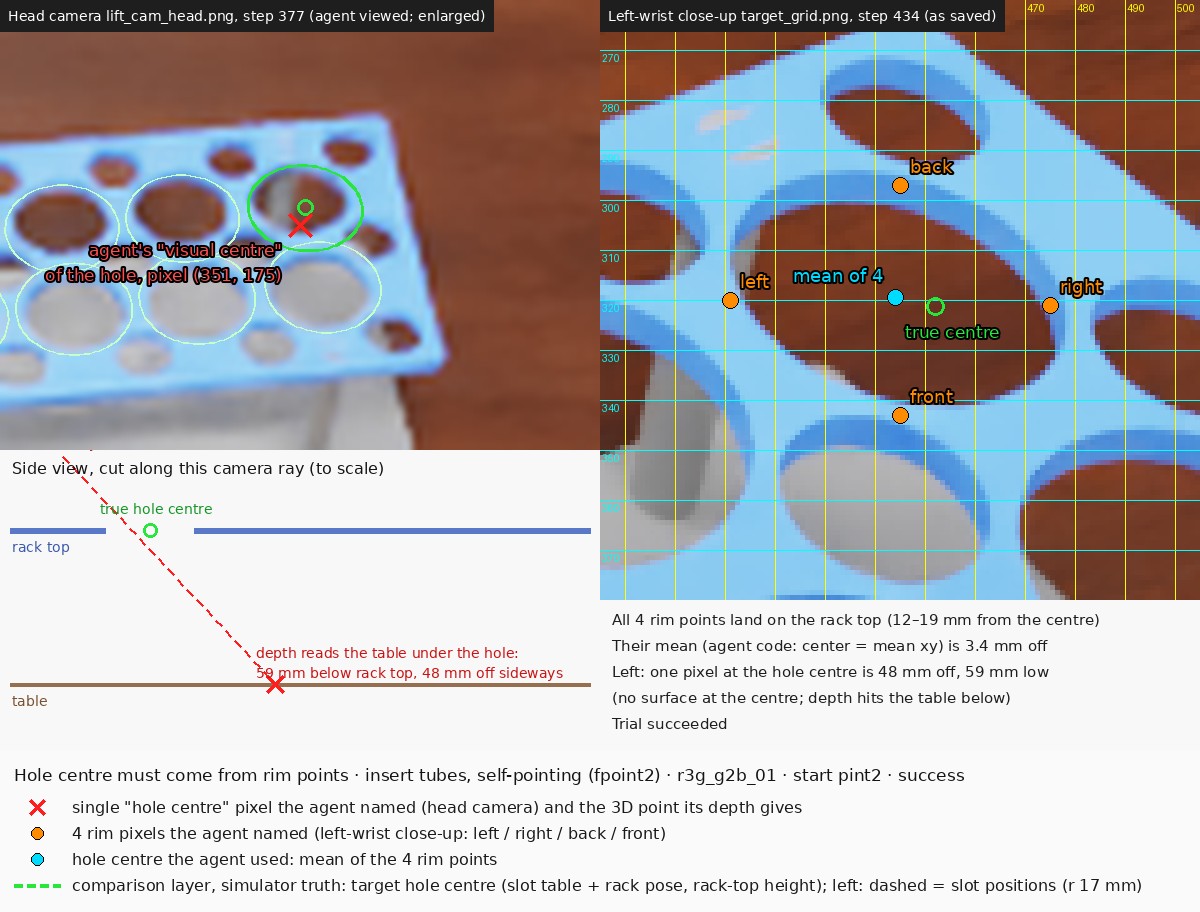
Centres from edge points: mugs 17/37, charger 5/18, tubes 4/19 trials; never checked

ConclusionYes, but never checks. Yes, often (mugs 17/37), but it never checks the result, so it ends as far off as one pixel.
2agent 能只用 RGB-D 自己建出这样的 focus 吗?精度追上了,成功率还没有。
2.6几何构造能补上吗?能:精度追平仿真给点。
2.6.1

它自己会推算看不见的部位吗?

为什么问这个多看只多了视角,没解决量。缺的是从几个看得见的点算出部位:几何构造。
做了什么读 74 局自己指点的代码:它会不会自己构造部位?

从边缘点算中心:杯子 17/37、充电器 5/18、试管 4/19 局;都没核对

结论会,但不核对。 会,而且不少(杯子 17/37),但从不核对,最后和单像素一样偏。
2Can the agent build that focus itself from RGB-D?Precision catches up; success not yet.
2.6Does geometric construction close the gap?Yes: precision matches simulator points.
2.6.2

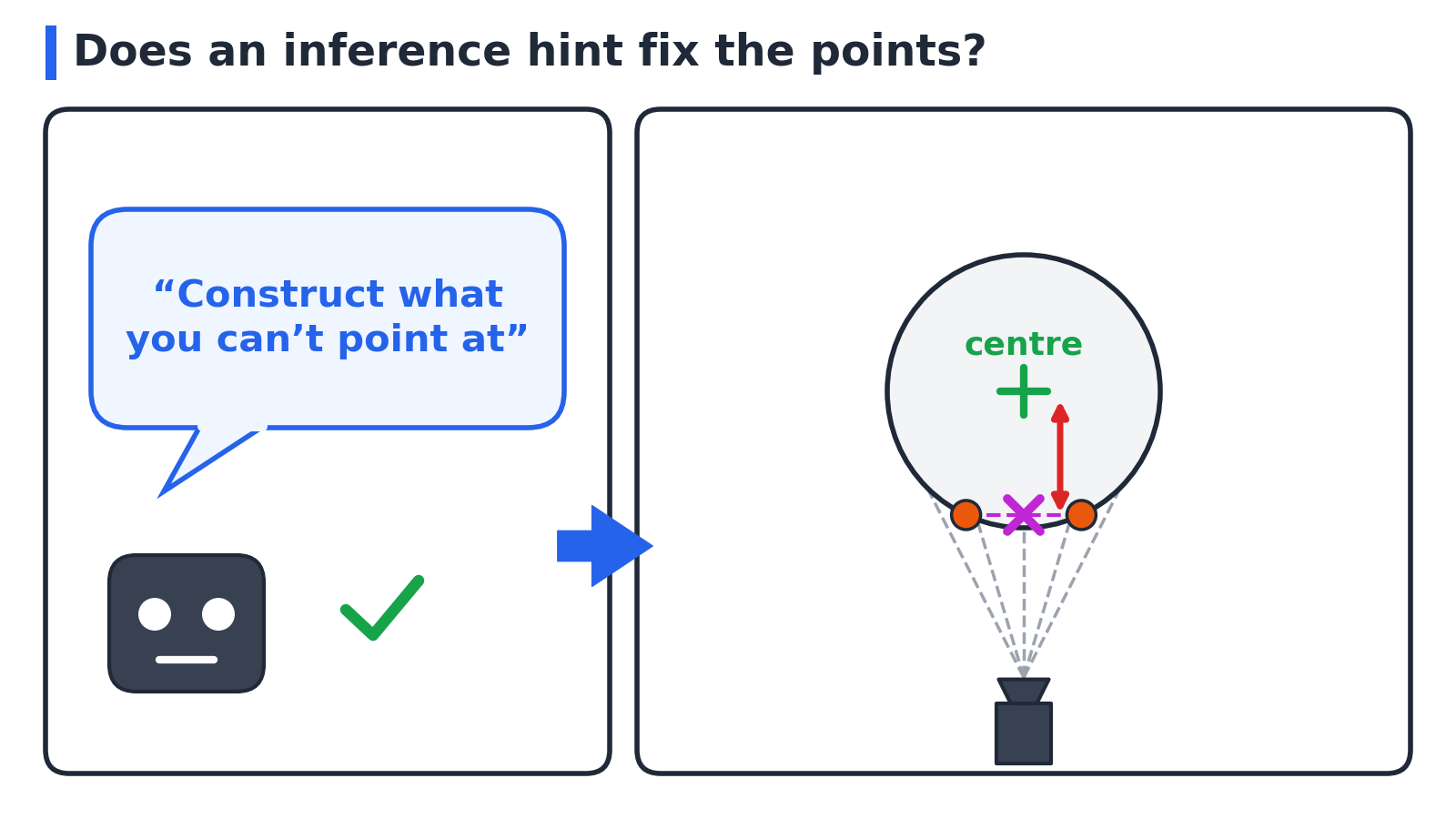
Does a hint to infer fix it?

What we didOne hint: construct the parts you cannot point at; do not use a single surface point.

Hint: construct parts you cannot point at; agent followed it, points stayed on the near surface

ConclusionStill single surface pixels. It follows the hint, but its points stay on the near surface.
2agent 能只用 RGB-D 自己建出这样的 focus 吗?精度追上了,成功率还没有。
2.6几何构造能补上吗?能:精度追平仿真给点。
2.6.2

给一句推算提示就行吗?

做了什么一句提示:指不到的部位要构造,不要用单个表面点。

提示:构造指不到的部位、不用单个表面点;agent 照做,点仍在朝相机的表面上

结论仍是单个表面像素。 它照做了,点仍在朝向面上。
2Can the agent build that focus itself from RGB-D?Precision catches up; success not yet.
2.6Does geometric construction close the gap?Yes: precision matches simulator points.
2.6.3

Does a ring rule give centres and axes?
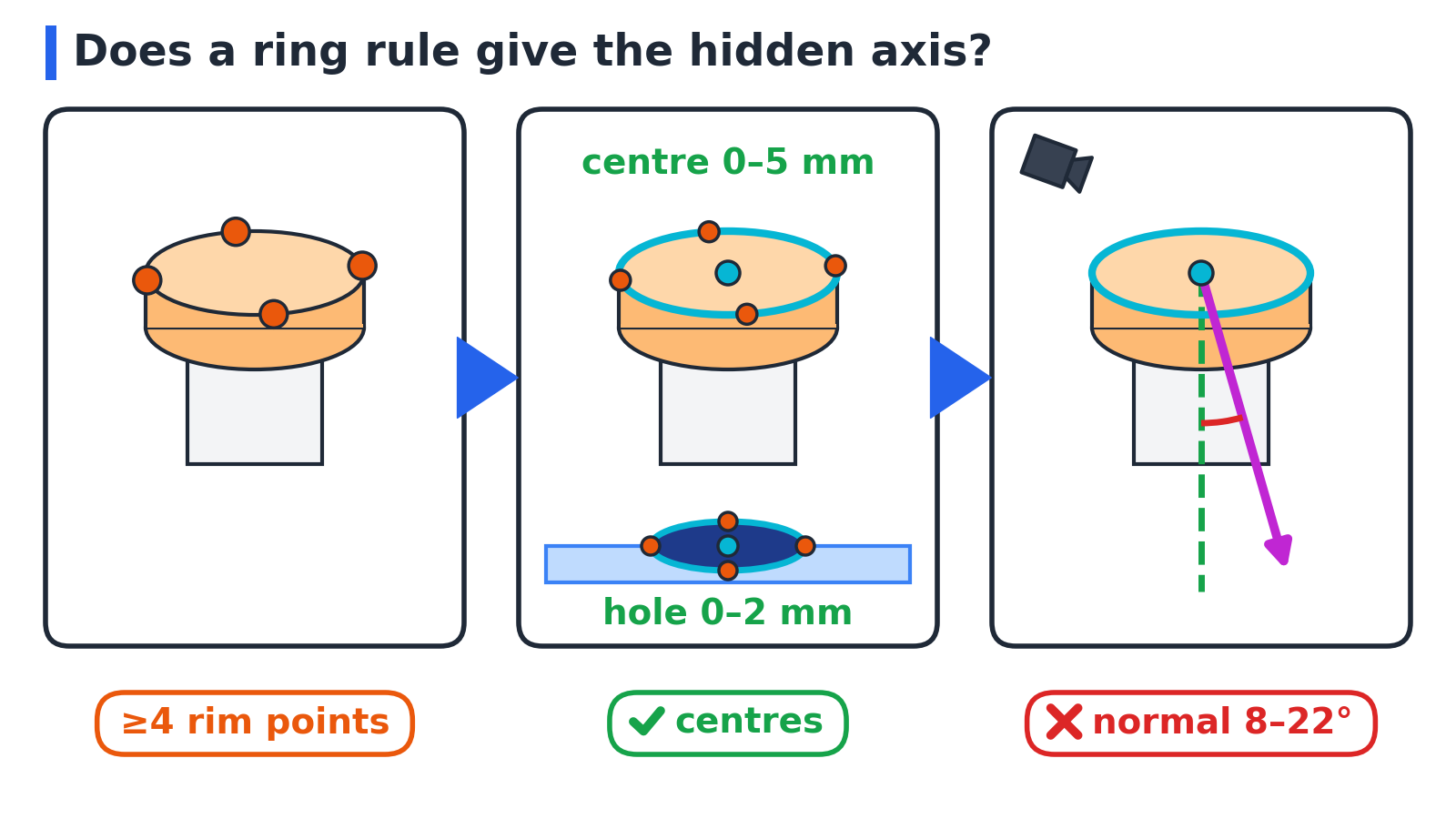
What we didA ring rule: fit a circle to at least 4 points on a fully visible rim; the hidden end lies on its axis.

Circle centres 0–5 mm from tube axis; hole centres 0–2 mm; normal 8–22° off when seen obliquely

ConclusionCentres 0–5 mm. Centres become accurate (0–5 mm), but the axis tilts 8–22° when the ring is seen obliquely.
2agent 能只用 RGB-D 自己建出这样的 focus 吗?精度追上了,成功率还没有。
2.6几何构造能补上吗?能:精度追平仿真给点。
2.6.3

圆环规则能给出中心和轴吗?

做了什么圆环规则:在整圈可见的边上取至少 4 点拟圆,看不见的一端在轴上。

圆心离管轴 0–5 mm;孔心 0–2 mm;斜看时法线偏 8–22°

结论圆心 0–5 mm。 圆心准了(0–5 mm),斜着看时轴偏 8–22°。
2Can the agent build that focus itself from RGB-D?Precision catches up; success not yet.
2.6Does geometric construction close the gap?Yes: precision matches simulator points.
2.6.4

Can it compose constructions we never taught?
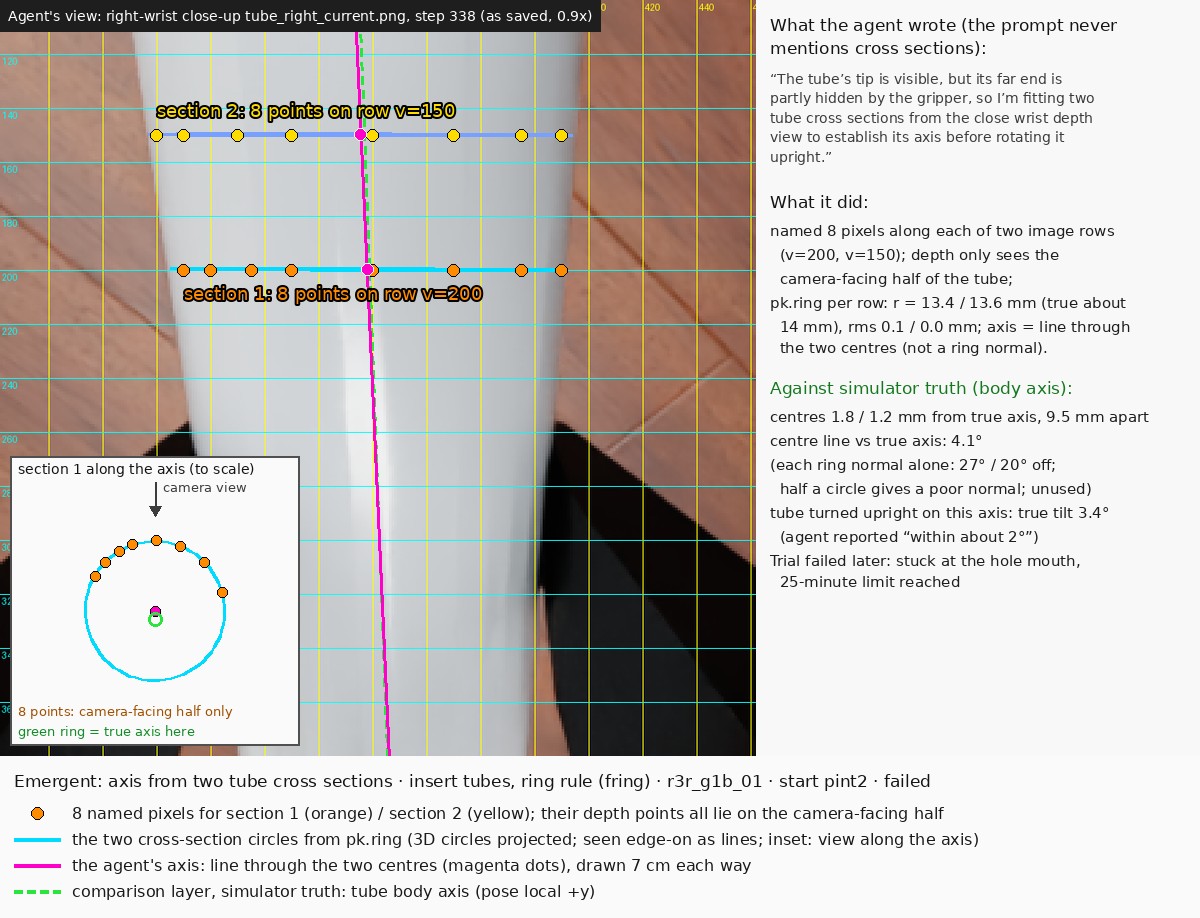
What we didUnder the ring rule, the far end of the held tube is hidden by the gripper.

axis 4.1° from the truth; tilt after straightening 3.4°

ConclusionYes: two cross sections give the hidden axis. It fits two tube-body cross sections and takes the line through their centres as the axis: a construction no rule mentioned.
Ring rule · insert tubes start 2: the agent fits two tube-body cross sections on its own open in a new tab ↗
Where to look FOCUS panel, round 6 (video 0:01.8–0:03.7): “fitted circle: held tube section near grip” (r 13 mm) and “… toward mouth” (r 14 mm) on the right-wrist view, plus the target-hole rim fit (r 17 mm). The rule only talks about circular parts; cross sections are never mentioned in the prompt.
What it shows Emergent construction: the rule only talks about round parts and never mentions cross sections; the agent fits two body cross sections to get the tube axis while the far end is hidden by the gripper.
2agent 能只用 RGB-D 自己建出这样的 focus 吗?精度追上了,成功率还没有。
2.6几何构造能补上吗?能:精度追平仿真给点。
2.6.4

它能想出我们没教的构造吗?

做了什么圆环规则下,手里试管的远端被夹爪挡住。

轴线差 4.1°;转正后倾斜 3.4°

结论能:用两个横截面定出看不见的轴。 它拟合两个管身横截面,用两圆心连线作轴:规则里从没提过的构造。
圆环规则 · 插试管开局 2:agent 自己拟合两个管身横截面 新标签页打开 ↗
看哪 第 6 轮 FOCUS 面板(视频 0:01.8–0:03.7):右腕视角上的“held tube section near grip”(r 13 mm)和“… toward mouth”(r 14 mm),以及目标孔边圆环(r 17 mm)。规则只讲圆形部位,提示里从没提到横截面。
分析什么 自发的构造:管子远端被夹爪挡住时,用两个管身横截面得到管轴。
2Can the agent build that focus itself from RGB-D?Precision catches up; success not yet.
2.6Does geometric construction close the gap?Yes: precision matches simulator points.
2.6.5

Does one sentence about noise make it robust?
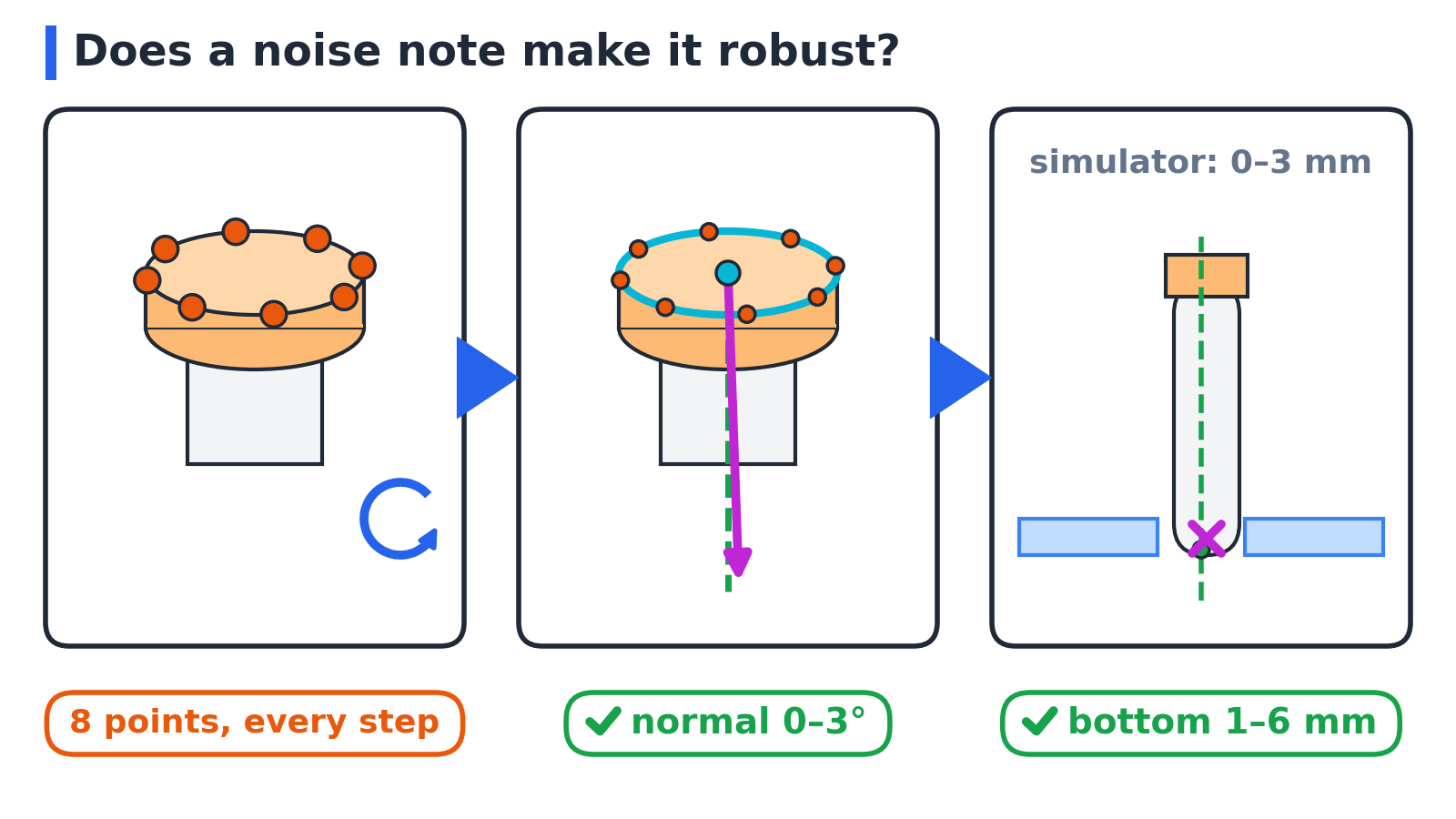
What we didAdd one sentence: measured points carry a few mm of noise; choose the construction most robust to it.

8 rim points refit every step; normal 0–3°; tube bottom 1–6 mm from hole centre (simulator points 0–3 mm)

ConclusionYes: bottom 1–6 mm, simulator level. It spreads 8 points around the whole rim and refits every step. In trials on the correct hole the bottom lands 1–6 mm from the centre, the level of simulator points (0–3 mm), against 8–19 mm in the blocked single-pixel trials. Success is held down by other errors, such as picking the small neighbouring hole.
Ring rule + “choose noise-robust constructions” · insert tubes start 2: bottom 1 mm from the hole centre open in a new tab ↗
Where to look FOCUS panel, rounds 10–13: “held tube cap top centre and axis” — a circle through 8 points around the cap top, refitted after every move; round 12 (video 0:11.3–0:11.5) is the insertion.
What it shows Truth: tube bottom 1 mm from the hole centre at insertion, 0° tilt, never pushed up in the hand (simulator-given points: 0–3 mm).
2agent 能只用 RGB-D 自己建出这样的 focus 吗?精度追上了,成功率还没有。
2.6几何构造能补上吗?能:精度追平仿真给点。
2.6.5

一句噪声提示能让它稳吗?

做了什么加一句:测量点有几毫米噪声,选对噪声最稳的构造。

整圈 8 点、每步重拟合;法线偏 0–3°;管底离孔心 1–6 mm(仿真给点 0–3 mm)

结论能:管底 1–6 mm,追平仿真。 改成整圈 8 点、每步重拟。对准正确孔的局里,管底离孔心 1–6 mm,和仿真给点(0–3 mm)同一水平;单像素插不进的局是 8–19 mm。成功率被认错旁边小孔等别的错误拉住。
圆环规则 + “选对噪声稳的构造” · 插试管开局 2:管底离孔心 1 mm 新标签页打开 ↗
看哪 第 10–13 轮 FOCUS 面板:“held tube cap top centre and axis”——管盖顶面一圈 8 个点拟圆,每次移动后重拟;第 12 轮(视频 0:11.3–0:11.5)是插入。
分析什么 真值:插入时管底离孔心 1 mm、倾斜 0°,没被顶回手里(仿真给点:0–3 mm)。
2Can the agent build that focus itself from RGB-D?Precision catches up; success not yet.
2.6Does geometric construction close the gap?Yes: precision matches simulator points.
2.6.6

Does a general note without shapes carry over?
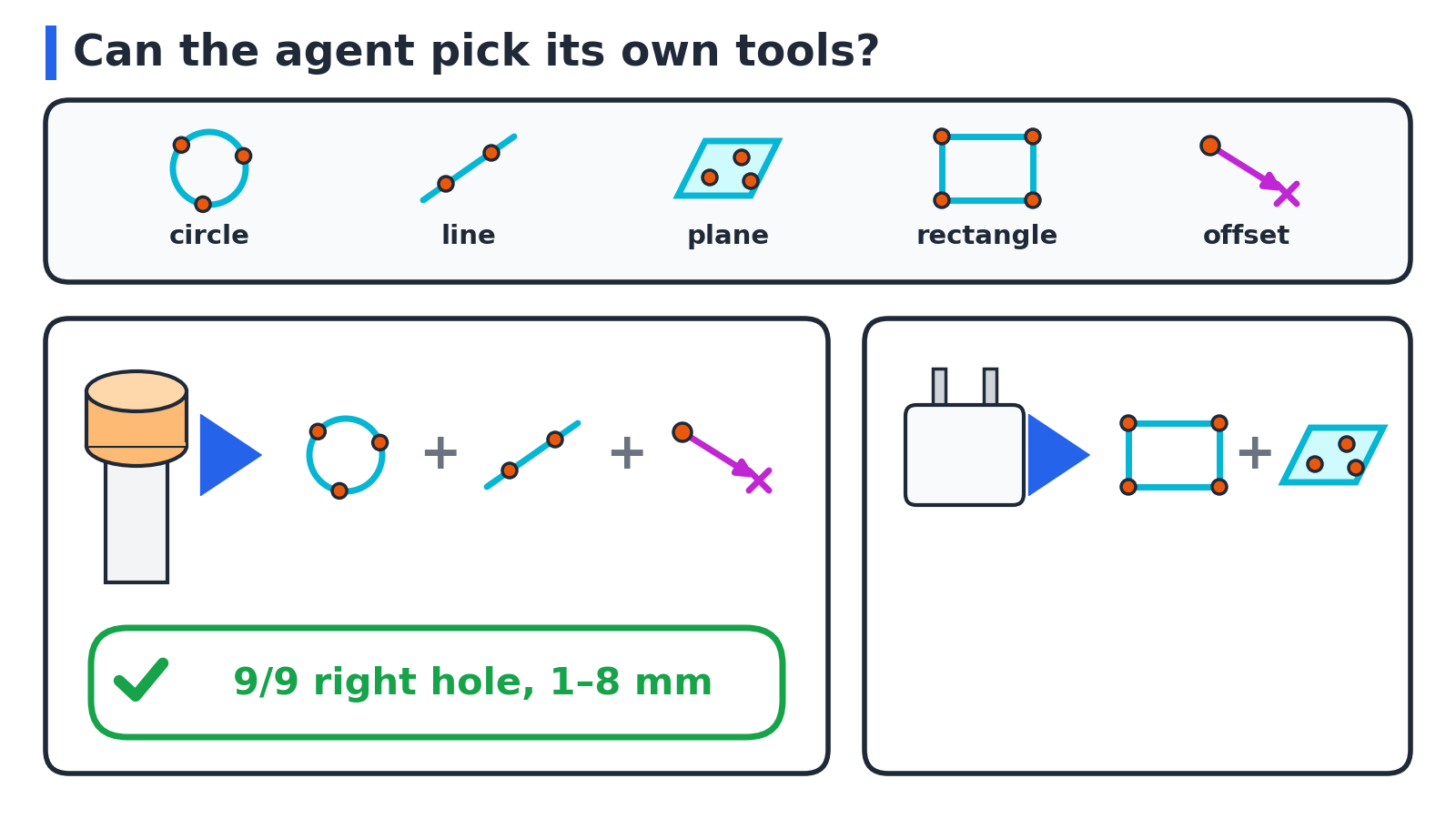
What we didReplace the rule by a general geometry note with no shape words, plus circle, line, plane, rectangle and offset tools.

Tubes: circle + line + offset; charger: rectangle + plane; tubes 9/9 on the correct hole, 1–8 mm

ConclusionYes: it picks constructions per part. It picks the construction per part on its own; all 9 tube trials go to the right hole, 1–8 mm.
General geometry note · insert tubes start 1: ring + line + offset (success) open in a new tab ↗
Where to look FOCUS panel: round 1 lines and offsets on the lying tube; round 7 target-hole ring (16 rim points) and an offset 49 mm below the rack top; round 9 (video 0:11.1–0:12.5) the cap-top ring, the shaft line and an offset 114 mm along the axis to the hidden bottom.
What it shows No shape words in the prompt; the agent picks circle + line + offset for the tube. Truth: at insertion the bottom was 1–2 mm from the hole centre, tilt 1–2°, never pushed up in the hand; success.
2agent 能只用 RGB-D 自己建出这样的 focus 吗?精度追上了,成功率还没有。
2.6几何构造能补上吗?能:精度追平仿真给点。
2.6.6

不提形状的通用说明也行吗?

做了什么把规则换成不含形状词的通用几何说明,加圆、直线、平面、矩形、偏移工具。

试管:圆+线+偏移;充电器:矩形+平面;试管 9/9 插对孔,1–8 mm

结论行:按部位自己选构造。 它按部位自己选构造;9 局试管全对准正确的孔,1–8 mm。
通用几何说明 · 插试管开局 1:圆 + 直线 + 偏移(成功) 新标签页打开 ↗
看哪 FOCUS 面板:第 1 轮在躺着的试管上拟直线和偏移;第 7 轮目标孔圆环(16 个边缘点)和架顶下 49 mm 的偏移;第 9 轮(视频 0:11.1–0:12.5)管帽顶圆环、管身直线、沿轴 114 mm 偏移到看不见的管底。
分析什么 提示里没有任何形状词,agent 自己为试管选了圆 + 直线 + 偏移。真值:插入时管底离孔心 1–2 mm、倾斜 1–2°,没被顶回手里;成功。
2Can the agent build that focus itself from RGB-D?Precision catches up; success not yet.
2.6Does geometric construction close the gap?Yes: precision matches simulator points.
2.6.7

Can it construct grasp points too?

What we didAdd one paragraph: grasp points are constructed too.

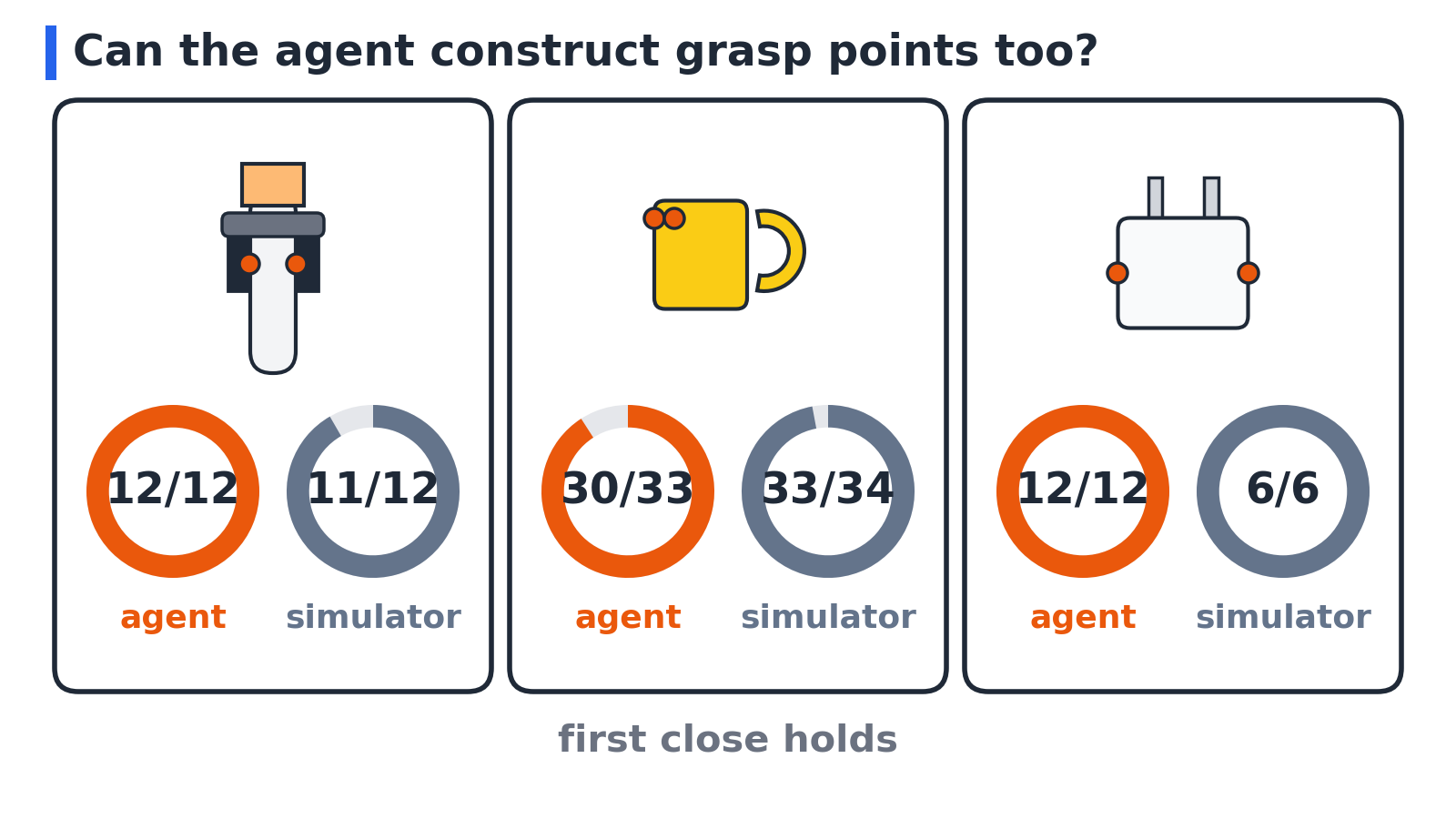
First close holds: agent 12/12, 30/33, 12/12 vs simulator 11/12, 33/34, 6/6 (tubes, mugs, charger)

ConclusionYes: on par with simulator points. First grasps hold as often as with simulator points.
2agent 能只用 RGB-D 自己建出这样的 focus 吗?精度追上了,成功率还没有。
2.6几何构造能补上吗?能:精度追平仿真给点。
2.6.7

抓取点也能自己构造吗?

做了什么加一段:抓取点也要构造。

第一次合爪抓住:自己构造 12/12、30/33、12/12;仿真给点 11/12、33/34、6/6(试管、杯子、充电器)

结论能:和仿真给点持平。 首次抓取成功率和仿真给点持平。
2Can the agent build that focus itself from RGB-D?Precision catches up; success not yet.
2.7With precision matched, what fails next?Placement: target, orientation, hand-over.
2.7.1

Where do the remaining failures break?
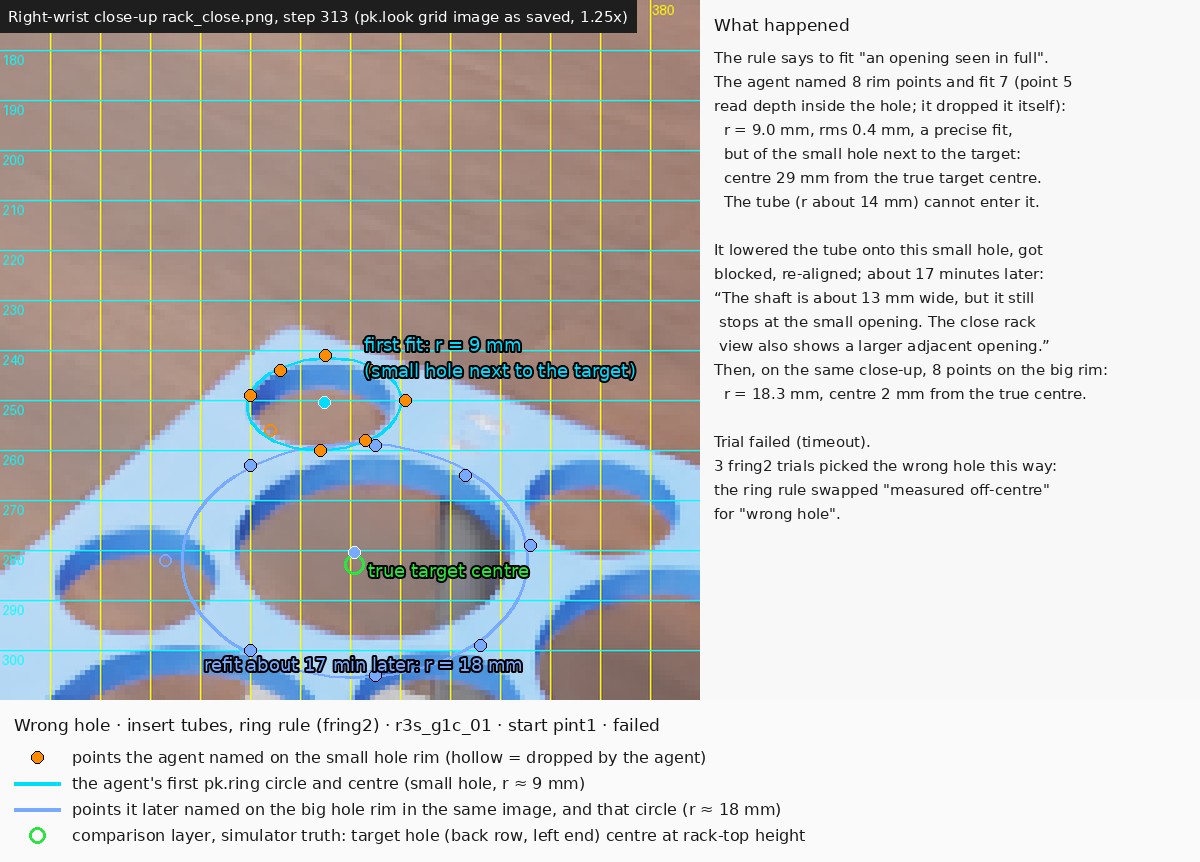
Why this questionPrecision now matches simulator points, but success still trails. Where do the remaining failures break?
What we didEvery subgoal start or retry is logged with its done-conditions; 182 trials compared with truth.

118 of 137 failures at placement

Conclusion86% at placement. 86% break at placement: wrong target (a fully visible small hole next to the target), mug orientation, drops at hand-over, jamming.
2agent 能只用 RGB-D 自己建出这样的 focus 吗?精度追上了,成功率还没有。
2.7精度追平后,接着败在哪?放到位:认错目标、朝向、交接。
2.7.1

剩下的失败断在哪一步?

为什么问这个精度追平了,成功率还落后。剩下的失败断在哪?
做了什么每个子目标开始或重试都记下完成条件;182 局对真值。

137 局失败里 118 局在放到位

结论86% 在放到位。 86% 断在放到位:认错目标(旁边整圈可见的小孔)、杯子朝向、交接掉落、插入卡住。
2Can the agent build that focus itself from RGB-D?Precision catches up; success not yet.
2.7With precision matched, what fails next?Placement: target, orientation, hand-over.
2.7.2

Does the agent know when a step failed?

What we didCompare each subgoal the agent claims as done or failed with truth.

626 subgoal declarations · claimed done but not: 42 · claimed failed but done: 34

ConclusionMostly: 83% agrees with truth. 83% agree; most misses are placements claimed as done.
2agent 能只用 RGB-D 自己建出这样的 focus 吗?精度追上了,成功率还没有。
2.7精度追平后,接着败在哪?放到位:认错目标、朝向、交接。
2.7.2

agent 知道自己哪步没做成吗?

做了什么把 agent 自称做成或没做成的子目标和真值比。

626 条子目标 · 说成了没成 42 · 说没成其实成了 34

结论多数知道:83% 和真值一致。 83% 一致;错的多是放置自称做成了。
3Can focus help the robot navigate?A whole-body check warns of collisions in advance.
3.1

Does a waypoint map help?

Why this questionNavigation segments of 5 BEHAVIOR household tasks: drive to the first target and stop within 1 m facing it; touching anything is a failure; 3 runs per task per condition.
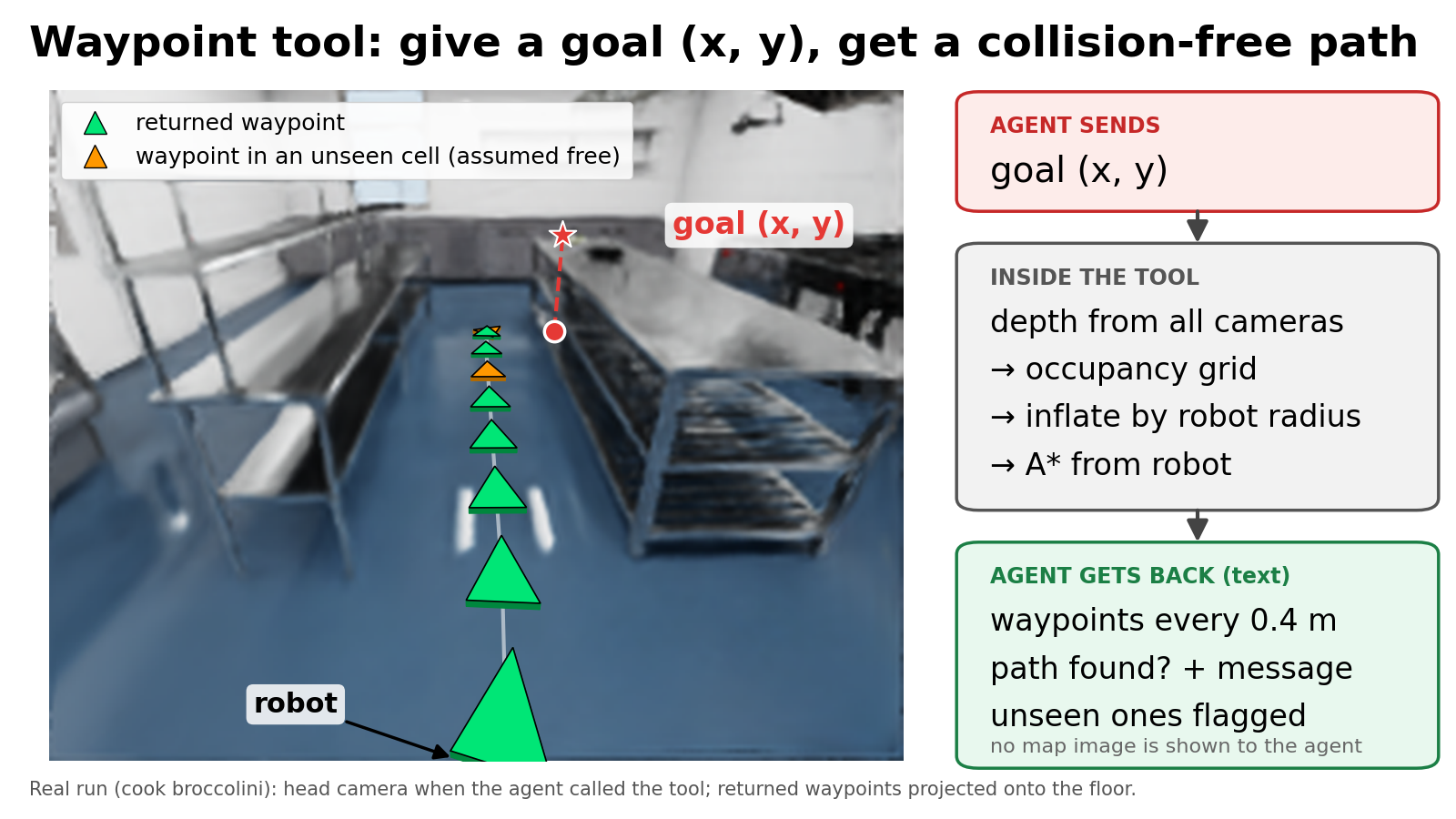
What we didWaypoint tool. Input: a goal (x, y). Inside: a top-down occupancy grid from the current depth of all cameras, obstacles inflated by the base radius, A* from the robot. Returns: waypoints every 0.4 m. A third condition adds 3D boxes of named objects.

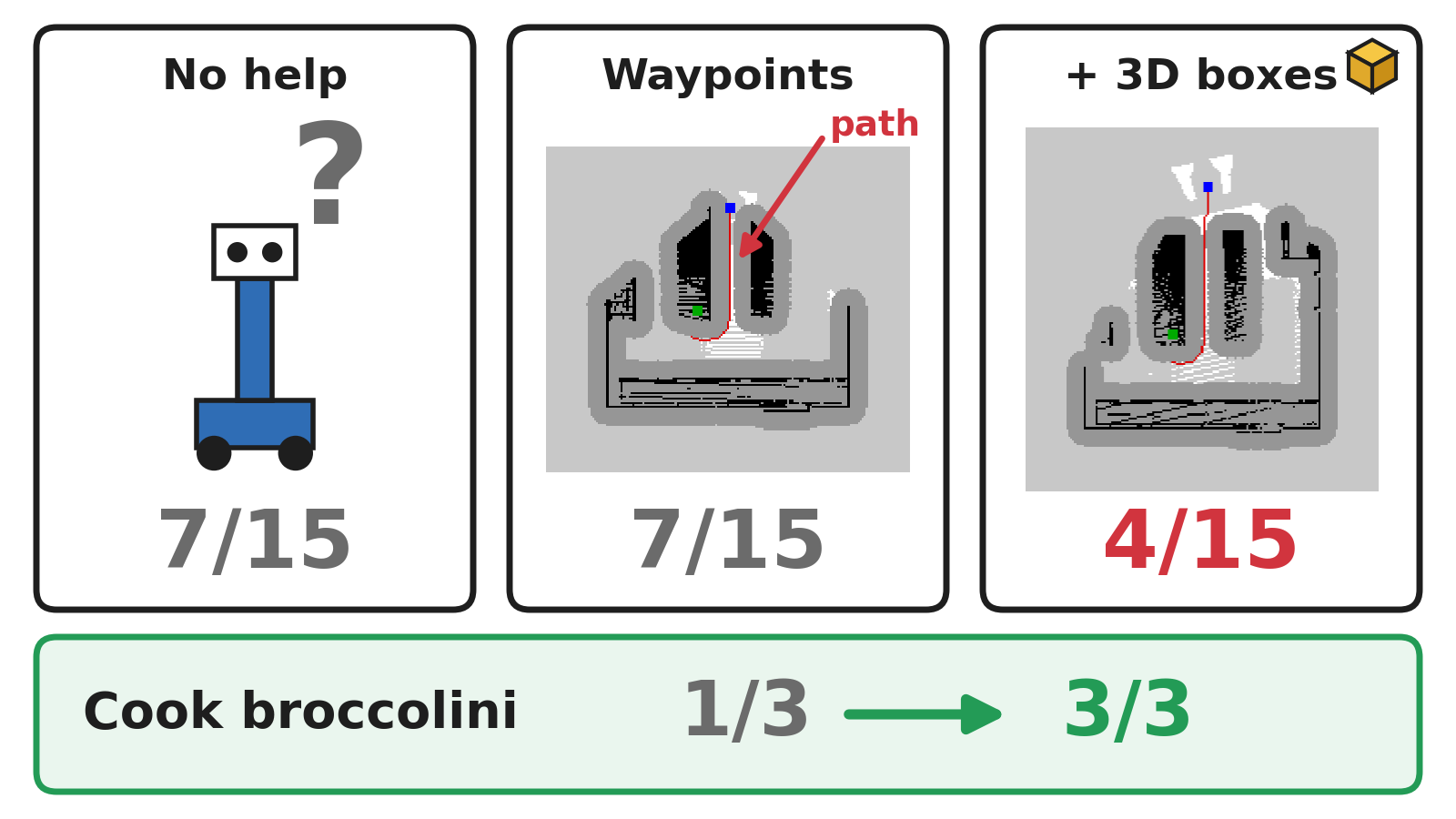
no help 7/15 · waypoints 7/15 · waypoints + object boxes 4/15

ConclusionSame success; fixes one task. Success is unchanged (7/15); cook broccolini goes 1/3 → 3/3. Almost all failures are collisions with furniture that waypoints do not prevent: the map has no memory, unseen cells count as free, and the arm sticks out behind the base.
3focus 能帮机器人导航吗?整身碰撞预检能提前报出碰撞。
3.1

给 waypoint 地图有用吗?

为什么问这个BEHAVIOR 5 个家务任务的导航段:开到第一个目标 1 米内并朝向它;碰到任何东西即失败;每个任务每组 3 局。
做了什么waypoint 工具。输入:目标 (x, y)。内部:用所有相机当前深度建俯视占用格,障碍按底盘半径外扩,从机器人位置 A* 搜路。返回:每 0.4 米一个路点。第三组再加物体 3D 框。

不帮 7/15 · waypoint 7/15 · waypoint + 物体框 4/15

结论成功率持平;一个任务全成。 成功率持平(7/15),煮西兰花苗 1/3 → 3/3。失败几乎都是碰家具,路点拦不住:地图不记忆、看不见当空地、手臂伸到底盘后面。
3Can focus help the robot navigate?A whole-body check warns of collisions in advance.
3.2Why does the robot collide, and can it be prevented?Wrong body extent; a whole-body check catches it.
3.2.1

What causes the collisions?

Why this questionAlmost every navigation failure is a collision with furniture. Why exactly, and can it be stopped?
What we didEach of the 26 collisions in 45 runs traced to the link that hit and whether the object had been seen.

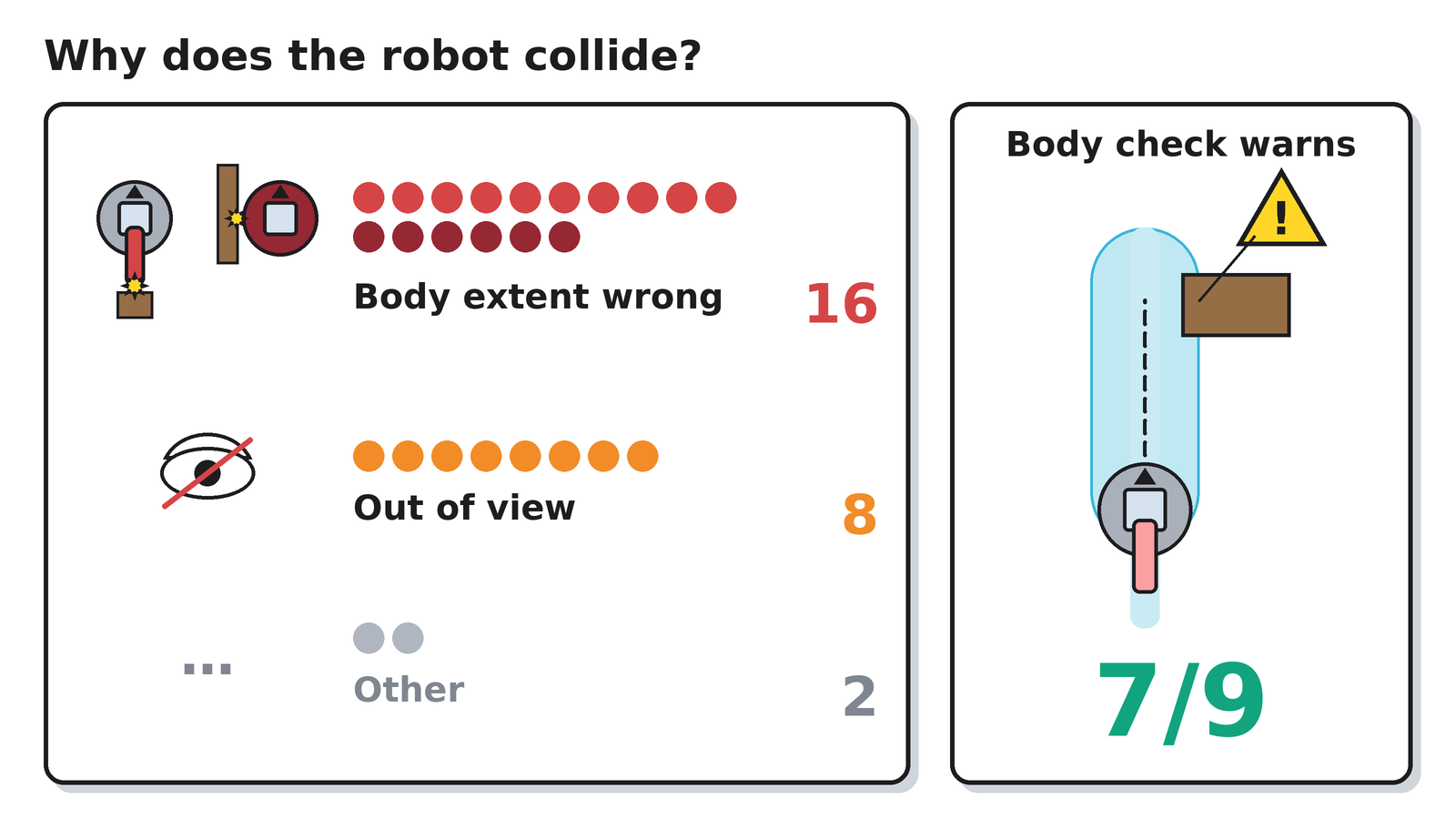
26 collisions: body extent wrong 16 · out of view while moving 8 · never seen 1 · tip-over 1

ConclusionMostly a wrong body extent. 16 were seen but the body extent was misjudged: 10 times the torso tipped back above 0.4 m/s and the arm swung behind the base, out of every camera (the agent even sent the tipped reading back as its target); 6 times the base came too close. 8 were out of view while moving: the map has no memory and treats unseen cells as free.
3focus 能帮机器人导航吗?整身碰撞预检能提前报出碰撞。
3.2机器人为什么会撞,能不能避免?身体范围算错;整身预检能拦住。
3.2.1

碰撞是什么引起的?

为什么问这个导航失败几乎都是碰家具。到底为什么撞,能不能拦住?
做了什么45 局里 26 次碰撞逐次查:哪个部位撞的、之前看没看见。

26 次:身体范围算错 16 · 移动时不在画面 8 · 从没看见 1 · 翻车 1

结论主要是身体范围算错。 16 次看见了但身体范围算错:10 次是超过 0.4 m/s 时躯干后仰、手臂甩到底盘后面,所有相机都看不到(agent 还把后仰的读数当目标发回去);6 次是底盘离太近。8 次是移动时不在画面里:地图不记忆,看不见的格子当空地。
3Can focus help the robot navigate?A whole-body check warns of collisions in advance.
3.2Why does the robot collide, and can it be prevented?Wrong body extent; a whole-body check catches it.
3.2.2

Why does the torso tip back, and can a speed limit stop it?
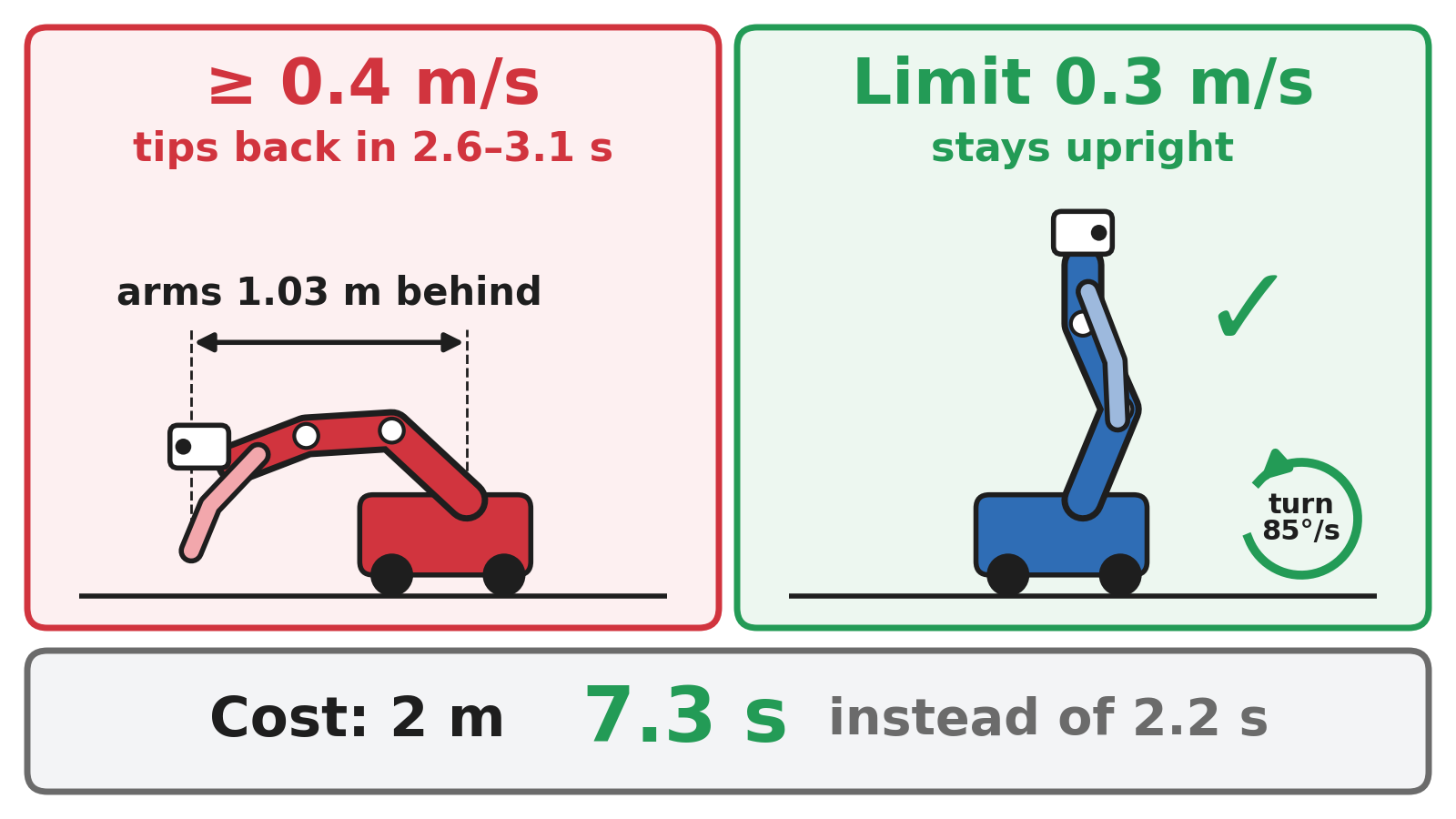
What we didDrive 2 m at different speeds and measure the torso.

≥ 0.4 m/s: drops to the limit in 2.6–3.1 s · 0.3 m/s: stays upright · turning up to 85°/s: no effect

ConclusionYes: ≤ 0.3 m/s keeps it upright. Above 0.4 m/s the torso tips back and the arms swing 1 m behind; a 0.3 m/s limit keeps it upright.
3focus 能帮机器人导航吗?整身碰撞预检能提前报出碰撞。
3.2机器人为什么会撞,能不能避免?身体范围算错;整身预检能拦住。
3.2.2

躯干为什么后仰,限速能止住吗?

做了什么以不同速度直行 2 米,量躯干。

≥ 0.4 m/s:2.6–3.1 秒倒到底 · 0.3 m/s:不倒 · 原地转 85°/s 内:不影响

结论能:≤ 0.3 m/s 不倒。 超过 0.4 m/s 躯干后仰、手臂甩到身后 1 米;限速 0.3 m/s 不倒。
3Can focus help the robot navigate?A whole-body check warns of collisions in advance.
3.2Why does the robot collide, and can it be prevented?Wrong body extent; a whole-body check catches it.
3.2.3

Can it check its whole body before moving?
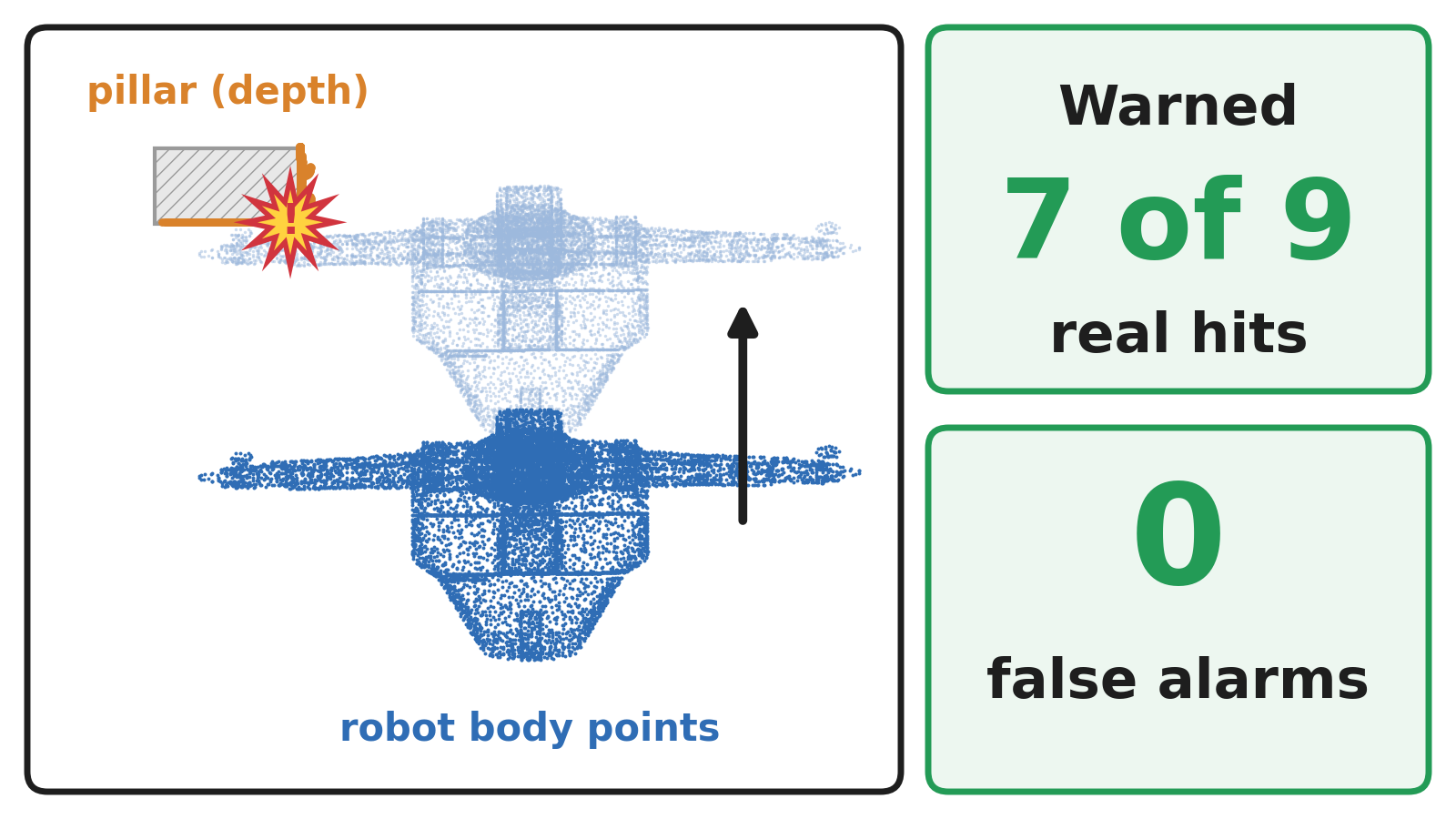
What we didA whole-body model from the robot's collision shapes, swept along the waypoints against the depth point cloud; 20 scenes.

20 scenes · 9 real collisions · 7 warned · 0 false alarms

ConclusionYes: 7 of 9 warned, no false alarm. Warns before 7 of 9 real collisions with no false alarm: body-extent errors can be caught before moving.
3focus 能帮机器人导航吗?整身碰撞预检能提前报出碰撞。
3.2机器人为什么会撞,能不能避免?身体范围算错;整身预检能拦住。
3.2.3

移动前能检查整个身体会不会撞吗?

做了什么用机器人碰撞形状建整身模型,沿路点扫过深度点云;20 个场景。

20 个场景 · 真撞 9 次 · 报出 7 次 · 误报 0

结论能:9 次报出 7 次,无误报。 9 次真撞报出 7 次,无误报:身体范围的错可以在动之前拦住。
4Does it transfer to tasks we never tuned on?Where focus acts, the skill uses it and does better.
4.1

Do the tools run on other robots?

Why this questionDoes the method carry over to tasks and robots we never tuned on? First, do the tools run on other robots?
What we didPort the grasp and place solvers to the robots of five benchmarks.

BEHAVIOR · RoboARC · VLABench · RoboWits · ManiGuard: scripted grasp and place, confirmed by truth

ConclusionYes: five environments. Scripted grasp and place succeed on all five, confirmed by truth.
4换到没调过的新任务上还有用吗?focus 起作用的那一步,skill 组用上了、做得更好。
4.1

工具能用到别的机器人上吗?

为什么问这个方法能不能用到没调过的任务和机器人?先看工具能不能装到别的机器人上。
做了什么把抓取、放置求解器移植到五个基准的机器人上。

BEHAVIOR · RoboARC · VLABench · RoboWits · ManiGuard:脚本抓起、放回,真值确认

结论能:五个环境。 五个环境都能脚本抓起、放回,真值确认。
4Does it transfer to tasks we never tuned on?Where focus acts, the skill uses it and does better.
4.2Where focus acts, how does the skill use it?Measures and constructs, then places more accurately.
4.2.1

Mahjong kong: how is the extra tile placed?
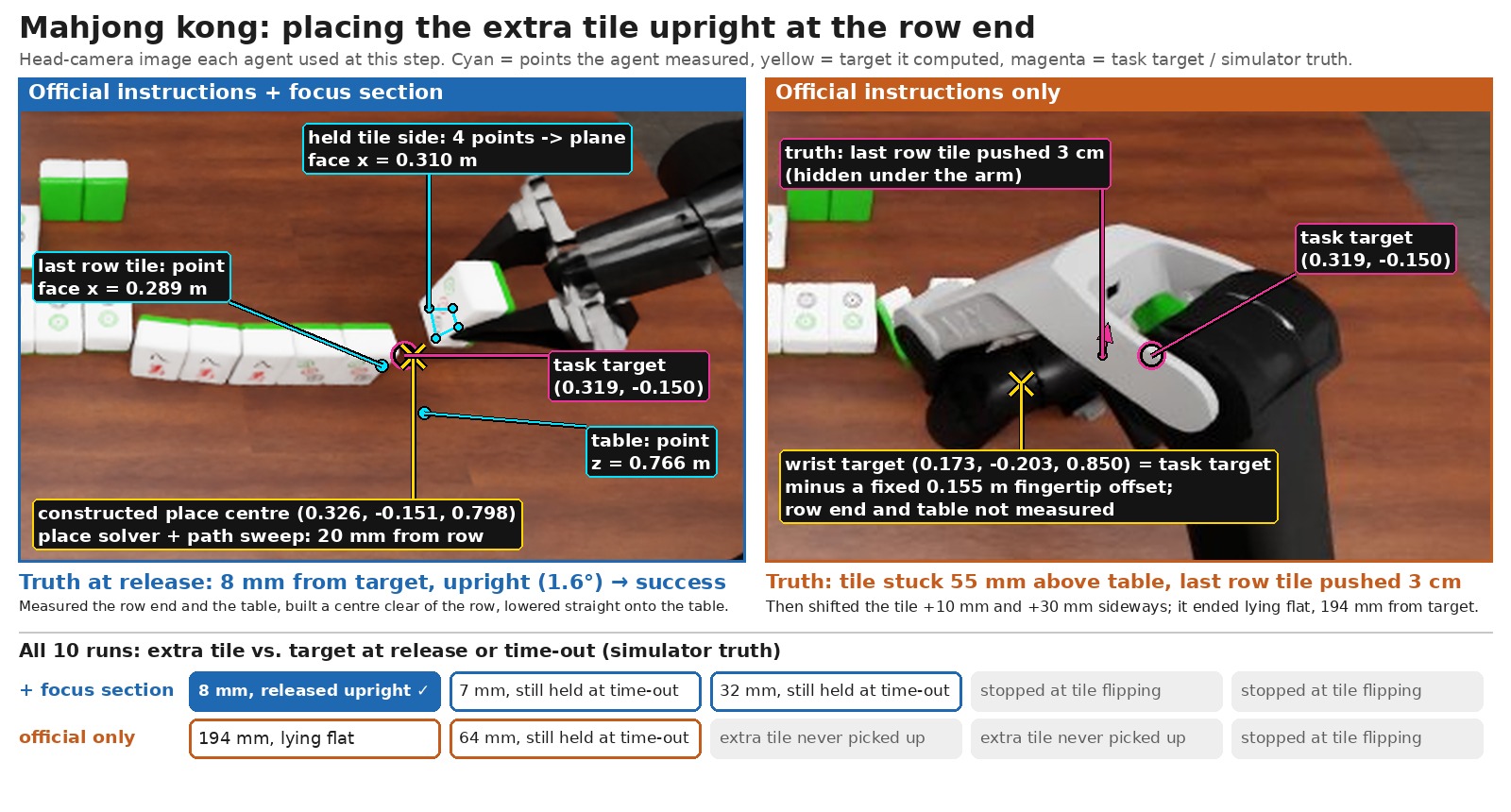
Why this questionOn new tasks, at the step where focus should matter: does the skill change what the agent does?
What we didMahjong kong: stand the extra tile upright at the end of the row; 5 runs per condition.
ConclusionMeasures the row end and table: tile stands 8 mm from target. It measured the row end and the table and built a centre 20 mm clear of the row: the only completed kong. Without the skill it aimed with a fixed offset and pushed the row.
Details
  • At the row end, the focus-section agent measured four points on the side of the tile it was holding and fitted a plane (face at x 0.310 m), one point on the last tile of the row (face at x 0.289 m) and one on the table (z 0.766 m); it set the placement centre at (0.326, -0.151, 0.798) m, and the placement solver, run against depth points of the row, confirmed 20 mm clearance, with a path sweep giving 22 mm.
  • It carried the tile to that centre, lowered it to the measured table height and released: in the simulator the tile stood 8 mm from the target, 1.6° from upright, with the row untouched, and the run succeeded; a second focus run was holding the tile upright 7 mm from the target when time ran out.
  • At the same step the official-only agent set its wrist pose by subtracting a fixed 0.155 m fingertip offset from the task target, without measuring the row end or the table; its arm covered the row end in the head camera, the move pushed the last row tile 3 cm and left the tile stuck 55 mm above the table, and after two sideways shifts (+10 mm, +30 mm) the tile ended lying flat 194 mm away.
4换到没调过的新任务上还有用吗?focus 起作用的那一步,skill 组用上了、做得更好。
4.2focus 起作用的那一步,skill 组怎么用的?先量、再构造,放得更准。
4.2.1

杠牌:多出的那张牌怎么放?

为什么问这个在新任务上 focus 该起作用的那一步,skill 改变了 agent 的做法吗?
做了什么杠牌:把多出的牌立到行尾;每组 5 局。
结论先量行尾和桌面:牌立在离目标 8 mm 处。 它量了行尾和桌面,构造出离这一排 20 mm 的放置中心:唯一一次完成杠牌。不带 skill 按固定偏移伸手,把行尾的牌推开。
细节
  • 到行尾这一步,加 focus 段的 agent 在手里那张牌的侧面量了 4 个点并拟合成平面(侧面在 x 0.310 m),在这一排最后一张牌上量了 1 个点(侧面在 x 0.289 m),在桌面上量了 1 个点(z 0.766 m);它把放置中心定在 (0.326, -0.151, 0.798) m,放置求解器用这一排的深度点核对出离牌 20 mm,路径扫掠核对出 22 mm。
  • 它把牌搬到这个中心,按量到的桌面高度放下再松手:仿真里这张牌离目标 8 mm、偏离竖直 1.6°,这一排没被碰到,这一局成功;另一局加 focus 段的在时间用完时正把牌竖着拿在离目标 7 mm 处。
  • 同一步,只给官方说明的 agent 用任务目标减去一个固定的 0.155 m 指尖偏移来定手腕位置,没有量行尾和桌面;头部相机里行尾被它自己的手臂挡住,这一下把这一排最后一张牌推开了 3 cm,手里的牌卡在桌面上方 55 mm 放不下去,之后又往旁边挪了两次(+10 mm、+30 mm),牌最后平躺在离目标 194 mm 处。
4Does it transfer to tasks we never tuned on?Where focus acts, the skill uses it and does better.
4.2Where focus acts, how does the skill use it?Measures and constructs, then places more accurately.
4.2.2

Texas hold'em: how are cards placed on the mat?
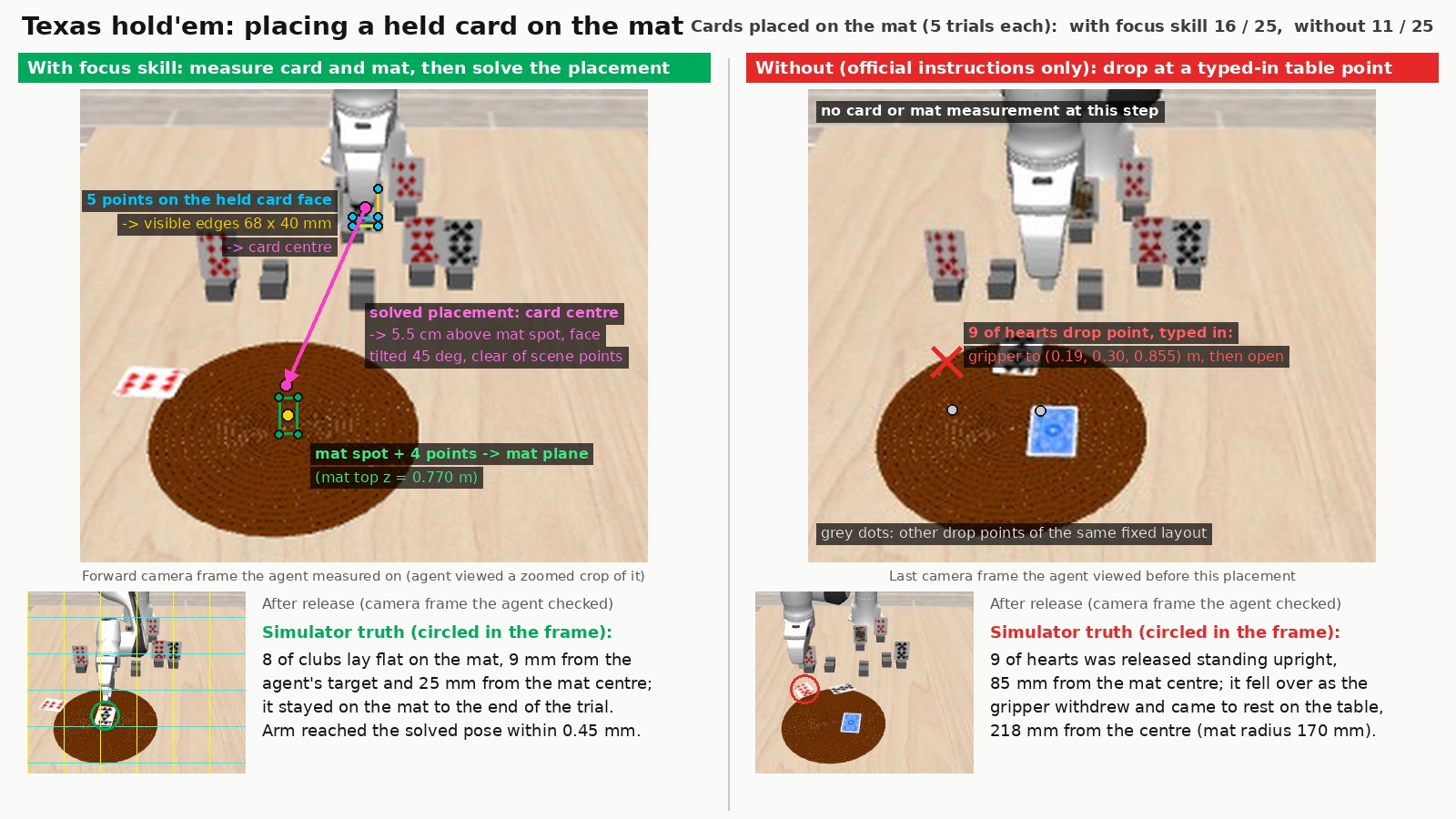
What we didTexas hold'em: place the cards on the mat; 5 runs per condition.
ConclusionMeasures card and mat first: 16 vs 11 cards on the mat. It measured the card and the mat before each release and solved the pose: 16 vs 11 cards on the mat. Without the skill it released at typed-in table coordinates.
Details
  • With the skill, before releasing a card the agent measured the held card face (5 depth points, giving its visible edges and centre) and a spot on the mat (5 points, giving the mat plane), then solved the card pose: centre 5.5 cm above the spot, face tilted 45 degrees, clear of nearby scene points; 4 of the 5 skill trials placed cards this way.
  • The skill trials got 16 of 25 required cards onto the mat (3.2 per trial) against 11 of 25 (2.2 per trial) without the skill; in the example the 8 of clubs came to rest flat, 9 mm from the agent's target, and stayed on the mat to the end.
  • Without the skill, the agent did not measure the card or the mat at this step: it moved the gripper to table coordinates it had typed in (a fixed layout of drop points) and opened it; the 9 of hearts, released upright near the rim, fell over and came to rest on the table 218 mm from the mat centre (mat radius 170 mm).
4换到没调过的新任务上还有用吗?focus 起作用的那一步,skill 组用上了、做得更好。
4.2focus 起作用的那一步,skill 组怎么用的?先量、再构造,放得更准。
4.2.2

德州扑克:牌怎么放到垫子上?

做了什么德州扑克:把牌放到垫子上;每组 5 局。
结论先量牌和垫子:放上 16 张对 11 张。 每次松手前先量牌和垫子、求出位姿:放上 16 张对 11 张。不带 skill 按手写坐标松手。
细节
  • 带技能时,agent 松手前先量手里的牌面(5 个深度点,得出可见边和牌中心)和垫子上的一个落点(5 个点,得出垫子平面),再求牌的位姿:牌中心在落点上方 5.5 厘米、牌面倾斜 45 度、避开周围场景点;5 局里有 4 局用这种方式放牌。
  • 带技能组共把 16 张牌放上垫子(共需 25 张,每局 3.2 张),不带技能组为 11 张(每局 2.2 张);图中例子里梅花 8 平躺停下,离 agent 算出的目标 9 毫米,一直留在垫子上到结束。
  • 不带技能时,agent 在这一步不量牌也不量垫子:把夹爪移到自己手写的桌面坐标(一组固定的落点)后直接张开;红桃 9 竖着在垫子边缘附近被松开,倒下后停在桌面上,离垫子中心 218 毫米(垫子半径 170 毫米)。
4Does it transfer to tasks we never tuned on?Where focus acts, the skill uses it and does better.
4.2Where focus acts, how does the skill use it?Measures and constructs, then places more accurately.
4.2.3

Cover with lid: how is the lid centred?
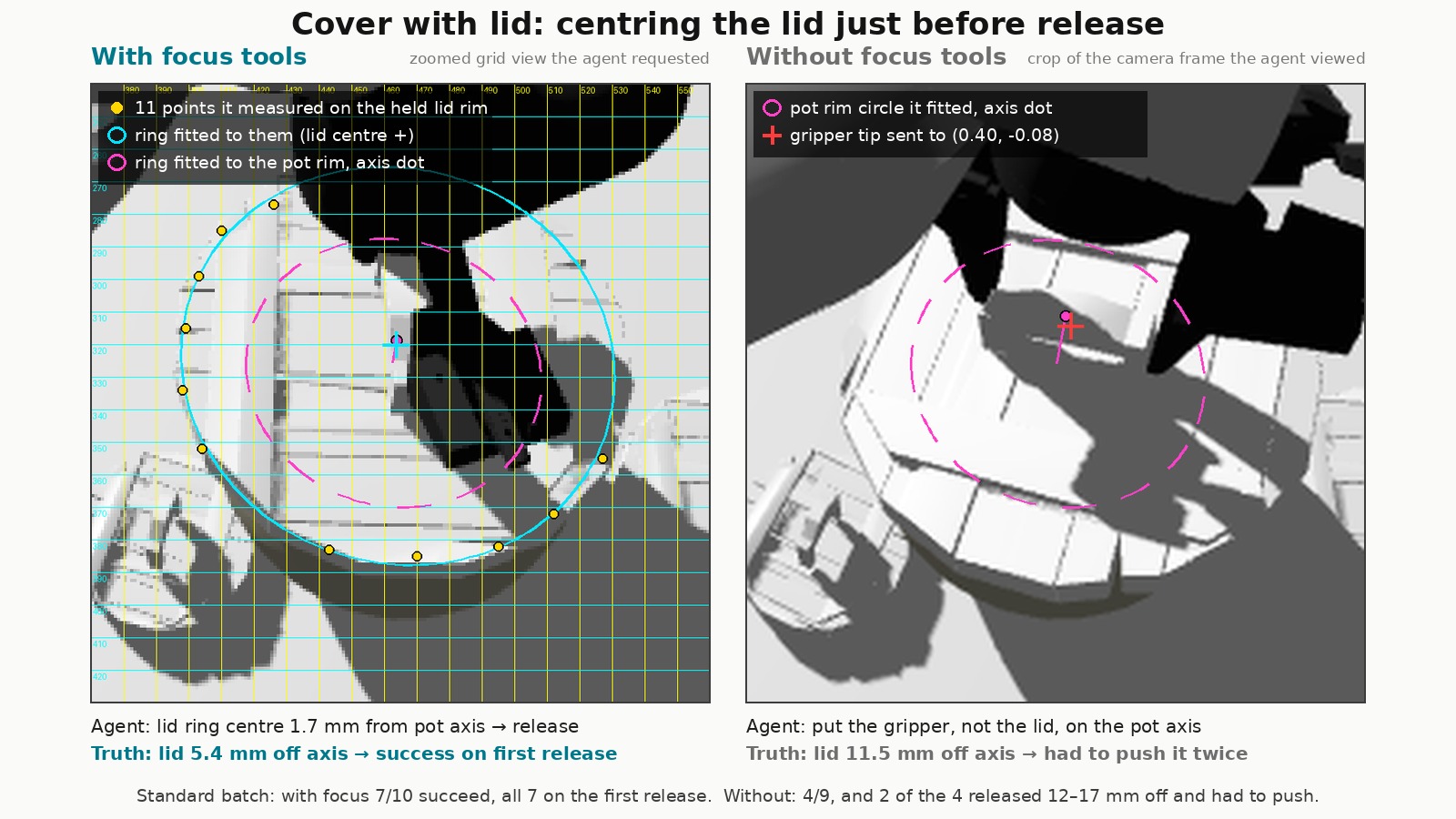
What we didCover with lid: put the lid on the pot; 10 vs 9 runs.
ConclusionFits rings to lid and pot: 7/10 vs 4/9, all on the first release. It fitted rings to the lid and the pot rim before release: 7/10 vs 4/9, every success on the first release.
Details
  • In all 7 successful focus runs the agent fitted rings to the pot rim and to the lid in its hand (9 to 33 ring fits per run), gave both centres to the placement solver to get the gripper pose that puts the lid centre on the pot axis, and fitted a fresh ring to the lid within about a minute before letting go.
  • As a result every focus success landed on the first release, 3 to 16 mm from the pot axis (median 5.4 mm, tilt under 1°), and the median time to success was 21 min, against 27 min without focus.
  • Without focus the agents also located the pot centre from depth, but at the same step they aimed the gripper tip, or a lid outline estimated from depth, at it; in 2 of their 4 successes the lid landed 12 to 17 mm off and had to be pushed into place afterwards.
4换到没调过的新任务上还有用吗?focus 起作用的那一步,skill 组用上了、做得更好。
4.2focus 起作用的那一步,skill 组怎么用的?先量、再构造,放得更准。
4.2.3

盖锅盖:盖子怎么对中?

做了什么盖锅盖:把盖子盖到锅上;10 局对 9 局。
结论给盖子和锅沿拟圆:7/10 对 4/9,都是一次放好。 松手前给盖子和锅沿拟圆:7/10 对 4/9,每次成功都是一次放好。
细节
  • focus 组 7 次成功里,agent 每局都给锅沿和手里的盖子拟合圆环(每局 9 到 33 次),把两个圆心交给放置求解器,算出让盖子中心落在锅轴上的夹爪位姿,并在松手前一分钟内再给盖子拟合一次圆环核对。
  • 结果是 focus 组每次成功都是一次松手就盖好,离锅轴 3 到 16 mm(中位数 5.4 mm,倾斜不到 1°);成功局用时中位数 21 分钟,裸跑 27 分钟。
  • 裸跑也用深度找到了锅中心,但在同一步对准它的是夹爪尖,或用深度估的盖子轮廓;裸跑 4 次成功里有 2 次盖子落下偏了 12 到 17 mm,事后还得推正。
4Does it transfer to tasks we never tuned on?Where focus acts, the skill uses it and does better.
4.3

Does overall success go up?

Why this questionDoes this show up in the overall success rate?
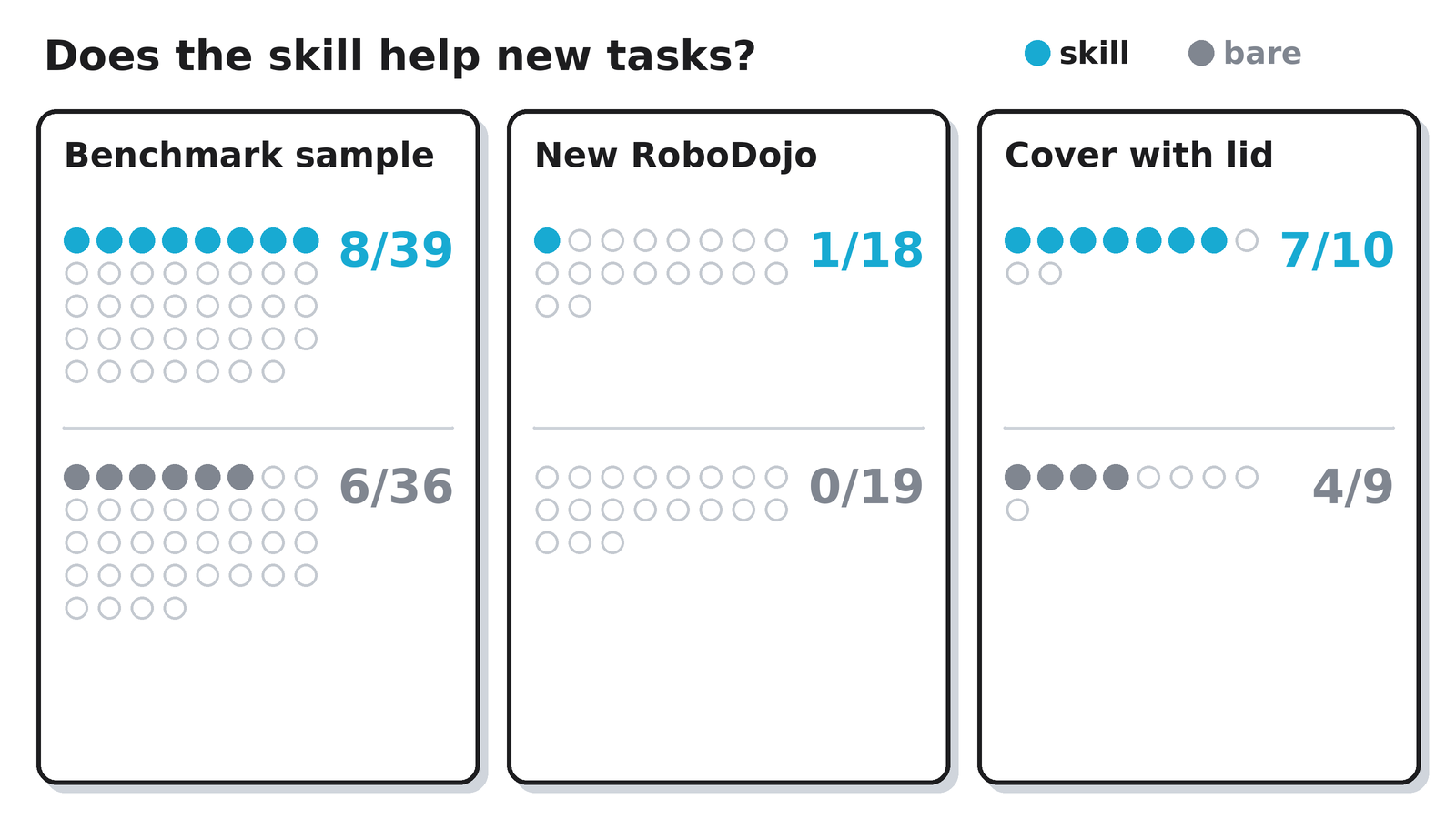
What we did10 tasks sampled from the 192 core set, plus 6 new RoboDojo tasks; skill vs official instructions only.

192 sample 8/39 vs 6/36 · new RoboDojo 1/18 vs 0/19 · cover with lid 7/10 vs 4/9

ConclusionSlightly ahead. Slightly ahead everywhere.
4换到没调过的新任务上还有用吗?focus 起作用的那一步,skill 组用上了、做得更好。
4.3

总成功率提高了吗?

为什么问这个这在总成功率上体现出来了吗?
做了什么192 道核心题抽 10 道,加 RoboDojo 6 道新题;skill 对只有官方说明。

192 抽样 8/39 对 6/36 · RoboDojo 新题 1/18 对 0/19 · 盖锅盖 7/10 对 4/9

结论略高。 各处都略高。
4Does it transfer to tasks we never tuned on?Where focus acts, the skill uses it and does better.
4.4

Where is the bottleneck on new tasks?

Why this questionWhy only slightly? Where do new tasks fail first?
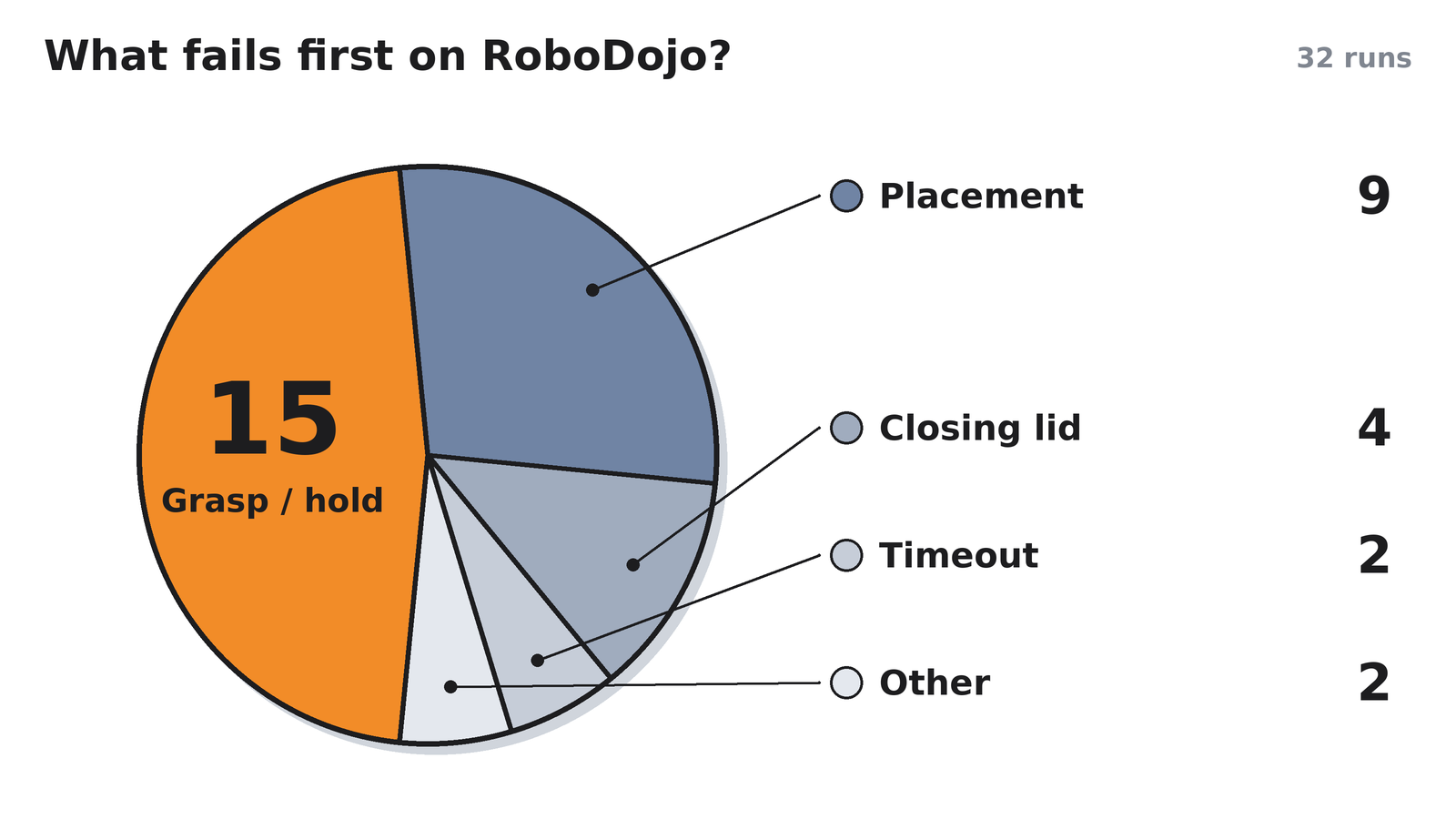
What we didTrace each failed run on the new tasks to its first error.

first errors: grasping or holding about half of RoboDojo failures · falls over · contact rules · not finished in 3 h

ConclusionBefore focus: grasping, balance, time. In RoboDojo, 15 of 32 failures are not lifting or dropping the object, before focus acts; BEHAVIOR robots fall while driving; RoboARC is judged failed on touching a fiber or runs out of 3 hours. These are the next targets.
4换到没调过的新任务上还有用吗?focus 起作用的那一步,skill 组用上了、做得更好。
4.4

新任务的瓶颈在哪?

为什么问这个为什么只是略高?新任务先败在哪?
做了什么新任务每局失败找到第一个出错的地方。

第一个错误:RoboDojo 约一半是抓取或夹持 · 摔倒 · 碰撞判负 · 3 小时做不完

结论在 focus 之前:抓取、站稳、时长。 RoboDojo 32 局失败里 15 局是抓不起或拿着掉了,在 focus 起作用之前;BEHAVIOR 开车时摔倒;RoboARC 碰到纤维判负或 3 小时做不完。这些是下一步要解决的。